The Machine Isn’t Coming for Your Job. The Business Model Is.
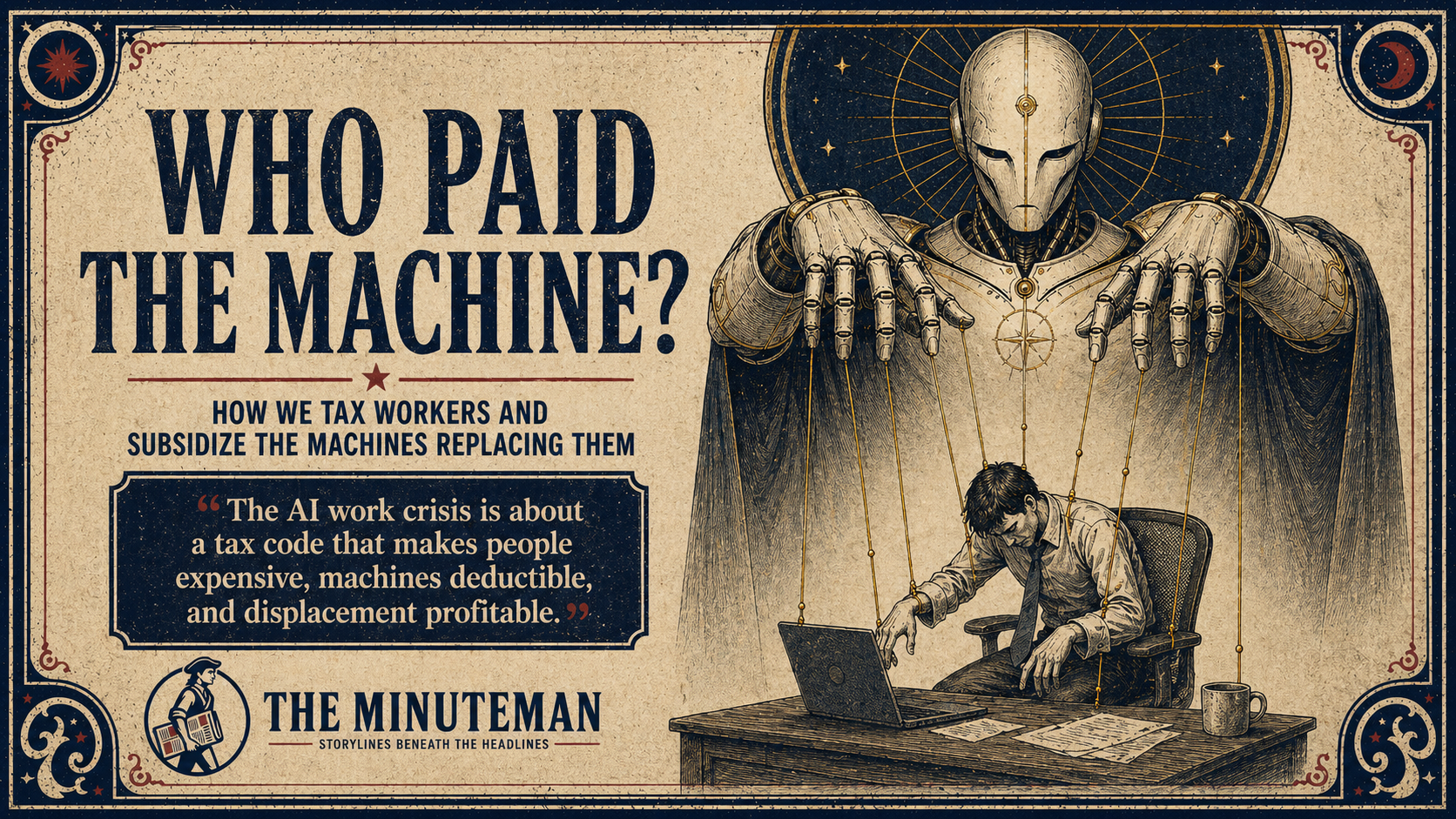
The AI work crisis is not just about what software can do. It is about a tax code that makes people expensive, machines deductible, and displacement profitable.
We Tax Workers and Subsidize the Machines Replacing Them
You open your laptop and the work is already done. The report you planned to spend your morning writing is sitting in a shared doc, formatted, sourced, ready for review. Your name goes on it. You check the math, adjust a few sentences, send it along. A year ago that report was the reason your role existed. Now the role exists to check what the software produced.
Your title hasn’t changed. Your salary hasn’t changed yet. But the thing you were hired to do, the skill you built over years, the part of the work that made you good at it, that’s thinner than it was six months ago. And six months from now it will be thinner still.
This is not a hypothetical. A UC Berkeley and Yale study tracked 200 employees at a tech company for eight months after AI tools were deployed. Senior engineers absorbed work that used to be distributed across entire teams. Instead of building, they reviewed. Instead of mentoring junior developers, they spent their hours checking and fixing AI-generated code. One engineer described the shift: the role felt less like engineering and more like being a judge on an assembly line that never stops. A copywriting agency that employed eight people and brought in roughly $600,000 a year was reduced to less than $10,000 in revenue after clients replaced human writers with AI tools. A support operations manager watched his job transform in real time. He used to train people to do the work. Now he trains AI to do the work he used to train people to do. The job that was his pathway into his career no longer exists for the person coming after him.
These are different industries, different titles, different pay grades. The pattern is the same. The job stays on paper while the substance drains out of it. The worker becomes the quality-control layer between the machine and the output, the human stamp on an automated process. Not replaced. Hollowed out.
And while this is happening, Congress passed a law that makes it cheaper. In July 2025, legislation permanently restored full, immediate tax write-offs for equipment and software purchases. A company deciding between hiring three junior analysts or licensing an AI tool can now expense the software in full, the same year it’s purchased. The analysts come with payroll taxes, benefits, and no equivalent tax advantage. Three months after that law was signed, a Senate committee released a report warning that AI and automation could displace nearly 100 million jobs in the next decade. The first law made automation cheaper. The second report described what happens when it is.
Even the companies building the technology see the problem. Earlier this year, OpenAI published a policy blueprint telling the government, in plain terms, that the current tax and social insurance structure cannot survive what AI is about to do to the labor market. The company racing to build the displacement technology is now asking the government to restructure the incentives before the damage becomes irreversible.
This is not happening because AI is too powerful to stop. It is happening because we tax labor and subsidize capital, and that makes replacing people the most profitable move a company can make. The conversation about AI and work has been stuck on the wrong question. We keep asking how to prepare workers for displacement. We should be asking why we are paying for it.
What Hollowing Out Actually Looks Like
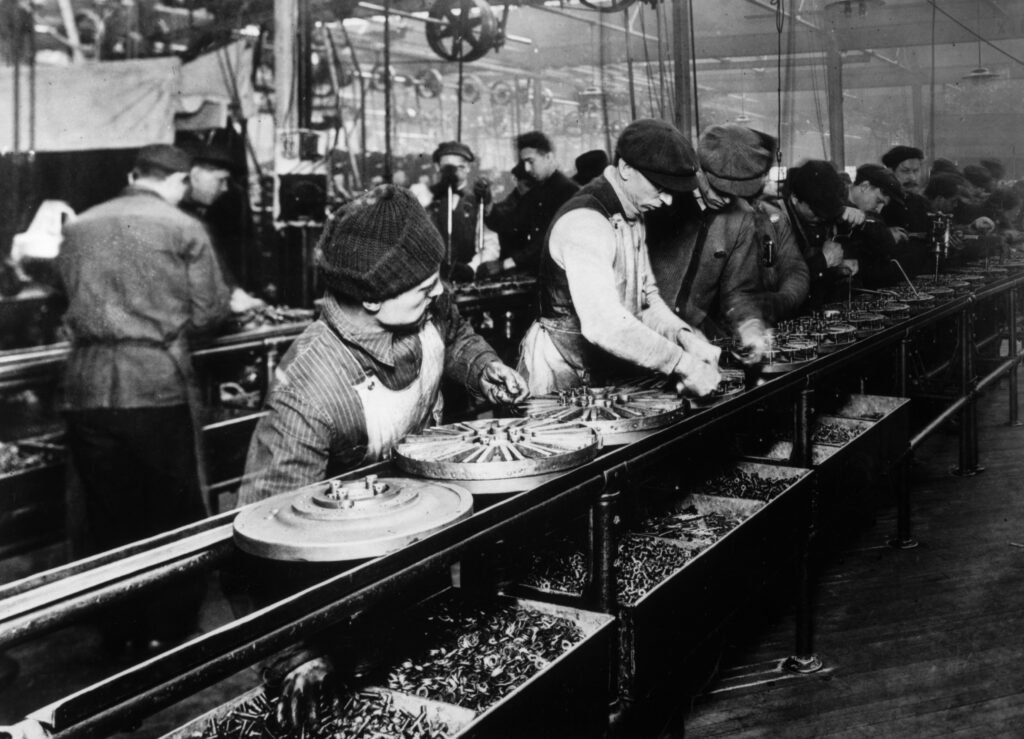
The word “automation” makes most people think of factories. Robotic arms on assembly lines, welding stations that used to be staffed by people, warehouses where machines move pallets instead of workers. That picture is decades old and it is misleading, because it trains us to expect automation to look like a clean swap: a person leaves, a machine arrives, the job is gone.
What is happening now is different. Whole occupations are rarely wiped out overnight. Instead, the tasks inside a job get broken apart. Some are automated. Some are handed to cheaper labor. Some are pushed outward to clients and customers. The human role narrows. The person is still employed, still holds the title, but the skilled middle of the work has been removed. What remains is oversight, verification, exception-handling, and the kind of interpersonal work that machines can’t yet perform convincingly. The job title survives. The career inside it does not.
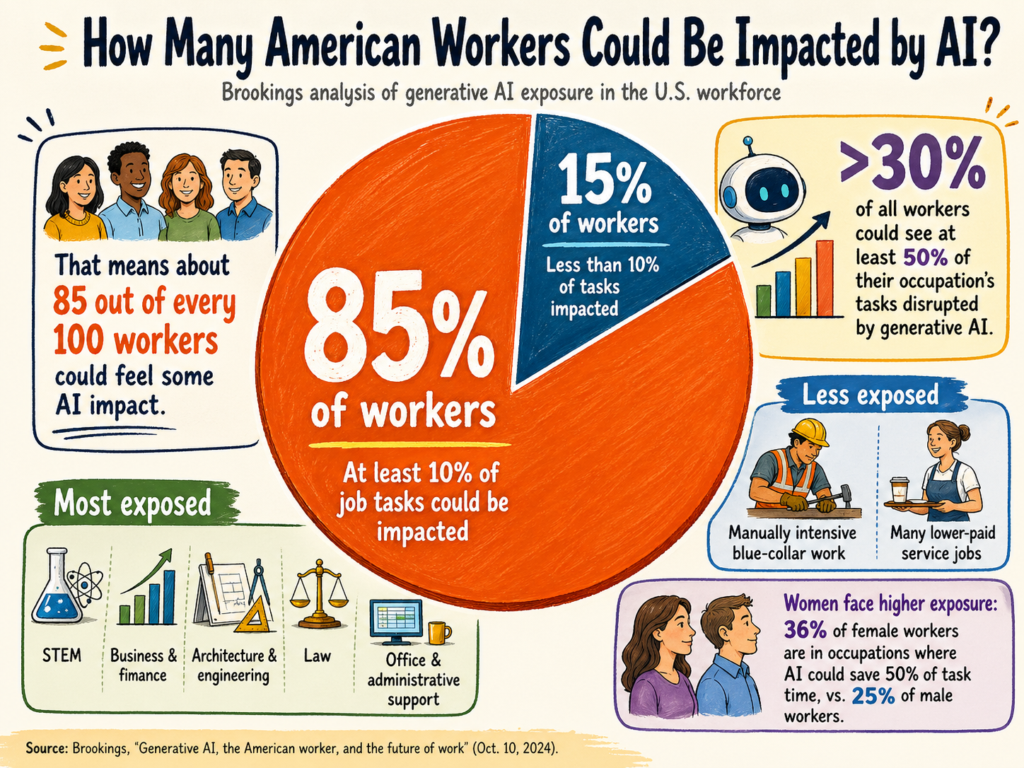
Brookings found that more than 30 percent of American workers could see at least half of their occupation’s tasks disrupted by generative AI. Roughly 85 percent could see at least 10 percent of their tasks affected. And the exposure is not concentrated where most people expect. This is not a blue-collar story. Brookings’ research shows that higher-income, white-collar, and college-educated occupations are among the most exposed. Anthropic’s own labor market study confirmed the same pattern: workers in the most exposed professions tend to be older, more educated, higher-paid, and disproportionately female. The technology is moving into writing, analysis, coding, customer support, research, document processing, and coordination-heavy professional work.
One of the clearest windows into how this plays out inside a company comes from an NBER study of a customer support operation. Researchers found that AI assistance raised average productivity by about 14 percent, with much larger gains for newer and lower-skilled workers and almost no measurable benefit for the most experienced. The AI captured the practices of top performers and redistributed them to everyone else. That sounds like a success story, and in the short term it was. But follow the logic one step further. If the software can take what your best people know and hand it to your least experienced people, the firm needs fewer people to climb the old ladder. The expertise that used to justify senior pay and senior authority is now embedded in the tool. The worker’s individual knowledge becomes less scarce, and less scarce means less valuable.
This is not a hypothetical future problem. It is already showing up in hiring data. U.S. programmer employment fell 27.5 percent between 2023 and 2025, according to the Bureau of Labor Statistics. Software developer roles, which are more architectural and design-oriented, barely moved. The displacement is concentrated at the execution level, exactly where AI tools are strongest. Entry-level tech hiring at major companies dropped by more than 50 percent over three years. A Harvard study of 285,000 U.S. firms found that companies adopting AI cut junior developer hiring by 9 to 10 percent within six quarters. Big Tech’s share of new graduate hires dropped from 32 percent in 2019 to roughly 7 percent by 2026.
Computer science graduates now face unemployment rates above 6 percent, among the highest of any major. These are people who did everything the conventional advice told them to do. They chose the field the economy was supposed to reward. They studied the skill that was supposed to be future-proof. And the entry-level version of that skill is now something a software tool can approximate for a fraction of the cost.
The damage here is not just that people lose jobs. It is that the pipeline into professional expertise breaks. If companies stop hiring juniors because AI tools let senior workers absorb more, then juniors never become seniors. The experience required to develop judgment, to learn how to handle ambiguity, to build the kind of knowledge that AI currently cannot replicate, that experience is no longer available. We are pulling the bottom rungs off the ladder and wondering why nobody is climbing it.
The Structural Cause
So why is this accelerating? The obvious answer is that AI is powerful and getting more powerful. But that only explains what is technically possible, not why companies are choosing displacement over other options. The less obvious and more important answer is that we built a tax system that makes replacing people with software one of the most financially rational decisions a company can make.
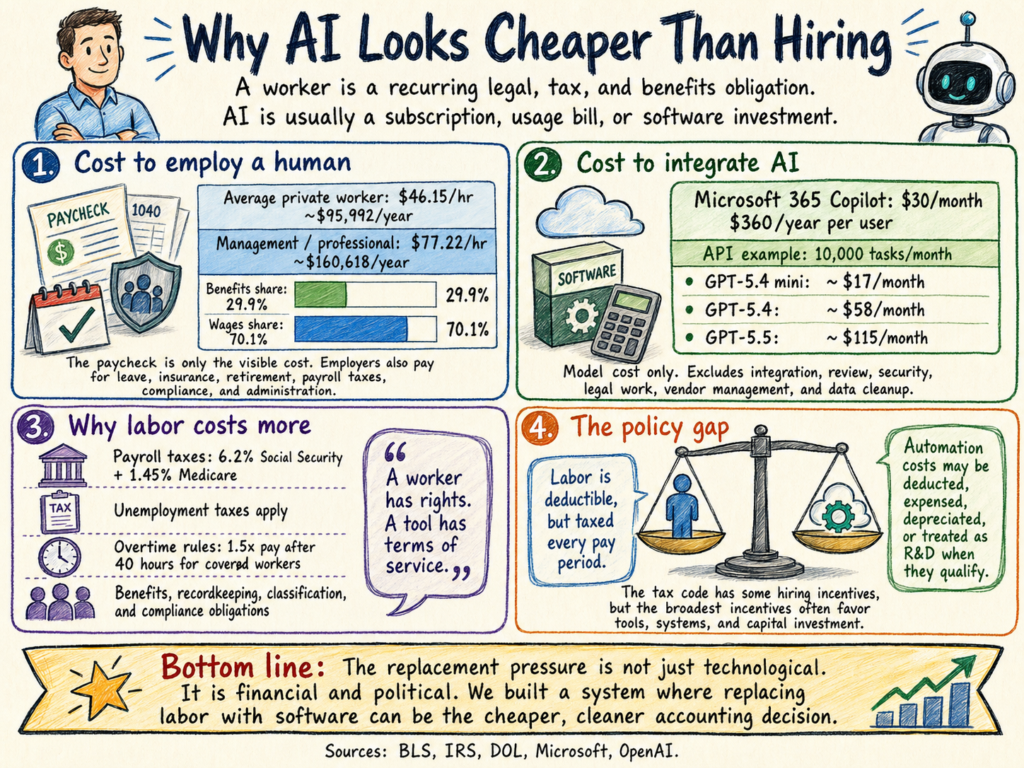
Every dollar an employer pays in wages comes with a surcharge. The employer owes 6.2 percent of that dollar to Social Security and 1.45 percent to Medicare. That is 7.65 percent in federal payroll taxes before the employer considers state unemployment insurance, workers’ compensation, health benefits, or any other labor-linked cost. These are not optional. They are the price of employing a human being in the United States.
Software does not trigger payroll taxes. Neither does equipment. When a company buys an AI tool or a piece of automation technology, that purchase can be written off immediately and in full under current law. The IRS allows businesses to expense qualifying software and equipment through a provision called Section 179, and since July 2025 the federal government has permanently restored 100 percent bonus depreciation, meaning the full cost of a qualifying purchase can be deducted in the year it is made. The ceiling on Section 179 deductions is now $2.5 million. For 2026, adjusted for inflation, it is $2.56 million.
To be clear, wages are deductible business expenses too. The IRS says ordinary and necessary business expenses, including employee pay, can be deducted. The asymmetry is not that workers cost money and software doesn’t. The asymmetry is that workers cost money and trigger additional tax obligations, while software costs money and receives favorable cost recovery with no payroll-linked surcharge. The gap is at the margin, and the margin is where business decisions are made.
Economists have a term for what happens when this gap gets wide enough. MIT researchers Daron Acemoglu, Andrea Manera, and Pascual Restrepo call it “excessive automation,” meaning automation that companies adopt not because it delivers large productivity gains but because the tax structure makes it cheaper than the alternative. The distinction they draw is important. Capital deepening, investing in technology that makes workers more productive, tends to complement labor and raise wages. Automation, replacing tasks that people used to perform with machines, substitutes for labor. When the tax code tilts the math toward substitution, companies can end up automating tasks even when the productivity benefit is marginal, simply because the numbers work out.
The International Monetary Fund reaches the same conclusion. Its 2024 working paper on AI economics states that when taxes on capital are too low relative to taxes on labor, automation becomes artificially cheap. A separate IMF analysis adds a historical dimension: effective taxation of capital income has fallen relative to labor income over the last several decades. The gap was already widening before AI entered the picture. AI just makes the consequences of that gap harder to ignore, because AI moves faster, replicates cheaper, and reaches further into the workforce than any previous automation technology.
And this is the part that should make you angry, or at least confused. In July 2025, with this research already published, with the IMF and MIT already on record warning about excessive automation, Congress passed the One Big Beautiful Bill Act and permanently expanded the very incentives that make displacement more attractive. Full bonus depreciation restored. Section 179 limits doubled. Software explicitly eligible. The law was not designed to subsidize AI displacement. Bonus depreciation applies to all qualifying capital purchases, from delivery trucks to factory equipment to software licenses. A company buying a forklift gets the same write-off as a company buying the AI tool that replaces its analysts. That is the problem. The policy is indifferent to the difference between investment that creates jobs and investment that eliminates them, and indifference to a foreseeable consequence is its own kind of policy failure. Standard Bots, a robotics industry publication, described the law as having quietly triggered a massive opportunity for manufacturers to invest in automation. Quietly is the key word. Nobody held a press conference to announce that the government had just made it cheaper to replace workers with machines. But that is what the math says.
Why AI Is the Accelerant
The capital-labor tax asymmetry is not new. It has existed in various forms for decades. What is new is the speed, the cost, and the reach of the technology that exploits it.
The St. Louis Federal Reserve found that generative AI adoption rose faster than the personal computer and the internet did at comparable stages after public release. Overall adult adoption jumped from about 45 percent in August 2024 to nearly 55 percent a year later. Workplace adoption went from 33 percent to 37 percent in the same period. Federal Reserve Vice Chair Michael Barr warned in a 2026 speech that AI adoption may be much faster than previous general-purpose technologies, leaving less time for workers and institutions to adapt.
Previous waves of automation required physical infrastructure. You needed a factory, a robot, a production line. The capital costs were high, the deployment was slow, and the industries affected were relatively concentrated. AI is software. Once it is built, copying it costs almost nothing. The IMF’s Thomas Prugsamatz made this point in a way that deserves attention: as software, AI is easier and cheaper to replicate and distribute than physical capital. Firms still pay for licenses, compute power, integration, and training. But scaling an AI tool across an entire knowledge workforce is faster and cheaper than building a new assembly line.
And unlike the automation waves that came before, this one does not stop at the factory floor. It reaches into the professional class, into the work that college degrees were supposed to protect. Writing, analysis, research, coding, legal review, financial modeling, customer support, administrative coordination. These are the occupations where generative AI exposure is highest, and they are also the occupations that form the economic backbone of the educated middle class.
The International Labour Organization’s 2025 update says most jobs are more likely to be transformed than eliminated outright. That is entirely consistent with the hollowing out pattern. The job persists. The substance changes. The worker’s role shrinks from creator to supervisor to exception-handler. And because AI makes this shrinkage cheap and fast, the timeline for adaptation is shorter than anything the labor market has dealt with before.
Brookings’ research on occupational mobility adds another layer to the problem. When automation displaces white-collar workers, those workers do not simply vanish from the economy. They compete for adjacent jobs, clog mobility channels, and block advancement for others coming up behind them. The damage spreads sideways through the labor market before it shows up in the headline unemployment number. By the time the aggregate data catches up, the structural harm is already embedded.
What We Could Do Instead
The most common response to AI displacement is retraining. Retrain the displaced workers. Upskill the workforce. Prepare people for the jobs of the future. This is not a bad idea, but it is an incomplete one, because it accepts the displacement as given and only tries to manage the aftermath. It never asks whether the displacement should have happened that way in the first place.
There are concrete proposals on the table that go further.
Wage insurance is one. The Federal Reserve Bank of New York published a 2025 study showing that wage insurance, which supplements the income of displaced workers who accept a lower-paying job, produces real results. It increases short-run employment, reduces time spent out of work, and raises long-run cumulative earnings. The researchers found it may even be self-financing under conservative assumptions. For a professional who spent fifteen years becoming an expert in a field that AI just compressed, wage insurance addresses the immediate reality: you will probably not find an equivalent job at equivalent pay, and the gap between what you earned and what you can earn next should not fall entirely on you.
But wage insurance is a repair tool. It helps after the damage is done. It does not change the incentive that caused the damage.
The upstream fix is the harder conversation, and it is the one that matters more. If the tax code makes displacement artificially cheap, the answer is to stop making it artificially cheap. That could mean reducing payroll-tax pressure on labor so that hiring people does not carry as steep a surcharge. It could mean narrowing the favorable capital treatment that currently applies to automation technologies without distinguishing between tools that complement workers and tools that replace them. It could mean taxing capital income at rates that are more comparable to labor income, reversing a trend that the IMF says has been widening for decades.
These are not radical ideas. They are adjustments to a system that was designed for an economy where the primary threat to jobs was foreign competition and the primary tool of growth was physical capital investment. That economy is not the one we live in anymore.
The policy conversation is already further along than most people realize. In 2017, Bill Gates proposed that companies benefiting from automation should pay taxes on robotic labor comparable to what human workers would have contributed. The European Parliament considered and rejected a similar framework the same year, worried it would stifle innovation. In October 2025, Senator Bernie Sanders announced plans to introduce a robot tax, an excise tax on large companies that replace workers with AI or automation, with revenue directed toward displaced workers. Tax experts immediately raised definitional problems. What counts as a robot for tax purposes? Could the definition include an ATM or a word processor? The bill was declared dead on arrival.
But the idea did not die. In April 2026, OpenAI published its policy blueprint for the intelligence age, and the proposals read like a concession that the critics were right all along. OpenAI called for shifting the tax base from labor to capital. It proposed taxes related to automated labor, a public wealth fund seeded by AI companies, automatic safety-net triggers that would increase benefits when displacement metrics hit preset thresholds, and employer-backed trials of a four-day workweek at full pay. Sam Altman framed the moment as comparable to the Progressive Era and the New Deal, periods when American institutions were rebuilt to match new economic realities.
When the company building the most advanced AI systems in the world publishes a document saying the tax code needs to stop subsidizing the displacement its own products make possible, and that Social Security, Medicaid, and housing assistance will lose their funding base if the current structure stays in place, the argument is no longer about whether the problem is real. It is about whether anyone in a position to act will treat it as urgent.
Brookings has offered a framework that avoids the crudeness of a blanket robot tax. Economists Anton Korinek and Benjamin Lockwood argue that the question is not whether to tax automation but where in the production chain to apply the levy. Taxing robot-provided services at the point of consumption is sound economics and does not discourage investment. Taxing the ownership or operation of robotic equipment is a capital tax that can slow productivity growth. The distinction matters. A blunt tax on all automation would be counterproductive. A targeted restructuring of the incentives that currently favor displacement over retention would not.
There is a real cost to changing this, and it is worth being honest about it. The IMF’s own research acknowledges that taxes on automation can reduce inequality and slow labor displacement, but they can also slow productivity growth and capital accumulation. Any restructuring of the incentive system involves a tradeoff between protecting workers now and maintaining the pace of investment that creates opportunities later. That tradeoff is genuine. But it is not an argument for doing nothing. It is an argument for calibration, for designing policy that distinguishes between technologies that complement human work and technologies that merely replace it at the margin. The current system does not make that distinction at all. It treats every capital purchase the same regardless of whether it creates jobs or destroys them. The risk of doing nothing is not neutrality. It is an ongoing, compounding subsidy for displacement.
The Choice
We have been told that AI displacement is a force of nature, something to weather rather than something to direct. The framing serves a purpose. If displacement is inevitable, then the only conversation left is how to help workers adapt. That is a useful conversation, but it is a small one compared to the conversation we are avoiding.
The larger question is why public policy makes it profitable to hollow out professional work in the first place. We built a tax system that charges employers a surcharge for hiring people and offers accelerated write-offs for buying the technology that replaces them. We then expanded those write-offs at the exact moment the most powerful replacement technology in a generation began spreading through the workforce. We did this while the IMF, MIT, the Federal Reserve, Brookings, and eventually the companies building the technology itself all warned that the incentive structure was tilted in the wrong direction.
None of this was inevitable. All of it was chosen. Not chosen in the sense that a committee sat down and decided to undermine professional labor, but chosen in the sense that we wrote tax policy without asking what it would mean when a technology came along that could exploit every asymmetry in the code. That technology is here now, and it is exploiting them.
The question going forward is not whether AI will change work. It will. The question is whether we will continue to subsidize the version of that change that benefits shareholders at the expense of workers, or whether we will restructure the incentives so that companies have a reason to invest in people alongside the machines. The research says the gap between capital and labor taxation is real, widening, and dangerous. The policy tools to narrow it exist. The choice is whether to use them.
Eighty-four percent of federal revenue comes from individual income and payroll taxes. Roughly two-thirds of that is directly tied to labor. If we keep building an economy that makes labor less necessary, we are not just hollowing out jobs. We are hollowing out the revenue base that funds the systems we depend on: Social Security, Medicare, the safety net that catches people when the economy shifts beneath them. We are undermining the foundation while congratulating ourselves on the efficiency of the wrecking ball.
The companies building AI will be fine. They will profit regardless of whether the transition is managed or chaotic. The workers whose skills are being absorbed into software will not have that luxury. And the question of what happens to them is not a technology question. It is a policy question, and right now the policy is giving the wrong answer.