The Trash Problem
Your trash is a commodity.
There’s a bag of trash in your kitchen that you’ll carry out to the curb on whatever night your town collects. You’ll leave it at the curb and you won’t think about that bag of trash again, which is the whole point of the service.
But someone else is spending a lot of time thinking about your trash, because your trash is a commodity.
Trash is a source of raw materials (cardboard, aluminum, plastics, glass, electronics, etc.), bought by manufacturers who melt, shred, or otherwise process it to make new products that are then sold back to you.
Trash has its own financial markets; the price of a bale of recycled plastic or scrap cardboard goes up or down based on global economic factors (if construction booms, the demand/price for scrap copper and steel can skyrocket; if a major purchasing country, like China, changes its import laws by banning certain imports the global price of recycled plastics can crash overnight).
Trash drives a “circular economy” where the goal is to extract maximum value from the items you throw out. Companies that handle your trash will conduct “waste audits” to reverse engineer their “trash streams” to turn things that were once disposable into new revenue streams.
And the trash that is truly “unrecyclable,” the things that sit in landfills, is a commodity itself we call “disposal capacity.” Waste management companies treat landfills like dirty little (not so little actually) hotels, a limited piece of property that municipalities have to compete over and pay to keep their trash there.
The incentive for this whole industry is to process as much trash as possible, which means the more trash you bring out to your curb on trash day the better it is for the waste management company.
Then the rest of the chain kicks in. The raw materials are bought and sold, the waste audits find new ways to repurpose materials to sell it back to consumers, and the unrecyclable materials find a place to live.
And this is where things get problematic because so far, while the incentive may be to create more trash, at the very least there is a competing incentive to repurpose that trash into recyclable materials, and while this drives a circular economy that will always be making more trash it at least attempts to repurpose it. But more trash means more truly unrecyclable material and all that material needs a place to live. And that brings us to the landfill problem.
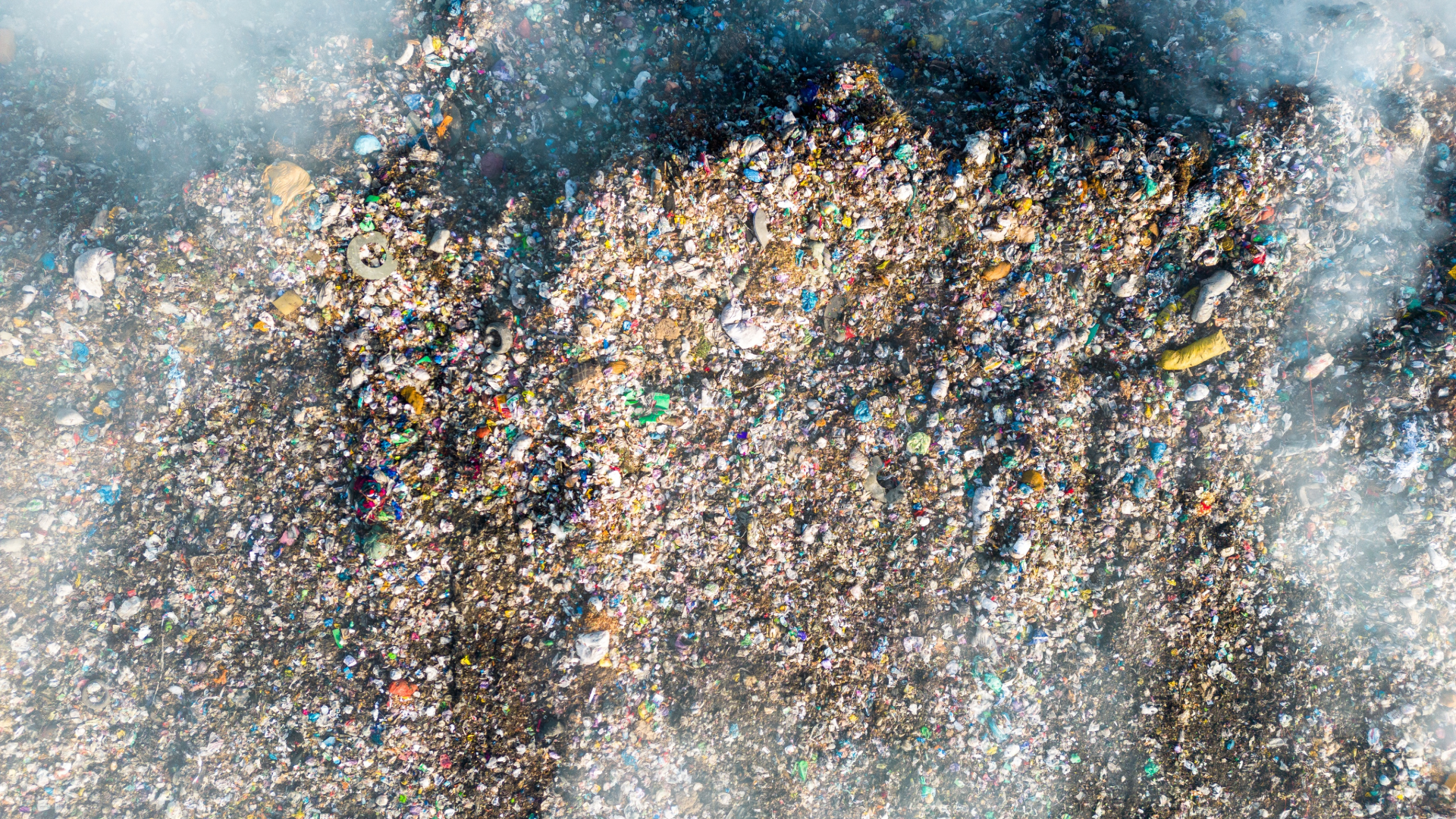
A whole bunch of trash sitting somewhere for a long time.
The waste management company will probably say something like, “That’s why we have waste audits so we can identify previously unrecyclable materials, which, through innovation, have become recyclable materials.” Which would be a good answer if it weren’t for the incentive.
Waste management companies make significantly more money from owning and operating landfills than they do from selling your trash back to people. Landfills brought WM $5.3 billion last year against $1.9 billion from recycling. Recycling can turn your trash into a commodity but that commodity is highly volatile, has a low margin, and is a complex business. Landfills, on the other hand, are incredibly stable, highly lucrative, geographic monopolies.
Landfills don’t make money by selling anything; they make money by charging other people to drop your trash off. Every truck that pulls up to a landfill is weighed and then the company charges a tipping fee per ton. In 2024 the national average was $62.28 a ton, up 10 percent in a single year. Since your town generates thousands of tons of trash every year, it has to put it somewhere and this creates this massive non-negotiable stream of recurring revenue.
It is also nearly impossible to obtain government permits to open up a new landfill due to environmental regulations and community resistance, like the “not in my backyard” or NIMBY effect. Because major public companies like Waste Management and Republic Services already own a massive percentage of permitted landfills in the U.S., they hold a virtual monopoly in many regions and that allows them to steadily raise pricing without the fear of new competition.
And landfills have a secondary highly profitable revenue stream called renewable energy. As buried garbage decomposes it naturally produces methane gas. Waste companies trap this gas and convert it into electricity or refine it into renewable natural gas, which they sell to utility companies or use to power their own collection fleets.
So landfills are a highly profitable business, like hotels that you have no choice but to stay in owned by a small collection of businesses that keep lowering the number of rooms and increasing the rent.
In 1986, the U.S. had about 7,683 municipal landfills and dumps. That was its own problem, so the Environmental Protection Agency introduced strict regulations in the late 80s early 90s (RCRA Subtitle D) that forced thousands of local dumps to close due to the high cost of compliance. By the 2020s the total number of active landfills had shrunk to roughly 1200 mega-facilities. As of 2022, five publicly traded corporations took in about 61% of all the trash going into U.S. landfills. (Waste Management, Republic Services, Waste Connections, GFL Environmental, Casella Waste Systems)
This corporate dominance gives these five companies more control over where your trash ends up than every local government in the country combined. So the question that this whole operation now depends on is: how do they decide where to put a landfill?
Who decides?
The company that owns the landfill needs the town’s permission to be there and that permission costs money. The company pays the town a fee, calculated by the ton, for the standing right to keep operating. That’s called a hosting fee.
So back up for a second. There are two payments and they run in opposite directions. Your town pays to have a “pick-up service” take your trash and drop it off at a landfill. A “landfill” pays a town to keep your trash there.
But it doesn’t all happen in the same place. The company you pay to pick up your garbage most likely brings it to a landfill located in a different county or even a different state.
I’m describing these as two different companies but the reality is that very often the business hauling your trash is the exact company that also owns the landfill. It’s vertical integration. As we’ve learned, dropping off a load of trash at a landfill requires paying a heavy per-ton tipping fee. If Waste Management drops trash off at a competitor’s landfill, Waste Management loses money but if those same Waste Management trucks drop trash off at a Waste Management-owned landfill, the company essentially pays itself. That keeps their operational costs low.
Small, independent trash-hauling companies that don’t (can’t) own landfills have to pay to dump their trash at landfills owned by these giant corporations. The giants can then artificially raise tipping fees for outsiders, thus squeezing the profit margins of small businesses and eventually forcing them to sell out to the larger corporations. Industry experts (and yes there are waste industry experts) refer to this as controlling the “internalized waste stream.” The goal for a company like waste management is to ensure that every single pound of trash their trucks pick up never touches a competitor’s property.
Now we understand that the business of owning and operating a landfill is very important and highly profitable for the “trash industry.” We also understand that the company that picks up your trash and the company that owns the landfill that holds your trash are very often the same company.
So the answer to who decides where to put a landfill is the same company that picks up your trash. The real question we need to ask is: How do they decide?
The process is incredibly complex, heavily regulated, takes a very long time, and costs a lot of money. Therefore it’s very hard for a small, independent trash hauling company to own a landfill without the size and vertical integration of one of the five “giants.”
The decision-making process is dictated by three primary factors:
- Federal and state “fatal flaws”
Earlier we mentioned a regulation put into place by the Environmental Protection Agency called RCRA Subtitle D. That and other federal regulations from the EPA essentially say that certain areas are legally disqualified from hosting landfills to prevent environmental catastrophes. These are places like wetlands and floodplains, fault lines and seismic zones, and locations close to airports (because landfills attract a lot of birds).
Ironically, the top five corporate waste giants are actually some of Subtitle D’s biggest beneficiaries. Building a modern fully compliant Subtitle D mega landfill costs tens of millions of dollars. If the EPA suddenly gutted these requirements and allowed cheap unregulated dirt dumps to open up everywhere again, it would collapse the financial barrier to entry. The strictness of Subtitle D is what keeps independent competition locked out of the market and protects the multibillion-dollar investments the corporate giants have made in their advanced facilities. (I’d argue it’s a tradeoff we need to accept to protect the environment, but it’s also fuel for concentration.)
- Geology and engineering needs
Landfills are essentially massive highly engineered bathtubs designed to keep toxic garbage liquid (leachate) out of the environment. So companies specifically look for properties with low-permeability soil, deep groundwater tables, and abundant soil sources.
Developers prefer areas that are naturally rich in deep clay because clay acts as a sponge that slows down leaks unlike gravel or rock which allows toxins to sprint towards water tables. Deep groundwater tables mean that the drinking water is further down and the further down it is the safer the site. And since landfills require thousands of tons of dirt to be thrown on top of trash every single day to control smell and pests, having abundant soil sources (soil on site) saves millions of dollars in trucking costs.
- Logistics, politics, and environmental justice (or lack thereof).
But finding a geologically perfect site doesn’t mean anything if the company can’t legally buy the land or get a permit.
Local zoning laws usually dictate that landfills have to be a specific distance away from homes, schools, and parks. Trash trucks are really heavy so landfills have to be placed near major highways or rail lines that are capable of handling hundreds of grinding truck trips a day without tearing local residential roads apart. So taking everything we’ve just learned above, where is a landfill most likely to end up?
Landfills are looking for dry, seismically stable flatlands away from major population centers and coastlines; agricultural valleys, old quarries, or regions with thick sedimentary rock; locations close enough to large cities to minimize trucking costs but far enough out to bypass urban density; low-income rural areas and unincorporated county land or communities with low voter turnout and minimal political capital.
What this means is that the best place for a landfill is somewhere rural, where the soil is essentially unfarmable, where public transportation is limited or non-existent, where political representation is small, and where the local economy has collapsed.
If you run a community like this, and a waste management company comes to you and says they’ll pay you a regular fee to operate in your backyard and create jobs for residents, that’s a hard offer to refuse. Communities like these need the capital, with a shrinking population, school districts in debt, and jobs going to big cities that are pricing out lower incomes, this deal is the best a suffering community has seen in years. But the thing the community is being paid for is also the thing that will continue to lower property values in that community. It’s a losing battle.
For those who disagree
The best counterargument is “this is simply what cheap land looks like.” Someone has to take the trash, we’re going to keep making it. And we have to put the trash somewhere. There’s no arrangement in which nobody hosts a landfill. Plus, while there may be a correlation between the location of landfills, lower property value, and below average income of the community host, there is not necessarily proof that a landfill itself causes the decline of the property value in that location.
To that I’d say: would you want to live near a landfill? I’d also point out that the “correlation does not equal causation” counterargument brings up a deeper concern. To understand why, a little story.
Before dawn on December 22, 2008, a wall at a coal-fired power plant in Roane County, Tennessee failed. Behind that wall sat a pond of coal ash, a gray powder full of arsenic, lead and mercury, left over after coal is burned. 5.4 million cubic yards of this toxic ash flooded 300 acres, wrecked dozens of homes, and poured into the Emory River.
It’s still one of the largest industrial spills in American history. And someone had to clean it up and store it.
The EPA ordered Tennessee Valley Authority (TVA), operator of the plant, to find a landfill. On July 2, 2009, the EPA approved the winning bid and four million tons of ash was loaded onto trains and hauled 300 miles south to the Arrowhead Landfill, just outside of Uniontown in Perry County, Alabama.
Roane County, Tennessee, a population of over 50k, is 93.6% white, the average household there earns about $66k a year. Uniontown, Alabama has a population of about 2,200, is 88% Black, and has an average household income of $14k a year.
TVA sold the idea to Perry County, Alabama, saying the landfill would create as many as fifty jobs, and would pay the county a hosting fee of one dollar on every ton of “material” the landfill took in. What wasn’t clear to many residents was that while the toxic ash sat in Tennessee it was governed by a federal law that covers toxic cleanups and handled as hazardous. The moment it arrived in Alabama it fell under a different federal law and was buried as ordinary household garbage.
The people of Perry County are not fools. They knew they stood to collect millions in fees from agreeing to host the landfill. In a place with 31% of families in poverty, a job at a landfill and millions in fees to the county is a good deal. Not everyone agreed, but it happened. And for 30 years researchers have argued about the impact of this agreement. Did the community suffer because of the landfill, or did the landfill take advantage of cheap land in a suffering community that was already on the decline?
In 2015, Paul Mohai and Robin Saha settled a good deal of this argument in Environmental Research Letters when they looked at every commercial hazardous waste facility opened in the U.S. between 1966 and 1995. They found the disparity was already there on the day each site was chosen, in every decade they examined, and that for communities that suffered in the wake of the opening of a new landfill, most continued a trend that had started 10 or 20 years earlier. Their conclusion was that a neighborhood already sliding attracts the facility, and that these decisions follow the path of least resistance.
So the cheap land explanation holds. Which means the question is: why was the land cheap?
Where Redlining meets the waste management industry
In the 1930s a federal agency called the Home Owners’ Loan Corporation surveyed roughly 200 American cities. In each one, local real estate men walked the neighborhoods and sorted them into 4 grades. A was best. D was worst, and D was colored red on the map. The notes explaining the grades described how a neighborhood with a majority of Black residents got a D.
Banks and federal mortgage insurers used those judgments to decide who to lend money to, so a D neighborhood could not get mortgages. Without mortgages people cannot buy houses. Without buyers, prices stop rising. Without rising prices, nobody repairs anything, because you cannot get the money back out. Welcome to redlining.
Daniel Aaronson, Daniel Hartley, and Bhashkar Mazumder, economists at the Chicago Fed, compared families living a few blocks apart on opposite sides of one of those grading lines, where everything else was nearly identical. They found that the maps cut home ownership, house values, and rents, and deepened segregation, for decades. Their estimate is that the maps alone account for about 40 percent of the gap in house values between D and C neighborhoods from 1950 to 1980. The gaps in house values and credit scores are still measurable now.
Somebody ran those old grades against the current census and found that 74 percent of the neighborhoods marked hazardous in the 1930s are low-to-moderate income today, and nearly 64 percent are majority-minority.
Then there is the air. A team led by Haley Lane and Joshua Apte matched the old grades to modern pollution measurements in 202 cities and found nitrogen dioxide levels more than 50 percent higher in the D neighborhoods than in the A ones. Within a single city, the pollution gap between 1930s lending grades is wider than the pollution gap between races today. A map drawn before the Second World War predicts what you breathe better than this year’s census does.
Those maps never reached Uniontown, because the program only surveyed cities above a population cutoff, and Perry County is rural Alabama. What the record shows is that the poverty was in place long before an engineer in Tennessee opened a spreadsheet.
That is the whole trick, and it does not require anybody alive to participate. A company looking for a cheap site does not need to ask about race. It asks about price. The price already had the answer inside it.
So the offer gets accepted, and then the offer does something to the town that accepted it. To see it you need one more piece of plumbing.
Your county decides what your house is worth. That number is called its assessed value. Your property tax is a percentage of that number, and the total of every assessed value in town is the pile the town taxes to pay for itself. Public schools in America run on this. Property taxes supply about 36 percent of all money for public schools nationally, and about 83 percent of every dollar a school district raises locally.
Now put a landfill next to it. Richard Ready gathered every credible study of what landfills do to nearby home prices and found that a large one, meaning 500 tons a day or more, knocks about 13.7 percent off the value of the houses beside it, with the damage fading roughly 5.9 percent for each mile you move away.
Because the houses are worth less, the assessed values fall. Because the assessed values fall, the same tax rate collects less money. Because it collects less money, the schools in the town that took the landfill deal have less to spend than the schools in the town that sent the garbage away. And because the schools have less, the children in that town start further back than the children in the town that ships its trash away.
The host fee was supposed to cover that. A dollar a ton against the value of every house in the county. Clearly, it doesn’t.
Sometimes it works, but it costs
Americans throw out about 4.9 pounds of household trash per person per day, which came to 292.4 million tons in 2018, the last year the EPA published a full national count. Garbage is what is left over after somebody buys something, so the volume follows the buying, and the buying follows the money.
You can see it at every scale you care to look at.
Between countries, the high-income ones hold 16 percent of the world’s population and generate 34 percent of its municipal waste.
Between households inside this country, the pattern holds too. Yang Yu and Edward Jaenicke went through the Agriculture Department’s survey of what 4,000 American households actually bought and actually ate, and estimated that the average household throws away 32% of the food it buys, worth about $240 billion a year nationally. Higher-income households waste more of it. Households receiving food assistance waste less.
And roughly half the garbage in an American city never came from a house at all. It came from offices, restaurants, stores, and construction sites. In New York City, businesses put out about 13,000 tons of trash every day.
One complication, because it cuts against me. When the Sanitation Department mapped residential trash by community district in 2011, the most per person came out of Staten Island, close to 100 pounds a month, and the least came out of East Harlem, at 43.5. The wealthy Manhattan districts sat in the middle. I think that number is mostly telling you how many people share a building and whether anybody has a yard to mow. The consumption shows up in the commercial half of the stream, which is why the commercial half is the half being fought over.
So the tonnage starts closest to the money, and the money is not evenly held.
Which means that if you are a town with nothing to sell, you have something to sell.
New York City has 38 waste transfer stations, and 26 of them sit in 3 neighborhoods. North Brooklyn, the South Bronx, and southeast Queens have handled about 75 percent of the city’s garbage for years, which is why diesel trucks idle down those streets all night and why those districts post the asthma numbers they post. By the city’s own environmental review, the South Bronx takes in more of the commercial stream than anywhere else in New York, more than 2,500 tons a day arriving on about 750 truck trips. The offices and restaurants that filled those trucks are mostly not in the Bronx.
In 2006 the Bloomberg administration proposed spreading the load across all 5 boroughs. One piece of the plan was a station at East 91st Street, on the Upper East Side, where trash would move from trucks onto barges. Neighborhood groups sued in state court and lost, sued again, and then went to federal court over an Army Corps of Engineers permit. The station opened in March 2019.
13 years, for one facility, in a city that had been running the other stations for decades without anybody filing anything.
I do not think that is hypocrisy. Those residents did what any of us would do. They had lawyers, a congresswoman, a real estate company with buildings across the street, and the time and money to file 3 lawsuits. The ability to hold a project up for 13 years is the thing actually being priced in every one of these decisions, and it is distributed exactly the way you would expect.
In 2018 the City Council voted 32 to 13 to cut how much garbage those 3 districts are permitted to take, and to bar new stations anywhere already handling a tenth of the city’s waste. That law came to be 40 years after the arrangement it aimed to correct, which tells you what equal distribution of waste management costs.
None of this is hidden. Every step between the wealth that makes the garbage and the town that keeps it is legal, priced, recorded, and open to anyone who asks. You can look up the tipping fee your town pays. You can look up the host fee your landfill pays somebody else. You can look up the permit, the census tract it sits in, the 1930s lending grade of that tract, and the assessed value of the houses on the road the trucks use.
There is a bag of trash in your kitchen. You will carry it out this week, the truck will come, and every step after that will run as designed. It will be weighed, priced, and driven to a place that agreed to keep it, because keeping it was the best offer anyone had brought that town in a generation, and it was the best offer because of what was done to that ground before anybody now living was born.
That arrangement gets sold as an opportunity. It is priced at a dollar a ton.