Who Was Ali Khamenei? How Iran’s Supreme Leader Built 37 Years of Absolute Power
The Man Who Built The Cage
Ayatollah Ali Khamenei ruled Iran for 37 years. He turned a revolution into a machine built to last – and built it to outlast him.
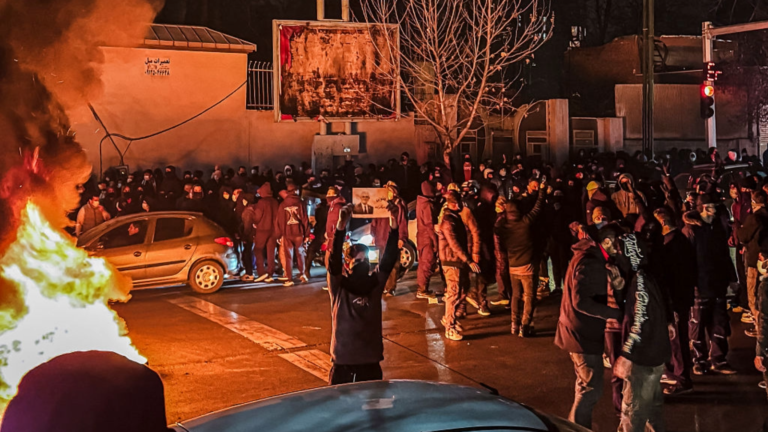
On the morning of March 1, 2026, Iranians in cities across the world did something they had not done in decades: they danced in the streets. In Los Angeles, in Toronto, in London, in Tehran itself—video after video showed people weeping, embracing, waving flags, setting off fireworks. Some held portraits, then tore them up. The object of their celebration, and of their grief, was the same man: Ayatollah Ali Khamenei, who had ruled the Islamic Republic of Iran for thirty-seven years, and who had just been killed in a joint American and Israeli airstrike on his compound in Tehran on the night of February 28, 2026.
The Iranian government confirmed his death the following morning. Khamenei was 86 years old. At the time of his death, he was the longest-serving head of state in the Middle East. He had survived an assassination attempt that cost him the use of his right arm. He had survived cancer, international isolation, the deaths of allies, the collapse of proxy armies, and wave after wave of his own people telling him, in the streets and with their blood, that they wanted him gone. For most of his life, those forces had failed to move him.
Now, within hours of his death, Iran’s government announced a provisional leadership council, the Assembly of Experts convened in emergency session, and the world held its breath asking the same question it had been quietly rehearsing for years: what happens to a country when the man who built its cage is gone?
That question matters beyond Iran’s borders, because the cage Khamenei built was not merely domestic. It was a regional architecture—a network of proxy militias, missile programs, and nuclear ambitions that shaped the Middle East for a generation. Understanding what he was, how he came to power, and how he held it is essential to understanding what comes next. And it requires going back much further than the airstrike.
A Cleric from Mashhad
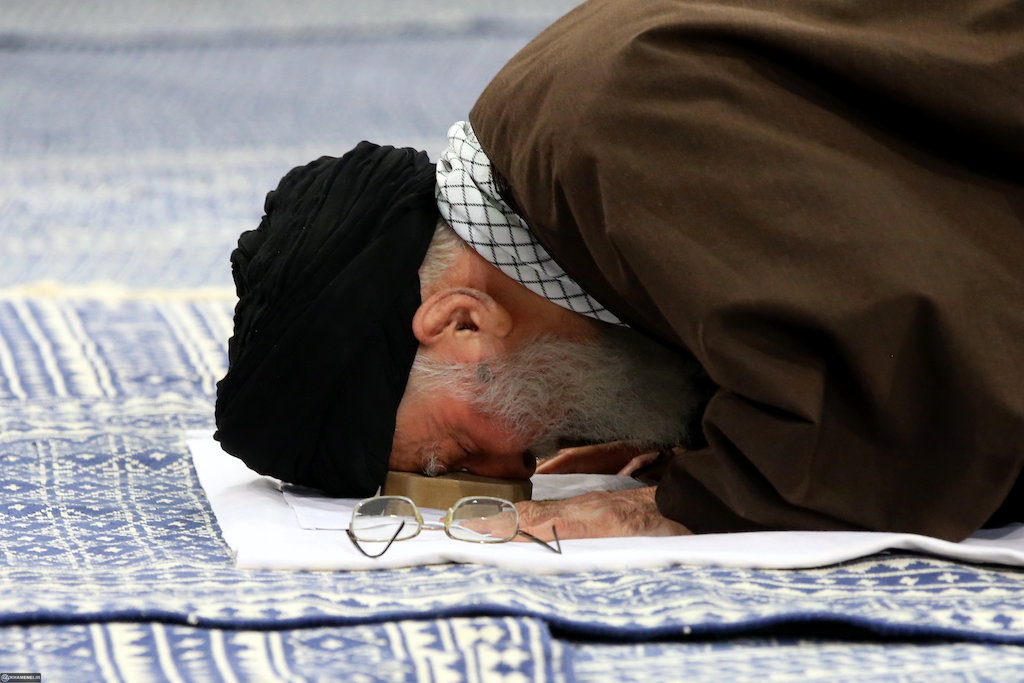
Ali Hosseini Khamenei was born on April 19, 1939, in the northeastern city of Mashhad, a pilgrimage destination, home to the shrine of Imam Reza, saturated in Shia devotion. His father was a cleric. He entered the seminary as a child, reportedly dressing in clerical garb by age eleven which, according to his biographers, drew mockery from peers. He was studious, serious, and driven in a way that would define him: he pursued authority not loudly, but relentlessly.
In 1958, he moved to Qom, the intellectual center of Shia Islam, where he became a student of Ayatollah Ruhollah Khomeini—the man who would reshape Iran and, in doing so, reshape Khamenei. Khomeini’s doctrine of velayat-e faqih, the Guardianship of the Islamic Jurist, held that clerics should govern the state, not merely advise it. For a young seminarian from Mashhad, it was not just theology. It was a political program.
As Mohammad Reza Shah Pahlavi tightened his grip on Iran through the 1960s and 1970s, Khamenei became part of the underground resistance. He was arrested six times by SAVAK, the Shah’s feared secret police, and tortured. He was exiled. Each arrest, by his own account, deepened his conviction. By the time the revolution came in 1979, he was not a famous cleric—he lacked the theological rank of a Grand Ayatollah—but he was a trusted insider, a man who had bled for the cause and been seen doing it.
The Unlikely Heir
After the revolution, Khamenei rose quickly through the new republic. He served on the Revolutionary Council, then as deputy defense minister, then as Friday prayer leader in Tehran—a platform that reached millions. In June 1981, a bomb hidden in a tape recorder exploded beside him during a mosque speech. He survived, but the blast destroyed the nerve tissue in his right arm, which hung limp for the rest of his life. He described the injury, characteristically, not as a trauma but as a mark of sacrifice.
Later that year, he was elected president, serving two terms through the catastrophic Iran-Iraq War—a conflict that killed an estimated one million people on both sides, produced a generation of traumatized veterans, and forged the institutional ties between Khamenei and the Islamic Revolutionary Guard Corps (IRGC) that would define his later power. During the war, the IRGC was not just a military force; it was the ideological army of the revolution. Khamenei understood early that whoever controlled it controlled Iran.
When Ayatollah Khomeini died on June 3, 1989, Iran faced an existential problem. Khomeini’s chosen successor, Ayatollah Montazeri, had been dismissed just months earlier after calling for political pluralism. The constitution required the new supreme leader to be a Grand Ayatollah—the highest rank in Shia scholarship. Khamenei was not one. He was a mid-ranking cleric who had, in a video that would surface decades later during the 2017 protests, openly admitted he was ‘not religiously qualified’ for the role.
What happened next reveals the machinery beneath the Islamic Republic’s theological veneer. The constitution was amended to remove the Grand Ayatollah requirement. Akbar Hashemi Rafsanjani, then one of the most powerful politicians in Iran, cited a private memory of Khomeini’s preference and guided the Assembly of Experts toward Khamenei. In return, Khamenei’s rank was elevated by regime decree and patronage—state media began calling him Ayatollah, then Grand Ayatollah, regardless of what the religious establishment in Qom thought. The clerics in Qom objected. The politicians in Tehran prevailed. Khamenei became supreme leader the same day Khomeini died.
He assumed the role, according to those who watched closely, with a notable absence of certainty—and then spent the next three decades making sure no one ever doubted him again.
The Architecture of Control
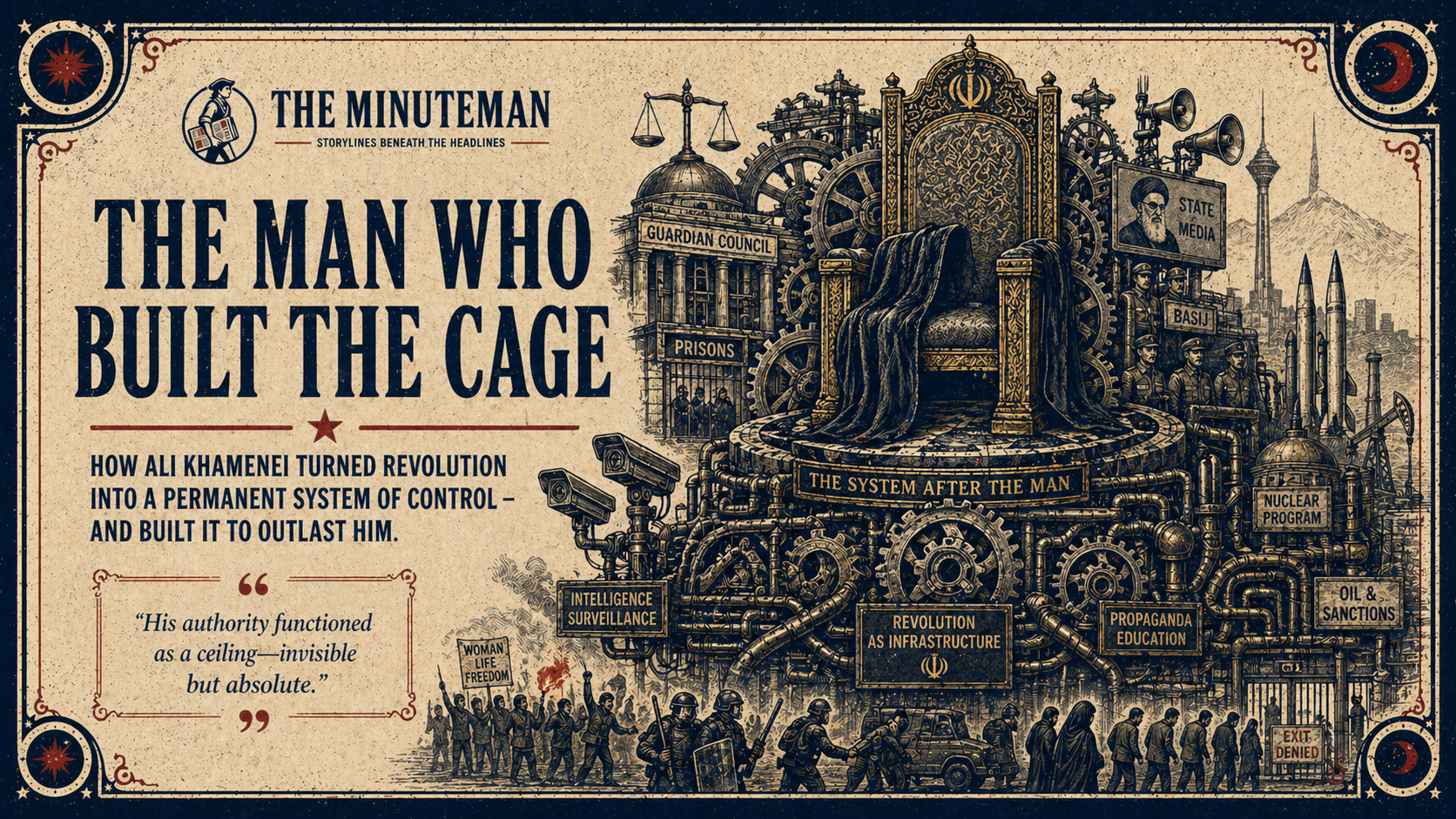
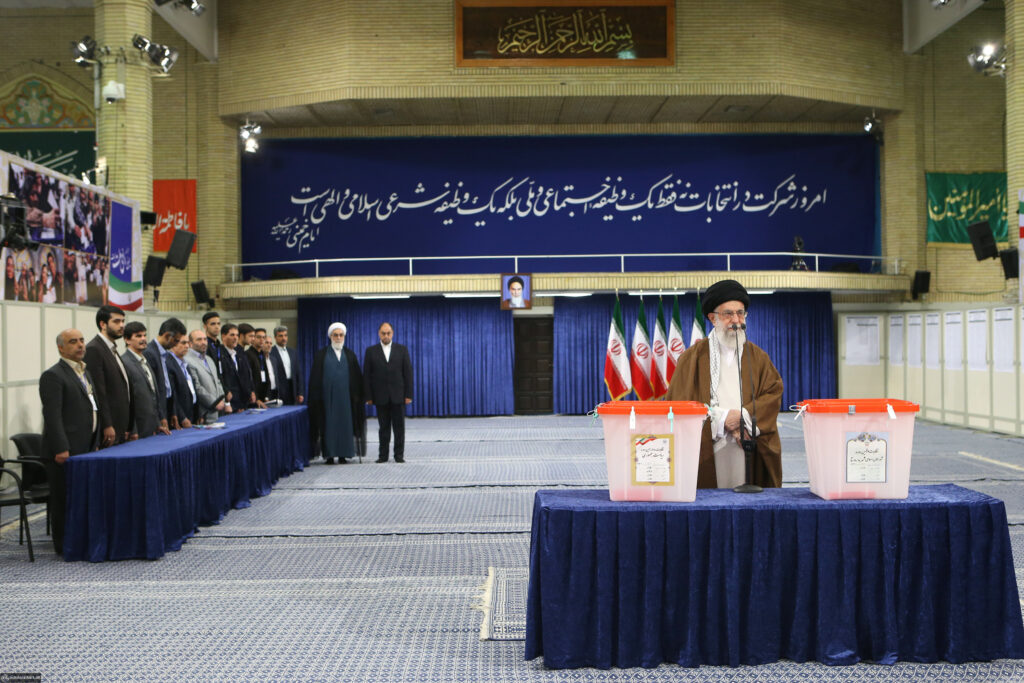
To understand how Khamenei held power for thirty-seven years, it helps to understand what the supreme leader actually controls. The position is not ceremonial. Under Iran’s constitution, the supreme leader commands the armed forces, appoints the head of the judiciary, appoints half the Guardian Council (which vets every candidate for every election), controls state broadcasting, and has final authority over foreign policy. Presidents come and go; their power is bounded by his. Parliament passes laws; the Guardian Council—his instrument—can strike them down.
Khamenei used this architecture not as a static guarantee but as a dynamic tool. He understood that the Islamic Republic’s greatest threat was not any foreign enemy but internal fracture—the competition among revolutionary factions, reformists, conservatives, technocrats, and clerics who all claimed to speak for the revolution. His solution was to function as the system’s ultimate adjudicator: letting factions compete, never fully letting any one of them win, and intervening decisively when any faction threatened his own position.
The IRGC was the lever he returned to most reliably. Khomeini had formally barred it from politics. Khamenei reversed that. Over decades, he encouraged the IRGC to expand into the Iranian economy—construction, telecommunications, energy, banking. By the time of his death, analysts estimated the IRGC controlled somewhere between a quarter and a third of Iran’s economy through a web of front companies and contracts. This was not incidental; it was structural. An institution with that much to lose from regime collapse becomes the most powerful force for regime continuity. The IRGC’s loyalty was never purely ideological. It was financial.
Alongside the IRGC sat the Basij militia—a volunteer paramilitary force embedded in neighborhoods, universities, and mosques, used as enforcers against dissent. A 2017 speech by Khamenei was widely interpreted as giving Basij members informal license to use force against regime enemies, effectively creating a layer of deniable violence the state could deploy without formally ordering it.
There was also Setad, a financial empire nominally created by Khomeini to manage properties seized from those who fled the revolution. Under Khamenei it grew into something extraordinary. A 2013 Reuters investigation estimated its assets at $95 billion or more, spanning real estate, pharmaceutical companies, and major industrial holdings—all beyond the reach of official oversight or legal challenge. Setad extended Khamenei’s informal reach into almost every sector of the Iranian economy, separate from and parallel to state institutions.
The result was a system in which the supreme leader never needed to govern in the daily sense. He did not hold cabinet meetings or manage ministries. His authority functioned as a ceiling—invisible but absolute. Presidents legislated beneath it. Reformists pushed against it. Every few years, some of them believed they had found a crack. They were always wrong.
The People Who Pushed Back
The most consequential challenge to that system came in 2009, and Khamenei’s response to it defined the rest of his rule. Mahmoud Ahmadinejad was declared the winner of that year’s presidential election with a margin that opposition figures—including his main challenger, Mir Hossein Mousavi—called fraudulent. Millions of Iranians took to the streets in what became known as the Green Movement. They wore green armbands. They held signs asking, quietly, “Where is my vote?” It was the largest popular uprising in Iran since the revolution itself.
Khamenei sided publicly and unambiguously with Ahmadinejad. He called the movement a “velvet revolution” orchestrated by Western powers. Then the IRGC and Basij moved in. The crackdown killed hundreds. Thousands were imprisoned. Mousavi and the other main opposition leader, Mehdi Karroubi, were placed under house arrest where they would remain for years, with no trial, no formal charges, no resolution. The Green Movement’s leaders disappeared not into exile but into a silence that was itself a form of message.
Khamenei was not done pressing the point. In 2019, protests over fuel prices turned into anti-regime demonstrations across more than a hundred cities. Security forces killed an estimated 1,500 people within days—one of the deadliest crackdowns in the Islamic Republic’s history. In 2022, the death of 22-year-old Mahsa Amini in morality police custody after being arrested for allegedly wearing her hijab incorrectly ignited something deeper. The protests that followed, under the slogan “Woman, Life, Freedom,” spread to all 31 of Iran’s provinces and were led largely by young women and teenagers who publicly removed or burned their headscarves. More than 500 people were killed. More than 19,000 were arrested. Several protesters were executed. Their bodies were displayed on construction cranes, a public theater of deterrence that had not been seen since the early years of the revolution.
The pattern across those decades is not incidental. Human rights documentation shows the same elements recurring in every major uprising: live fire against unarmed civilians, torture in detention, forced confessions, expedited trials on charges like “enmity against God,” and systematic internet shutdowns to limit documentation and coordination. Iran maintained one of the world’s highest per-capita execution rates throughout Khamenei’s rule. The executions were not confined to political prisoners; ordinary criminal cases were handled with the same finality. But the political executions, carried out with a consistency that researchers describe as structural rather than reactive, served a second function: they communicated the cost of dissent to everyone who remained.
In late 2025, protests erupted again—this time driven by economic collapse, with inflation hitting 49 percent and the rial falling below one million to the dollar. Reports indicated Khamenei ordered security forces into the field “with full authority.” A January 2026 statement attributed to him told the Iranian nation to “break the backs of the seditionists.”
None of those uprisings succeeded in removing him. His own niece, Farideh Moradkhani, was arrested in 2022 for calling on foreign governments to cut ties with Iran over the crackdown. The system, as Khamenei had built it, could absorb even that.
The Bomb He Never Built (and the Power He Got from Almost Building It)
Iran’s nuclear program became the defining international confrontation of Khamenei’s rule, and its logic was always more political than scientific. In 2002, a dissident group revealed the existence of secret nuclear facilities at Natanz and Arak, exposing an enrichment program far more advanced than Iran had disclosed to international inspectors. The revelation triggered more than two decades of negotiations, sanctions, crises, and agreements—none of which definitively resolved the underlying question of what Iran intended to do with its nuclear capability.
Khamenei’s position was characteristically ambiguous by design. He issued a fatwa declaring nuclear weapons un-Islamic and repeatedly denied Iran sought to build one. At the same time, he defended Iran’s right to enrich uranium as a matter of national sovereignty and permitted the program to expand significantly during periods of hardline governance. The ambiguity was not incoherence. It was a negotiating posture: Iran could claim moral high ground while maintaining the technical foundation for a weapons program, using the proximity to a bomb as leverage without actually crossing the line that would invite military retaliation.
The 2015 Joint Comprehensive Plan of Action—the nuclear deal signed with the United States, Britain, France, Germany, Russia, and China—was Khamenei’s most pragmatic foreign policy decision. He reportedly signaled “heroic flexibility” in 2013, authorizing President Hassan Rouhani’s team to negotiate, and approved the final agreement despite deep personal skepticism. The deal limited Iran’s enrichment activities in exchange for sanctions relief. It worked, until it didn’t. Donald Trump withdrew the United States from the agreement in 2018 and reimposed sanctions, and Iran gradually stepped back from its commitments. By the time of the 2026 US-Israeli strikes, Iran was estimated to have enough enriched uranium for approximately eleven nuclear weapons—though it had not yet assembled one.
That gap—between capability and weapon—was Khamenei’s final strategic hand. Indirect talks with the US were underway in the weeks before the strikes, with Washington demanding permanent enrichment limits and Tehran insisting it would not surrender the program. What those negotiations might have produced remains unknown.
The Axis That Fell Apart
Perhaps the most visible expression of Khamenei’s strategic ambition was what he called the “Axis of Resistance”—a network of armed groups and state allies arrayed against US and Israeli power across the Middle East. Iran helped create Hezbollah in Lebanon in 1982. It supplied and trained Hamas in Gaza, Shia militias in Iraq, the Houthi movement in Yemen, and propped up Bashar al-Assad’s government in Syria through years of civil war. The IRGC’s Quds Force, commanded for years by General Qassem Soleimani until his assassination in a US drone strike in 2020, was the operational engine of this regional network.
The logic was to project power beyond Iran’s borders without triggering direct war—to impose costs on adversaries through proxies while maintaining deniability and distance. For decades, the strategy worked well enough. Hezbollah became one of the most capable non-state military forces in the world. Iranian-backed militias dominated parts of Iraq after the US invasion. The Houthis gained control of Yemen’s capital. The axis held.
Then, in 2024, it began to collapse with speed that surprised even its critics. Hamas’s October 7, 2023, attack on Israel—which Iran denied knowing about in advance—triggered an Israeli military campaign in Gaza that decimated Hamas’s military structure. Israel then turned to Lebanon, killing Hezbollah’s top leadership in a series of strikes and degrading the organization more severely than any conflict in its history. Assad’s government fell to rebel forces in December 2024, depriving Iran of its most important land corridor to the Mediterranean. By the time Khamenei died in February 2026, the regional architecture he had spent billions of dollars and four decades building had been structurally dismantled.
His death came in the context of an escalation that began in June 2025, when Israel launched what became known as the Twelve-Day War against Iran’s military infrastructure. In the months that followed, reports emerged of Khamenei’s declining health and mental state, of IRGC commanders making decisions without his input, of factions maneuvering for position. He reportedly asked the Assembly of Experts to prepare for succession. He rarely appeared in public. His speeches, once long and stem-winding, became truncated and hoarse. The man who had built a system designed to outlast any individual was visibly approaching the moment that system would be tested.
What He Left Behind
Assessing a figure like Khamenei with honesty requires resisting two temptations: the temptation to reduce him to a monster, and the temptation to treat him as simply a product of circumstances. He was a genuine ideological actor who believed, by most accounts, in what he was doing. His anti-Americanism was not performed; it was rooted in a specific reading of history, colonialism, and the 1953 CIA-backed coup that restored the Shah, which Iranian schoolchildren have been taught as foundational trauma for decades. His support for Palestinian causes, however cynically deployed, connected to something real in the Islamic world. He was not without a worldview.
But the worldview was implemented through a system of organized violence that killed thousands of his own citizens for the act of protesting, imprisoned tens of thousands more, subjected women to mandatory dress codes enforced by morality police, executed gay men, and maintained one of the world’s most restrictive information environments. The Iranian passport became one of the most globally restricted. Hundreds of thousands of educated Iranians—doctors, engineers, academics—emigrated during his rule in what became a sustained brain drain that compounded the economic damage of sanctions. The IRGC’s economic empire crowded out private enterprise and entrenched a corrupt system in which political loyalty determined access to opportunity.
He governed, in short, in a way that secured the Islamic Republic’s survival at the direct expense of Iranian life, prosperity, and freedom. Those are not the same thing as each other, and Khamenei treated them as if they were.
It is also worth noting what he did not do. He did not build a nuclear weapon, despite possessing the capability to come close. He did not start a direct conventional war with the United States or Israel, despite decades of confrontation. He approved the nuclear deal in 2015, a pragmatic concession that suggested he understood the limits of ideology when survival was at stake. Whether those restraints reflected genuine strategic judgment or simply the absence of an opportunity he was waiting for is a question that will be argued over for years.
The Morning After
As of this writing, Iran is governed by a provisional council—President Masoud Pezeshkian, judiciary chief Gholamhossein Mohseni Ejei, and a Guardian Council representative—while the Assembly of Experts works to select a new supreme leader. No successor had been officially named before Khamenei’s death, though media reports had centered on several figures: his son Mojtaba, a 56-year-old cleric with deep IRGC ties but limited theological credentials and no government experience; Ali Larijani, a veteran politician Khamenei had recently appointed to head the Supreme National Security Council; and Alireza Arafi, a senior cleric from the seminary establishment. The IRGC’s backing will likely be decisive regardless of which name the Assembly selects.
Several senior figures were killed alongside Khamenei in the strikes, including his top security adviser and the IRGC commander-in-chief, further complicating any transition. The Assembly of Experts’ own offices in Qom were reportedly struck during a convened session. The succession process, already opaque by design, is now operating under wartime conditions with diminished leadership.
The Council on Foreign Relations assessed, before Khamenei’s death, that the most likely succession outcomes fell into three categories: regime continuity under a Khamenei-like figure, military takeover by the IRGC, or eventual regime collapse. None of those near-term scenarios, CFR warned, suggest meaningful political liberalization in the immediate aftermath. The institutions Khamenei built—the IRGC, the Basij, the Guardian Council, the judiciary, the system of vetted elections—remain intact. A single death, however seismic, does not dismantle a system constructed over decades.
The Iranians celebrating in the streets understand this. Many of them have celebrated before—in 2009, in 2019, in 2022—and watched the celebration end in crackdowns that left hundreds dead and thousands imprisoned. One Iranian engineer who left at age 27 told CNBC after Khamenei’s death: “I believe his death could mark the beginning of a new chapter.” He added the word “hope” carefully, the way people do when they have learned to be careful with it.
What This Is Really About
Khamenei’s life and death illuminate something that extends well beyond Iran: the specific way authoritarian systems sustain themselves in the modern era. He did not rule through the crude apparatus of a traditional dictatorship—there were elections in Iran, parliament, a constitutional framework, a Supreme Court, and competitive presidential races. The system’s genius, and its corruption, was to use the architecture of democracy as a filtering mechanism rather than a representative one: elections were held, but candidates who crossed ideological lines were disqualified before ballots were printed; parliament passed laws, but unelected bodies struck them down; courts operated, but the judiciary served the regime.
This model—not the abolition of institutions but their capture—has spread widely. The mechanics Khamenei refined over thirty-seven years can be observed, in different forms and contexts, in systems around the world that maintain the appearance of legal legitimacy while concentrating power beyond democratic accountability. Understanding how it works, how it holds, and what it costs the people living inside it is not merely an academic exercise.
It matters because the people who lived under that system paid for it with their lives, their opportunities, and their futures—not as collateral damage, but as the deliberate cost of its maintenance. The young women who pulled off their headscarves in the streets of Tehran in 2022 knew what the consequences might be. The protesters who gathered in 2009 wearing green armbands knew it. The families who waited for news of sons and daughters arrested in November 2019 knew it.
The cage Khamenei built was real. Its legacy will be determined not by what replaces him at the top, but by whether the people inside it can finally take it apart.