Classified Information and Mishandling: What It Is, Why It Matters
TL;DR
- Classified information is government data that requires restricted access to protect national security.
- It includes levels such as Confidential, Secret, and Top Secret based on potential damage from disclosure.
- The U.S. classification system was formalized in the mid-20th century to protect national defense and intelligence data.
- Several Executive Orders have shaped the process, with EO 13526 (2009) being the current framework.
- Mishandling classified information can result in prosecution under laws like the Espionage Act.
- There have been numerous high-profile cases involving unauthorized retention or disclosure.
- The classification system is crucial but faces criticism for overreach and lack of transparency.
For more than eight decades, the United States has relied on a structured system of classified information—an evolving framework designed to protect national security while enabling effective governance. From its early roots in the pre–World War II era to today’s digital age, classification rules have shaped how sensitive information is created, stored, shared, and eventually released to the public. Yet the system is often misunderstood, both in how it operates and in how it is enforced.
Understanding classification is essential not only for policymakers and government employees but also for the public, especially as high-profile cases of mishandled documents continue to dominate headlines. The rules that determine what becomes “Top Secret,” who gets to see it, and what happens when those rules are broken form the backbone of U.S. information security. They also reveal deeper tensions between secrecy and transparency, national protection and democratic accountability.
This article outlines how the modern classification system developed, how classified material must be handled, what legally constitutes mishandling, and why certain cases lead to prosecution while others do not. It also explores ongoing debates—such as over-classification and inconsistent enforcement—that shape the future of America’s secrecy system.
What it is
Classified information refers to government-owned or controlled information related to national defense or foreign relations that requires protection from unauthorized disclosure. Classification is applied through a system that includes levels such as Confidential, Secret, and Top Secret, each reflecting the potential damage to national security if the information were exposed.
Origins & evolution of classified information in the U.S.
The U.S. formally adopted classification systems during the World War II era. Executive Order 8381 in 1938 introduced initial categories like “Restricted.” EO 10290 in 1951 under Truman created a more unified system, including “Top Secret.” Later updates came from EO 12065 (Carter, 1978) and EO 13526 (Obama, 2009), now the guiding framework.
Why it matters
- National Security: Prevents adversaries from gaining access to sensitive defense and intelligence data.
- Public Trust: Ensures the government handles sensitive information responsibly.
- Legal Implications: Mishandling can lead to criminal charges, fines, or imprisonment.
- Accountability: Maintains checks and balances in handling sensitive government data.
Timeline
- 1938 – Executive Order 8381: First formal use of classification categories (e.g., Restricted).
- 1951 – Executive Order 10290: Introduced Confidential, Secret, and Top Secret levels.
- 1978 – Executive Order 12065: President Carter reforms classification and declassification procedures.
- 1995 – Executive Order 12958: President Clinton streamlines automatic declassification after 25 years.
- 2009 – Executive Order 13526: President Obama defines current standards for classifying, safeguarding, and declassifying national security information.
- 2005 – Sandy Berger: Former National Security Advisor pleads guilty to removing classified documents from the National Archives.
- 2016 – Hillary Clinton investigation: FBI investigates use of a private email server containing classified material; no charges filed.
- 2018 – Reality Winner: Convicted of leaking a classified NSA report; sentenced to over 5 years in prison.
- 2019 – Harold T. Martin III: Sentenced for removing over 50 terabytes of classified data from the NSA.
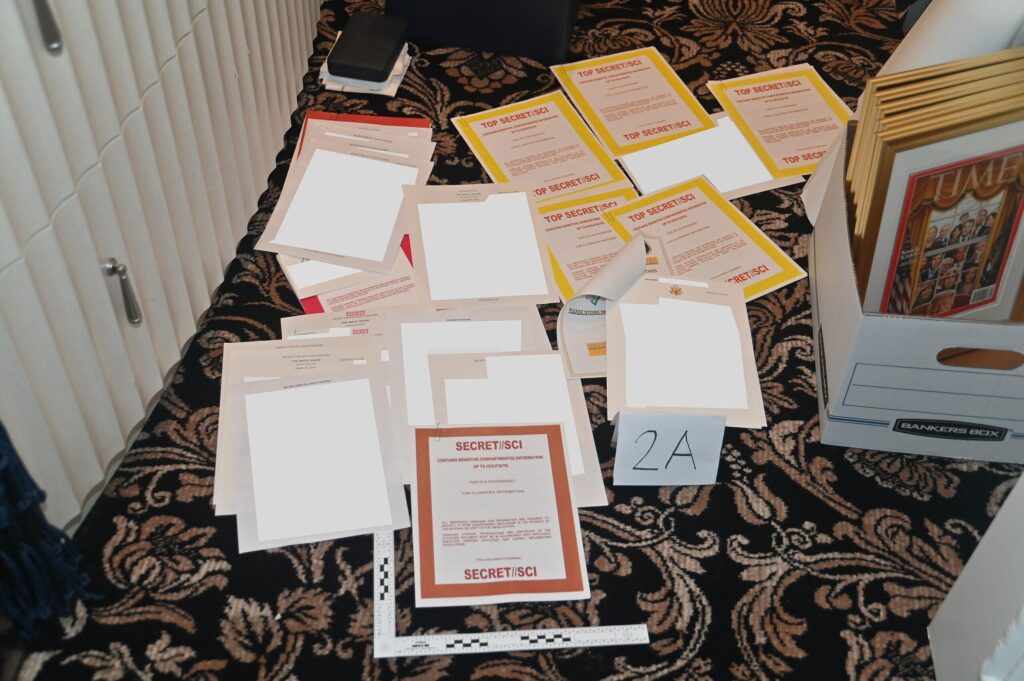
- 2023 – Donald Trump indictment: Former President Trump is federally indicted for willful retention of national defense information and obstruction, related to classified documents found at Mar-a-Lago after leaving office.
- 2023 – Kendra Kingsbury: Former FBI analyst sentenced to 46 months for unlawful retention of classified documents.
- 2025 – Margaret Anne Ashby: Former federal employee sentenced to 36 months for mishandling classified materials.
U.S. classification process & handling-controls
- Original Classification Authorities (OCAs) determine classification when disclosure could harm national security.
- Three primary levels: Confidential, Secret, Top Secret.
- Controls include proper marking, need-to-know access, secure storage, and regulated declassification (typically after 25 years).
- Special categories: SCI, SAP, and Restricted Data for nuclear info.
How it works / Key concepts
- Executive Authority: Classification is governed by Executive Orders such as EO 13526.
- Original and Derivative Classification: Agencies can classify information originally or based on existing classified sources.
- Handling Rules: Classified documents must be marked, stored, and transmitted according to strict rules.
- Access Control: Individuals must have a security clearance and a need to know.
- Declassification: Documents may be automatically declassified after 25 years unless exempted.
Mishandling classified information
Mishandling includes unauthorized retention, removal, or sharing. Legal definitions are outlined in 18 U.S.C. §1924 and the Espionage Act (18 U.S.C. §§793–798). Violations require willfulness or gross negligence and often hinge on the volume and significance of data mishandled.
High-profile U.S. mishandling cases
- Reality Winner (2018): Leaked NSA document; sentenced to prison.
- Harold T. Martin III (2019): Retained 50 terabytes of NSA data; pleaded guilty.
- Hillary Clinton: Used private server; investigation found classified content but no charges.
- Sandy Berger (2005): Removed classified docs from National Archives; pleaded guilty.
- Kendra Kingsbury (2023): Retained classified FBI documents; sentenced to 46 months.
Key legal issues
- Willful intent is a critical factor in prosecution decisions.
- Unmarked documents can still be classified under the law.
- Public interest disclosures (e.g., whistleblowing) raise legal and ethical tensions.
Implications and reform debates
- Over-classification: Excessive secrecy may hinder transparency and efficiency.
- Inconsistent Enforcement: Different standards for prosecution reduce credibility.
- Whistleblower Risks: Public interest disclosures may conflict with legal boundaries.
- Modern tech adds digital risks to classified data handling.
Summary
Classified information is central to U.S. national security. Mishandling it, whether through negligence or willful misconduct, can cause significant harm and carry serious consequences. The system faces ongoing challenges balancing security, transparency, and accountability.
FAQ
- Q1: What’s the difference between classified and sensitive but unclassified info?
A: Classified info meets legal secrecy thresholds; sensitive but unclassified (like CUI) requires protection but isn’t governed by classification laws. - Q2: Can private contractors classify documents?
A: No. Only authorized government officials can assign classification levels. - Q3: Are all Top Secret documents equally important?
A: Not necessarily. Critics argue that some may be over-classified. - Q4: What happens if you find classified material unsecured?
A: Report it immediately to security authorities; mishandling it further could be a violation. - Q5: What distinguishes a leak from mishandling?
A: Leaks are usually deliberate disclosures; mishandling includes negligent or unauthorized retention or storage.
Sources
- Congressional Research Service, 2023
- CDSE Guide: Security Classification Guidance
- Wikipedia: Classified information in the United States
- U.S. Department of Justice, 2023