Kash Patel Looks Great on Camera
What Kash Patel Does Instead of Running the FBI
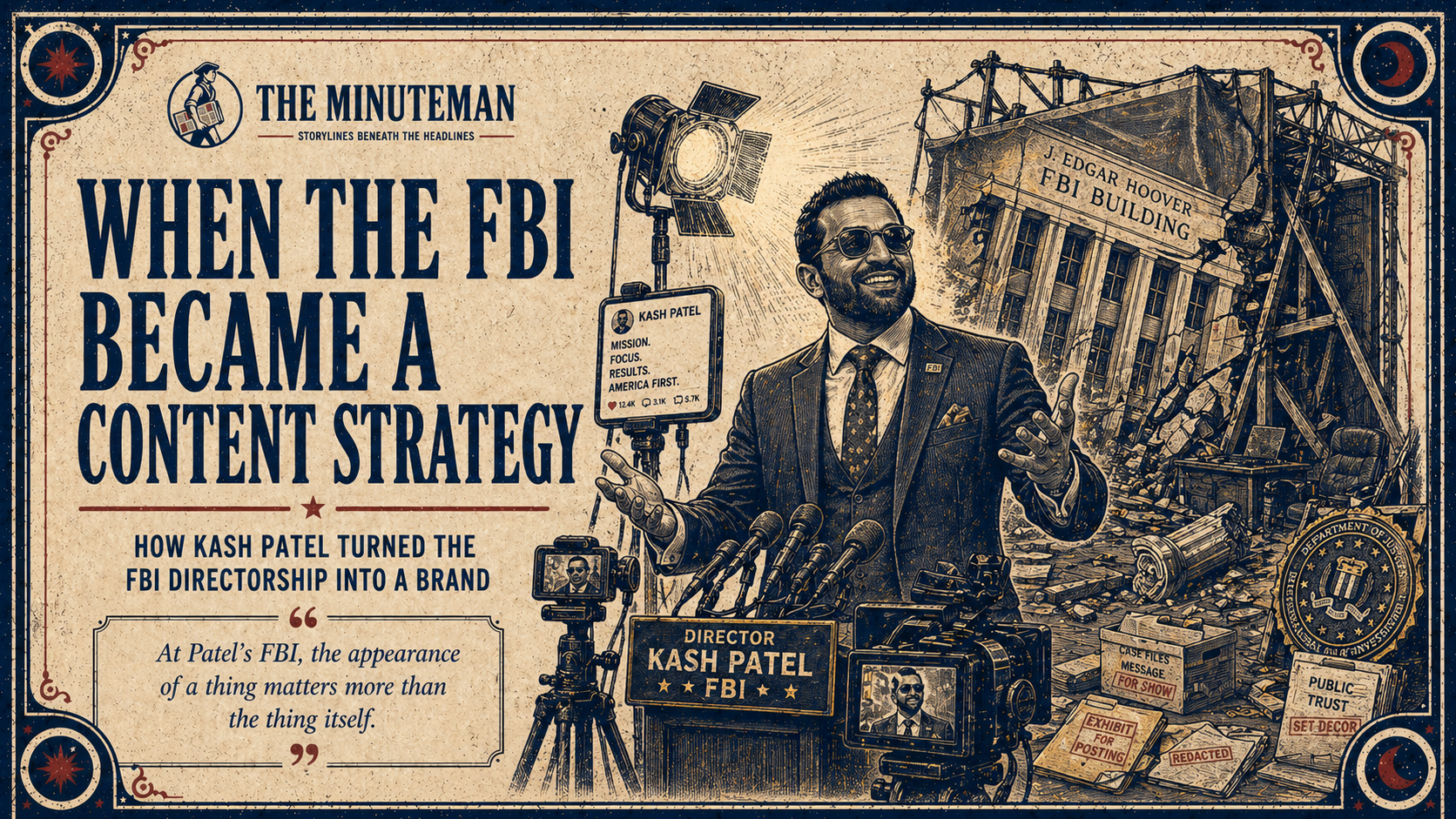
Kash Patel has turned the FBI directorship into a brand. A look at the optics, the resource abuse, and what’s not getting done while he’s on camera.

On February 22, 2026, the director of the Federal Bureau of Investigation was filmed in the Team USA men’s hockey locker room at the Milano Cortina Winter Olympics, chugging beer from a bottle, pumping his fists, banging a table, and screaming the lyrics to a Toby Keith song while surrounded by gold-medal-winning athletes. He wore a white USA long-sleeve shirt and jeans. The video went viral within hours.
Kash Patel was in Italy, according to the FBI, on an official trip to meet with Italian law enforcement and U.S. agencies providing Olympic security. Whether that was the plan before the men’s hockey team reached the gold medal game is a fair question. What isn’t up for debate is what the video looked like, because everyone saw it. The director of the FBI, the person responsible for counterterrorism, counterintelligence, cybercrime, and public corruption investigations across the United States, was partying in a locker room on a government-funded trip abroad while singing along to “Courtesy of the Red, White and Blue.”
Even Donald Trump, who appointed Patel and has defended him publicly on multiple occasions, reportedly told the director to his face that he wasn’t happy about the Olympic hijinks.
That video would be easy to dismiss as a bad moment, a lapse in judgment, a guy caught up in national pride. But it wasn’t a lapse. It was a pattern. And what that pattern costs isn’t measured in embarrassment. It’s measured in what the FBI is failing to do while its director treats the bureau like a content strategy.
Patel didn’t come to the FBI from inside it. He has never served as a special agent, never run a field office, never managed a large law enforcement operation. He was a public defender in Miami, then a staff attorney at the Department of Justice’s National Security Division. He became a political figure in 2018 when he authored the Nunes memo, a document alleging FBI officials abused their authority in surveilling Trump campaign advisor Carter Page, and that work put him in Trump’s orbit permanently. Between Trump’s first and second terms, Patel built a media brand: hosting “Kash’s Corner” on EpochTV, publishing children’s books featuring a character called “Kash the Distinguished Discoverer” who helps “King Donald” defeat villains like “Hillary Queenton,” and serving on the board of Trump Media & Technology Group, the parent company of Truth Social. He arrived at the FBI in February 2025 not as a law enforcement leader, but as a loyalist with a content portfolio.
That background matters because it explains what happened next.
On June 4, 2020, roughly a dozen FBI agents were deployed to Pennsylvania Avenue in Washington, D.C., to secure federal buildings during the protests that followed George Floyd’s murder. They had no tactical equipment: no riot shields, no gas masks, no helmets. They had never received crowd control training. When they arrived, they were outnumbered by an angry, volatile crowd that was pressing toward them.
Facing a situation that could have turned violent, the agents made a decision: they knelt. It was a de-escalation tactic, not a political statement. The Bureau investigated them at the time and found no cause for discipline. A previous internal review confirmed that the kneeling was a judgment call made under pressure to prevent bloodshed, not an act of protest.
Five years later, Kash Patel fired them.

The termination letters cited a lack of judgment. The agents, many of them decorated veterans with long service records, have since filed a federal lawsuit alleging the decision was made before Patel even joined the bureau and came directly from the White House. Their suit seeks reinstatement, back pay, and the expungement of their termination records. These weren’t agents who failed at their jobs. By every internal measure available at the time, they succeeded. They kept people safe. And Patel fired them for how it looked in a photograph.
At Patel’s FBI, the appearance of a thing matters more than the thing itself.
Patel’s girlfriend, Alexis Wilkins, is a twenty-seven-year-old country music performer based in Nashville. Since the two began dating, Wilkins has been assigned a full-time security detail consisting of four FBI agents and two vehicles, all pulled from the Nashville field office’s elite SWAT unit. These are agents trained for hostage rescue, counterterrorism operations, and violent crime arrests. Under Patel, they escort Wilkins to hair salon appointments, singing performances, resort trips to the United Kingdom, and personal errands. In one reported incident, Patel called the leader of the detail and screamed at him after agents left an assignment accompanying Wilkins to an NRA event early, having determined the location was secure.
The FBI says the detail exists because Wilkins receives active death threats, including graphic threats of rape and murder, as a result of her relationship with the director. Threats against anyone should be taken seriously, and there may be a real security concern worth addressing. But no previous FBI director has ever provided a separate security detail for a girlfriend or spouse. Past directors’ spouses received episodic protection only when traveling alongside the director. This is something different. This is a standing SWAT detail assigned to a private citizen with no government role, funded by taxpayers, staffed by agents who were hired to hunt violent criminals.
And the jet.

Patel has used the FBI’s government Gulfstream to fly to Nashville to visit Wilkins. He took it to Pennsylvania for what critics called a date night, watching her perform the national anthem at a wrestling event. He flew it to Scotland to play golf at the Carnegie Club with friends, and to a private hunting ranch in Texas. The Campaign Legal Center filed a complaint with the Department of Justice’s Office of Inspector General on March 4, 2026, flagging at least ten trips where Patel appears to have used the government aircraft for personal travel without reimbursement.
Ten trips on the taxpayer’s plane. And that number only covers what’s been documented so far.
This might sound like a story about government waste, another official living large on public money. But the FBI doesn’t have a fleet of planes sitting idle. It has limited aircraft serving a bureau of 38,000 employees across 56 field offices. When the director takes a jet to go golfing, that jet isn’t available for the agents who need it.
In December 2025, a mass shooting struck near Brown University in Rhode Island. According to a whistleblower who reported to Congress, the FBI’s elite evidence response team, the people trained to process the most complex crime scenes in the country, couldn’t get there by air. The bureau’s plane wasn’t available. Patel had one of the FBI’s two available jets while he was in South Florida and had ordered the other held for a different team. So the evidence response team drove. Through the night. In a snowstorm. The FBI has disputed this account, saying evidence response agents from the Boston field office reached the scene roughly two hours after the shooting. But the whistleblower’s version prompted a Senate inquiry into Patel’s use of government aircraft, and the question at its center doesn’t hinge on one flight: what happens to the mission when the director treats bureau resources as personal perks?
The FBI’s budget for fiscal year 2026 is $10.1 billion. It employs roughly 38,000 people, including more than 13,000 special agents. Its mandate covers everything from Chinese espionage to ransomware to terrorism to fentanyl trafficking to corruption at the highest levels of government.
The threats are not theoretical. As of 2020, the FBI was opening a new China-related counterintelligence case roughly every ten hours, a pace that has only accelerated since. In 2025 alone, multiple active-duty U.S. military members were arrested for conspiring with Chinese intelligence. A State Department employee with top-secret clearance was caught transmitting national defense information to the People’s Republic of China. Two PRC nationals were charged with overseeing intelligence operations that included recruiting American soldiers. Ransomware attacks hit over 3,100 reported victims in 2024, a nine percent increase from the year before. Terrorism threats surged after October 7, 2023, and haven’t receded. The fentanyl crisis continues to kill tens of thousands of Americans annually.
So what has Kash Patel been doing?

Since taking office, Patel has pushed out at least fifty employees, targeting two groups: anyone who worked on investigations involving Donald Trump, and anyone perceived as insufficiently loyal to the current administration. Agents involved in the Mar-a-Lago classified documents case were fired, at least ten to fifteen of them across field offices in Miami, New York, Atlanta, and Washington. The acting assistant director in charge of the New York field office was removed. The former Washington office leader overseeing January 6 investigations was pushed out. Three senior officials, Brian Driscoll, Steven Jensen, and Spencer Evans, sued the FBI and the Trump administration, alleging their terminations were part of a White House-directed purge.
Then Patel disbanded the FBI’s public corruption squad.
CR-15, as the unit was known internally, was the Washington Field Office’s federal public corruption team, the squad responsible for investigating violations of federal law by public officials at every level of government. Among its active cases was “Arctic Frost,” the internal FBI investigation that became the precursor to Special Counsel Jack Smith’s probe into efforts to overturn the 2020 election. Patel announced on social media that agents in the unit had tracked the communications of Republican senators and “weaponized law enforcement against the American people,” and he folded the squad entirely. The agents were fired. The cases were closed or reassigned.
This wasn’t trimming bureaucratic fat. Public corruption investigations require institutional memory: years of built-up knowledge about financial networks, relationships, and patterns of behavior that can’t be reconstructed once the people who hold that knowledge are gone. Without CR-15, the FBI still has the authority to investigate public corruption. What it lost is the specialized team that knew how to do it at the federal level, operating in the city where federal corruption happens.
And then there’s the counterintelligence unit. Just days before the United States launched a military operation against Iran, Patel fired a dozen agents and staff from CI-12, the FBI’s counterintelligence unit tasked with monitoring Iranian threats. These agents weren’t fired for misconduct or incompetence. They were fired because they had worked on the Trump classified documents case. The timing is hard to overstate. The FBI gutted its Iran-focused intelligence capacity at the precise moment the country needed it most, with national security analysts warning that Iranian sleeper cells could increase activity across the United States in response to the military operation.

Meanwhile, counterterrorism agents and intelligence analysts were reassigned from their national security roles to support mass immigration enforcement operations. Agents in the Domestic Terrorism Operations Section were transferred to immigration work. Multiple offices in the Department of Justice’s National Security Division lost at least half their employees. The office dedicated to counterterrorism specifically lost fifty percent of its workforce. A former senior DOJ official put it plainly: if you lose half your capacity, you lose half your ability.
At a Five Eyes intelligence partnership meeting at Windsor Castle, a gathering of the closest intelligence allies the United States has, Patel posed for a group photograph with foreign intelligence officials from allied nations. British officials explicitly told everyone present that the photo was not to be shared, because it contained intelligence officers whose identities and affiliations were meant to remain confidential for security reasons.
Patel posted it on social media anyway. To millions of followers.
The hockey locker room, the girlfriend’s SWAT detail, the government jet to a golf course, the Windsor Castle photograph. Every one of these is an act of someone who has confused being seen with being effective.
And when the coverage turns negative, when reporters document the jet trips or the security detail or the international embarrassment, Patel fires people. An analysis of the timeline found that in at least four documented instances, firings of experienced agents came within hours or days of unflattering press about the director’s conduct. The pattern repeats: bad press about Patel, then agents get fired, and the story shifts.
To enforce loyalty, Patel ordered approximately forty FBI officials to sit for polygraph examinations. These weren’t the polygraphs the FBI has historically used to determine whether an employee has been compromised by a foreign adversary. These were designed to find out whether agents had said anything negative about their director. Agents were asked directly whether they had ever made critical comments about Patel. In one case, the polygraph was used to try to identify who had leaked the fact that he requested a service weapon, a detail that embarrassed him publicly.

The FBI Agents Association, which represents the bureau’s special agents, condemned the firings as unlawful and said they endanger national security. Their statement was direct: these actions weaken the bureau by stripping away critical expertise and destabilizing the workforce, undermining trust in leadership and jeopardizing recruitment.
An internal report submitted by a national alliance of FBI agents to Congress in December 2025 described the bureau under Patel as “gripped by fear, divided by ideology, and drifting without direction.” The report warned of paralysis, described leaders as unprepared for their jobs, and noted that multiple sources inside the bureau consider the director to be in over his head. Agents with more than a decade of service said they feel marginalized. Managers are afraid a wrong move will cost them their careers. The culture is one of self-preservation, not mission.
In response to the staffing crisis Patel helped create, the FBI eliminated its four-year college degree requirement for new special agents, the first time in the bureau’s history. Training was cut from eighteen weeks to eight. Vetting steps for internal candidates were removed. A former senior FBI counterterrorism official called it “generational destruction,” noting that when you lower the standards, mission effectiveness goes down with them. Chinese espionage cases are multiplying faster than the bureau can staff them. Ransomware groups are crippling American businesses. Terrorism threats remain elevated. The bureau is lowering its standards at the moment it can least afford to.
Patel’s supporters argue that the FBI needed to be disrupted, and there’s a version of that argument worth taking seriously. The Department of Justice Inspector General’s 2019 report found seventeen significant errors and omissions in the FBI’s applications for surveillance warrants on Carter Page, including an FBI lawyer who altered a CIA email to conceal the fact that Page had been an agency source. Special Counsel John Durham’s investigation concluded that the FBI opened a full investigation into Trump’s campaign based on raw intelligence when only a preliminary assessment was warranted, and that the bureau applied a different standard when evaluating concerns about the Clinton campaign. These weren’t invented grievances. The IG and Durham reports documented real failures of process, analytical rigor, and institutional discipline that eroded trust in the bureau’s independence.
But the IG also found no evidence that political bias motivated the opening of the investigation. And the Durham probe, after three and a half years, produced one guilty plea (the lawyer who altered the email) and two acquittals. The documented problems were serious. The conclusion that the entire FBI had been “weaponized” was a political interpretation of those problems, not an investigative finding.
And even if you accept the premise that the bureau needed wholesale reform, what Patel has done doesn’t resemble it. Reform builds something. Patel fires people who investigated his patron, disbands the unit that investigates public corruption, guts counterintelligence days before a war, and replaces eighteen weeks of agent training with eight. What he’s built is a loyalty operation, and the cost is measured in the expertise walking out the door.
His defenders also point to crime statistics: a claimed 197 percent increase in arrests, doubled violent crime numbers, and large seizures of fentanyl and cocaine. These figures have not been independently verified by any outlet outside the administration. Trump has publicly praised him. Republicans in Congress supported his confirmation and continue to defend his tenure.
On September 10, 2025, conservative activist Charlie Kirk was shot and killed during an appearance at Utah Valley University. In the immediate aftermath, a senior FBI official described a conference call with Patel as “surreal.” Rather than discussing the investigation, resource allocation, or threat assessment, Patel and then-Deputy Director Dan Bongino began scripting their social media posts on the call. The official told the New York Times they had to interrupt and say, no, there is actual work to do here. Hours after the shooting, Patel posted on X that “the subject” was in custody. Less than two hours later, he had to correct it. The person had been released. The actual shooter, twenty-two-year-old Tyler Robinson, wasn’t arrested until the following day.
That call is the clearest window into how Patel understands his job. A political figure had just been murdered. His agents needed direction. And the director of the FBI was scripting a post.
The FBI exists because the country decided it needed an institution capable of protecting Americans from threats they can’t see: foreign spies, terrorist networks, cyber attacks, corruption at the highest levels of government. That mission requires competence, independence, and focus. It requires a director who understands that the job isn’t about him.
Kash Patel looks great on camera. He has the content, the plane, the SWAT team guarding his girlfriend, and the social media account broadcasting his exploits to millions of followers. What he doesn’t have is a bureau that trusts him, allies who trust him, or a record that suggests the actual work of the FBI is his priority.