How the Banana Shaped the World
There is a good chance there is a banana on your counter right now.
It is not supposed to be there. Bananas do not grow here, and they have never grown here in any quantity that could feed a country, because the plant requires warm tropical air, drenching humidity, and soil that does not freeze. Your banana probably came from Ecuador, or Guatemala, or Colombia, or Costa Rica. It was cut green off a cloned plant, sealed into a refrigerated ship, unloaded at a port like Gulfport or Wilmington, trucked to a ripening chamber in your region, gassed with ethylene to turn it yellow at exactly the moment the grocer needed it yellow, and set on a shelf next to apples for about sixty cents a pound.
It is the cheapest fruit in the store. It might be the cheapest thing in the store.
It is also, by the measure that matters, the most expensive piece of produce on your counter.
The banana is built on four thousand workers dead in twenty-five miles of jungle.
It is built on fifteen hundred men permanently sterilized by chemicals their employers knew were poisoning them.
It is built on the first democratic government in Guatemala, overthrown in 1954 in a CIA operation run by former lawyers for a fruit company, which touched off a civil war that killed two hundred thousand people.
It is built on a century-long racial caste system imported to Central America from the American South, and on payments from an American corporation to a Colombian paramilitary death squad that the United States had designated a terrorist organization.
Some of this has been admitted in federal court. The rest is in the historical record.
None of it is in the price.
That gap, between what a banana costs and what a banana has cost, is the subject of this article. The gap is not an accident. It is the point.
A corporation called the United Fruit Company figured out, over the course of a hundred and fifty years, how to push the cost of a piece of fruit off the balance sheet and into other people’s bodies, into other people’s countries, into other people’s history. The techniques it pioneered are now the standard operating procedure for every global corporation you interact with. Your phone runs on them. Your groceries run on them. Your cloud runs on them.
The banana is a playbook.
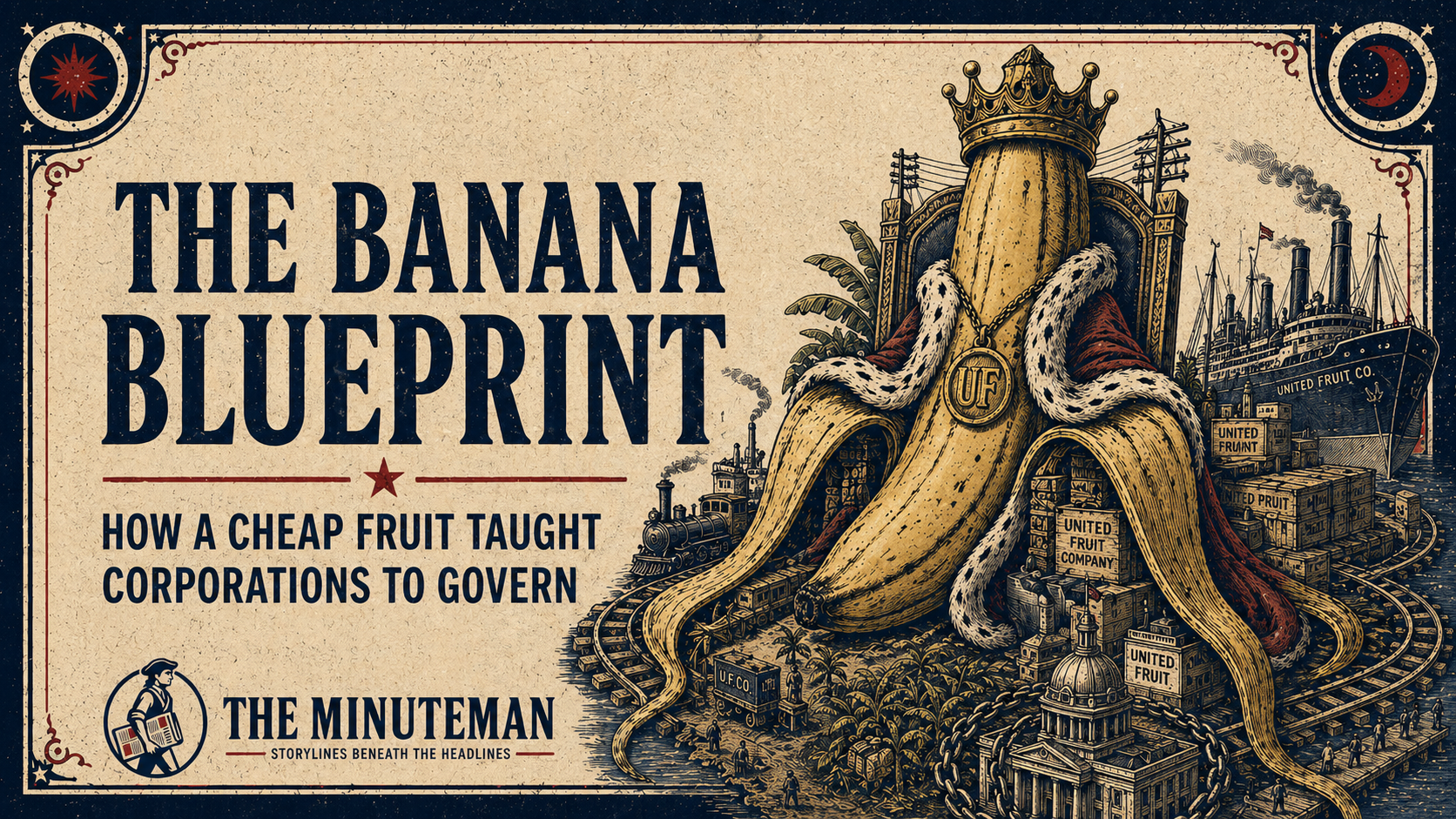
A century ago a banana company wrote the book on corporate sovereignty. Own the logistics, enforce the monoculture, privatize the infrastructure, and govern the countries you move through, all packaged into a cheap yellow fruit. Every modern conglomerate, from United Fruit to whoever owns your cloud, is running the same century-old code.
The store clerk from Brooklyn
The story does not begin with a fruit. It begins with a railroad.
In the early 1870s, Costa Rica had a profitable product and a terrible logistics problem. The country ran on coffee, grown in the Central Valley around the capital of San José, where the elevation and climate produced beans that European buyers in London and Paris would pay premium prices for. Getting the coffee to London, however, was a nightmare.
The Panama Canal did not exist yet. To reach Europe, a Costa Rican exporter had to load coffee onto wooden ox carts, haul it for days over mountain passes to the Pacific port of Puntarenas, sail it down the coast of South America, round Cape Horn, and come back up the Atlantic. Shipping ate most of the profit.
The obvious solution, obvious to anyone who looked at a map, was to build a railroad straight east across the country from San José to the Caribbean port of Limón. Coffee on the Atlantic side. Straight shot to Europe.
The Costa Rican government hired a prominent American railroad man named Henry Meiggs to build it. Meiggs, busy with a project in Peru, sent his nephew to manage the Costa Rica side. The nephew was twenty-three years old. He was from Brooklyn. He had worked as a store clerk, then managed a cattle ranch in Texas. He had never seen a tropical rainforest. His name was Minor Cooper Keith, and in 1871 he stepped off a boat into the swamp that was going to make him one of the most powerful private citizens in the Western Hemisphere.
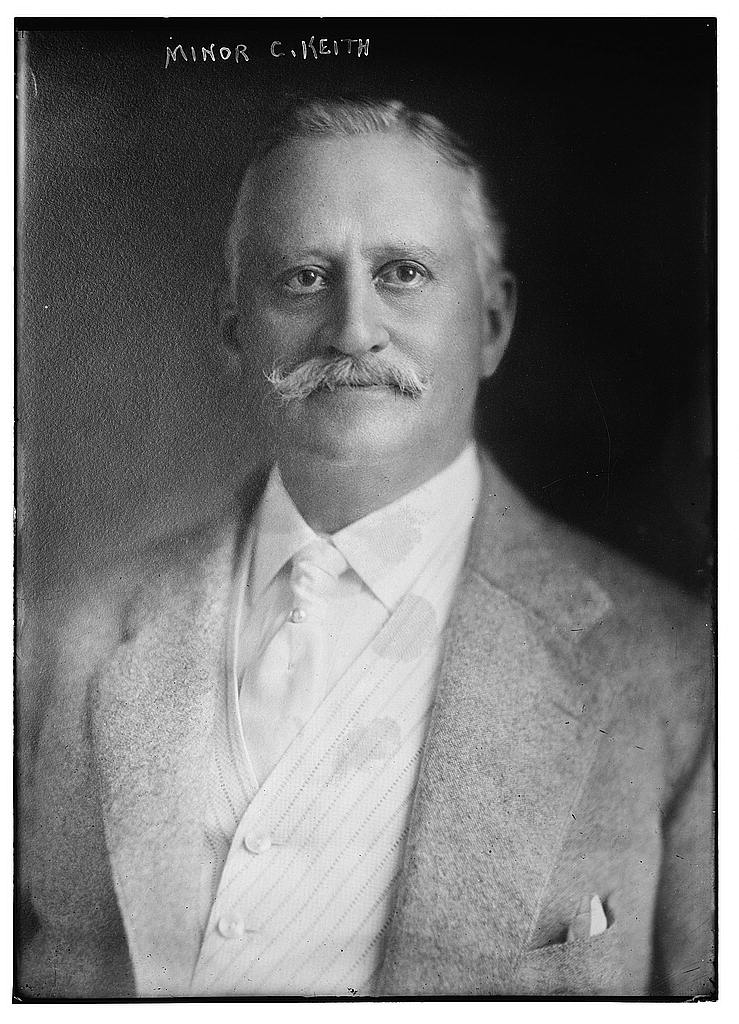
The Atlantic coast of Costa Rica in 1871 was not the tourist destination it is today. It was a vast, humid, perpetually raining lowland forest, cut through by shallow rivers that spilled over into standing water and bred mosquitoes in biblical numbers.
Germ theory was still new. Nobody understood that the mosquitoes were the disease vectors. The prevailing idea was that the swampy air itself was bad, that “miasma” was what made workers sick. What made workers sick was malaria, yellow fever, and dysentery, and what the workers mostly did was die.
Roughly four thousand people died building the first twenty-five miles of track. Keith’s uncle Henry Meiggs died in 1877. Three of Keith’s own brothers died, all of them in the jungle, all of them from tropical diseases.
The logical response to watching your uncle and three brothers die in a swamp would be to get on a boat and go back to Brooklyn. Keith did not do that. He took over the project and pushed onward.
Which turned out to be a problem, because the project was running out of money.
By 1882, the Costa Rican government, which had financed most of the railroad through British banks, defaulted on its national debt. The London bondholders were not going to get paid. The workers were not going to get paid. The tracks stopped where the money stopped, and the jungle began reclaiming them.
This is the moment the blueprint begins.
Keith did something that had no modern precedent. He did not file suit. He did not petition the American government to intervene. He got on a ship, sailed to London, walked into the offices of the banks holding Costa Rica’s debt, and personally negotiated the sovereign debt of a country he did not run.
He raised one point two million pounds sterling in new financing. He got the interest on the existing loans reduced from seven percent down to two and a half. He saved the Costa Rican treasury from full collapse.
A private American in his twenties, with no official title, acted as the central bank and chief diplomat of a sovereign state, and it worked.
The question, of course, is what he asked for in return.
The contract he got in return is where the blueprint is born. It is called the Soto-Keith Contract. It was signed on April 21, 1884. And it is, without much exaggeration, the single most consequential private agreement in the history of Latin America.
For saving the country’s finances and finishing the railroad, Keith received a ninety-nine-year lease on the only railway line connecting the Costa Rican interior to the world. He received eight hundred thousand acres of land along the tracks, completely tax-free, to do with as he pleased for ninety-nine years.
Eight hundred thousand acres works out to roughly 6.3% of Costa Rica’s total land area. To put that in modern terms, imagine if a single American businessman, in exchange for building a 5G network, received tax-free ownership of something on the order of the state of Delaware inside the United States, plus a hundred-year monopoly on every major highway in and out of it. No property tax. No federal oversight. Corporate sovereign territory, courtesy of the nation that owned it yesterday.
He owned the land. He owned the only way in or out of the land. In a functional sense, he was now the parallel government of a piece of a foreign country.
The railroad was finished on December 7, 1890. And then something almost funny happened.
It turned out the railroad was a financial catastrophe. Coffee exports and passenger traffic did not come close to covering the debt on its construction. The mathematics that had seemed so obvious on paper did not hold up when the trains actually ran. Keith was sitting on the most expensive piece of infrastructure in Central America, and it was losing money. He was staring at bankruptcy for the second time in a decade.
What saved him was an afterthought.
Back in 1873, while construction was still killing workers by the thousand, Keith had faced a mundane problem. The railroad crews needed food, and imported food was expensive, and the jungle the crews were dying in was not exactly teeming with farmable land.
Somewhere along the way Keith got some banana roots from a Frenchman and started planting them alongside the tracks as cheap food for the workers. The plant grew fast, produced calorie-dense fruit in its own packaging, and thrived in exactly the climate that was killing everyone. It was never meant to be a business. It was lunch.
In 1890, with an empty train and a failing railroad, Keith started throwing some of the bananas onto the empty cars going back to the coast and shipping them to New Orleans. He wanted to see if he could make a few extra dollars. Instead he discovered an industrial revolution in fruit.
The United States was in the middle of a massive urbanization boom. Cities were full of people who needed cheap, portable, easy-to-eat food. A banana arrived in its own wrapper, packed with sugar and potassium, and could be peeled and eaten without utensils in thirty seconds. It was a revelation.
The script flipped. The railroad that was supposed to haul Costa Rican coffee to the world started hauling bananas to the United States. Keith bought his own steamboats and formed the Tropical Trading and Transport Company. The train that the Costa Rican government had financed to move its own national economy was now moving Keith’s private fruit business. And that is when Keith, and eventually everyone else, figured out the single most important thing I am trying to show you.
Whoever controls the logistics controls the economy. The product is almost incidental.

The blueprint takes shape
Minor Keith was a builder. He was not a manager. By the end of the 1890s, having bought up more and more land and more and more track, he had overextended himself to the point of bankruptcy again. In 1899 he did what builders do when they run out of money. He merged.
His merger partner was the Boston Fruit Company, run by a hardened sea captain named Lorenzo Baker and a Boston businessman named Andrew Preston. Boston Fruit had mastered the shipping side of the banana business, hauling fruit from Jamaica to the American Northeast, which was a tougher voyage than the run from Costa Rica to New Orleans. Boston Fruit had the ships and the East Coast distribution network and the New England capital. Keith had the land, the railroads, and the political leverage. On March 30, 1899, they combined to form the United Fruit Company.
From the day it was born, the company looked less like a farm and more like a small country.
By the first decade of the twentieth century, United Fruit owned something in the neighborhood of 800,000 acres of land across Central America.
It owned the company towns the workers lived in. It owned the company stores, called commissaries, where the workers were required to buy their food and tools. It paid workers largely in company scrip, a currency that was only redeemable at those stores, which meant that wages left the company’s books and came right back to the company’s books on the same day. It owned the hospitals. It owned the schools. It owned, through a subsidiary called Tropical Radio and Telegraph, the radio and telegraph infrastructure of an entire region, which meant that any message sent out of Central America, whether by a local government or by a journalist wiring a story to New York, passed through United Fruit’s cables. It owned a private steamship fleet called the Great White Fleet, which at its peak carried more tonnage than the navies of most Latin American countries combined.
By one accounting, United Fruit moved 58% of Costa Rica’s total national exports through infrastructure it had built and owned.
A normal industry of that size would act as an economic engine in the country it operates in. It would hire local vendors, buy local materials, pay local taxes, and push wealth outward through the local economy. United Fruit did the opposite. It built sealed corporate enclaves. The money generated inside the enclave stayed inside the enclave, and then the enclave put it on a ship and sent it back to Boston.
You can see this in the railroad maps. If you look at historical maps of Honduras or Costa Rica in the early 1900s, the rail lines do not go where a national planner would put them. They do not connect the capital to the ports. They do not pass through the major existing population centers. They do not go up into the highlands where most of the people live. They loop and curve and reach deep into unpopulated jungles.
The reason is that United Fruit built them to connect United Fruit plantations to United Fruit ports, and if the train stopped in a local town on the way, then the locals might actually benefit from it. The enclave was the product, and the enclave was supposed to be airtight.

Out of this arrangement came a phrase most Americans have heard and almost none of us know the origin of. The phrase is banana republic.
It was not originally the name of a chain of retail clothing stores. It was a diagnosis.
It described a small Central American nation whose economy was so thoroughly dependent on a single exported crop controlled by a single foreign corporation that its political system became a function of the corporation’s needs.
The company picked the president. The company wrote the laws. The company paid the army. The country had a flag and a capital and a constitution, but those things were the paint job.
Throughout Latin America, United Fruit was not called the United Fruit Company. It was called el pulpo. The octopus. Because the tentacles reached into everything.
The octopus had a labor problem, and the way it solved it is worth pausing on, because you will see the solution again later in this article, in different clothes.
The Atlantic coast of Costa Rica, where the original plantations were, was the same lethal swamp that had killed four thousand railroad workers. The majority population of Costa Rica, the cooler-highland Hispanic Ticos, would not go there. They had watched their countrymen die of malaria for twenty years. You could not pay a Tico enough. Which meant the bananas sat on the trees and rotted, and the company faced a labor crisis that threatened the entire operation.
The solution was to import a workforce from somewhere else.
Between 1910 and 1913 alone, around twenty thousand Jamaican workers were brought into the Limón province of Costa Rica to cut bananas. A broader figure for the whole Caribbean workforce imported for regional banana and canal projects is closer to fifty thousand.
United Fruit chose the British West Indies for three reasons. First, the Caribbean sugar industry was in depression, which meant there was a vast pool of labor that was desperate enough to accept dangerous work. Second, the West Indian workforce had generations of experience in tropical agriculture, including banana cultivation. Third, they spoke English, which meant the Boston managers did not have to learn Spanish to run the plantations.
In practice, this meant that the company imported an entire English-speaking, Protestant, African-descended society into a Spanish-speaking Catholic country, and then built a wall around it in a section of the country the majority population already refused to enter.
Limón became an enclave within an enclave. Limón had English-language schools, Protestant churches, Caribbean food, Caribbean music, and the economic and cultural texture of a small piece of Jamaica transplanted into a corner of Central America.
The Costa Rican political elite, meanwhile, was in the middle of constructing a national identity built on a myth of European whiteness. Which meant that the twenty thousand Black English-speaking Protestants in Limón were, from the standpoint of the national project, a problem. They were isolated geographically and politically. Their movements were restricted. They were, legally, not quite citizens.
The company took this arrangement and industrialized it. Inside the plantation system, United Fruit set up an explicit three-tier racial hierarchy.
At the top were white American managers, in segregated company towns with manicured lawns and swimming pools and imported food. In the middle, because they spoke English, were the West Indians, serving as foremen, timekeepers, and clerical staff, often paid in U.S. dollars rather than local currency, and paid at a slightly better rate. At the bottom, doing the most dangerous manual labor, were the Hispanic and indigenous workers. Black workers were paid less than white workers for identical labor.
The hierarchy was not an accident. It was management. The company imported, and then deliberately worsened, the logic of Jim Crow that its Boston executives knew from the American South, because a divided workforce is a workforce that does not strike.
If the Hispanic workers organized, the company could threaten to replace them with West Indians. If the West Indians organized, the company could threaten to replace them with cheaper Hispanic labor. Workers looked sideways at each other instead of upward at the company, which was the entire point.
Everyone was in a dormitory with malaria, and everyone was being paid in scrip, and everyone was being fleeced by the commissary. Nobody could see it, because everyone had been carefully taught to see someone else.
In August 1934, they saw it anyway.
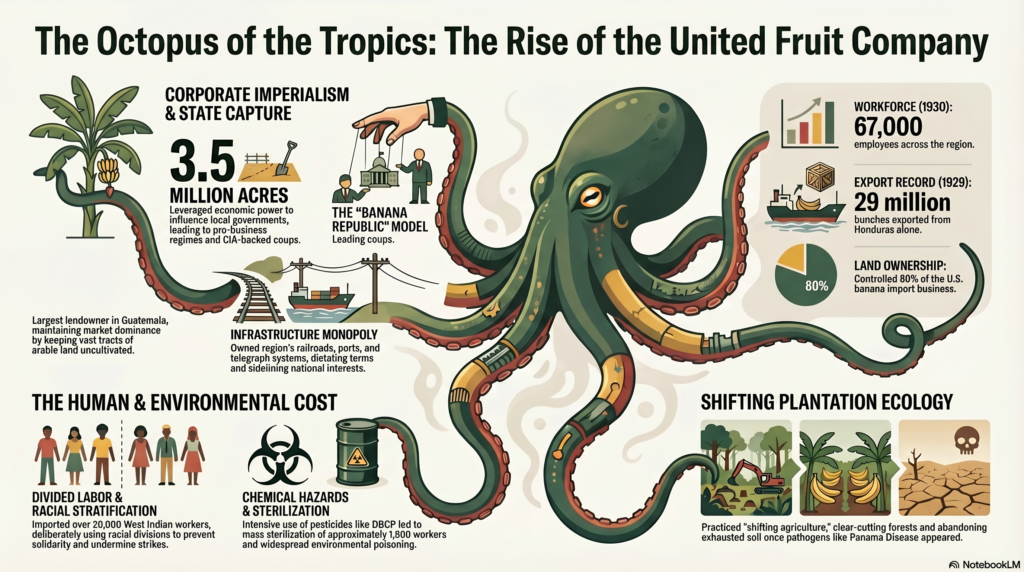
The Great Banana Strike of 1934 ran from August 4 to August 28. It involved more than thirty separate unions and something like a hundred thousand workers across the Costa Rican plantations. It was the largest labor action Central America had ever seen.
United Fruit agreed to a settlement on August 28, branded the strike a communist insurrection in its public relations, and then quietly failed to honor the settlement. It took another four years of fighting to pry a collective agreement out of the company in 1938.
But the more consequential fallout came in the contract the Costa Rican government signed with United Fruit in December 1934, as part of the arrangement to move the bulk of the company’s operations over to the Pacific coast, where the soil was still fresh and the workers had not yet organized.
That contract contained a clause. It explicitly forbade people of colour from working at or moving to the new Pacific plantations.
The company, which had imported twenty thousand people to harvest its fruit, agreed to it instantly. The West Indians were no longer useful. They had started asking for more money, and the Pacific side would be cheaper to staff with local Hispanic labor that had not yet organized.
From 1935 onward, Black Costa Ricans were barred from many public parks. English-language schools were closed. Citizenship was withheld even from West Indians born in the country. The community the company had built and then discarded was written out of the national story.
This is probably a good moment to pause and look at what we have.
By the mid-1930s, United Fruit had been running a continent-scale experiment, and the experiment had converged on a repeatable pattern. Build or take over infrastructure that a country needs. Use that infrastructure to lock up the land around it. Vertically integrate the entire value chain so that no outside competitor or regulator has a place to stand. Engineer a dependent workforce and prevent it from organizing by whatever means necessary, up to and including the importation and later the legal abandonment of entire ethnic groups. Own the communication channels so that you, and only you, shape the story about what is happening inside the enclave. And, when any of that becomes politically inconvenient, use your influence with the metropolitan government to make the problem go away.
The last step on that list is the one the company had not yet needed to use at full strength.
That changed in 1954.
The coup
By the early 1950s, the United Fruit Company was the largest landowner in Guatemala.
It owned something like 550,000 acres, or roughly 42 percent of the country’s arable land, and it was using only about fifteen percent of that land. The other eighty-five percent, the vast majority of it, was held idle.
This was partly as a hedge against plant disease, which was starting to ravage the company’s Atlantic operations, and partly as insurance against potential competitors, who could not enter the market if United Fruit was sitting on all the best soil.
This became a problem when Guatemala held democratic elections in 1950 and elected a reformist army colonel named Jacobo Árbenz.
Árbenz was not a communist. He was a nationalist with a common-sense observation. In a country where the majority of the population were landless and lived in poverty, a foreign corporation should not be allowed to leave 85 percent of the country’s best land sitting empty as a business hedge.
His response, passed in 1952 and implemented starting in 1953, was a land reform law called Decree 900. Decree 900 authorized the government to expropriate uncultivated land from large landowners, including domestic Guatemalan elites, and redistribute it to landless farmers.
The key detail, the detail that matters, is that Árbenz was not seizing the land. He was buying it. Decree 900 promised compensation to the landowners, paid in government bonds. And he announced that the price paid for the land would be the same price the landowners had declared on their own tax returns in 1952.
It was a clever move. United Fruit had been dramatically undervaluing its Guatemalan land holdings on its tax filings for years, in order to minimize the taxes it owed to the Guatemalan government. Árbenz called the bluff.
If you say it is only worth this much, he said, I will pay you exactly that much. The government offered United Fruit $627,572 for the expropriated land, because that was what United Fruit had said the land was worth. United Fruit suddenly insisted the land was actually worth $15.8 million, which was a number it had never paid taxes on. The United States State Department took up the demand.
At this point, the company made one of the more successful bets in the history of corporate public relations. It hired Edward Bernays.
Bernays is now understood to be the father of modern public relations. He was also Sigmund Freud’s nephew, which is the kind of biographical detail that used to sound random and now seems almost inevitable.
Bernays had, for decades, been working out how to manufacture mass opinion on behalf of corporate clients. He ran a front organization for United Fruit called the Middle America Information Bureau, founded in 1943, which quietly fed “background information” on Guatemala to something like twenty-five thousand American journalists. He sent a weekly Guatemala Newsletter to two hundred and fifty working reporters.
In January 1952 he flew a cohort of prominent American journalists, including a New York Times reporter named Will Lissner and the columnist Walter Winchell, on an all-expenses-paid junket to Guatemala, where Bernays controlled what they saw and whom they spoke to.
The narrative Bernays manufactured, in that moment, was the most useful narrative available in the early 1950s: communism.
The Korean War was underway. Senator McCarthy was in full cry. The American public had been trained, through years of cultural priming, to respond to the word “communist” the way a Pavlov’s dog responds to a bell.
Bernays framed Árbenz’s modest land reform law not as a national development project, which it was, but as a Soviet beachhead in the Western Hemisphere, which it was not. Major American publications including the New York Times, the New York Herald Tribune, Time, Newsweek, and the Atlantic Monthly picked up the framing. The story that Guatemala, a Catholic country with a reformist colonel for a president, was falling to Moscow reached the American public as established fact.
United Fruit had also, as a matter of long-standing corporate relationships, been a client for decades of the New York law firm Sullivan & Cromwell.
Sullivan & Cromwell’s senior partner for much of that period was John Foster Dulles, who personally negotiated major United Fruit land concessions in Central America during the 1930s. His brother Allen had also worked at the firm and had documented financial ties to United Fruit of his own.
In January 1953, John Foster Dulles became the United States Secretary of State. His brother Allen became the Director of the Central Intelligence Agency. Neither disclosed the full extent of the relationship when the Guatemala question came across their desks.
The Secretary of State and the Director of the CIA, looking at the Bernays-shaped public opinion in American newspapers, decided that Guatemala was a national security problem. (are we clearly seeing the modern parrallel yet???)
The operation authorized by President Eisenhower in early 1954 was called Operation PBSUCCESS, and it is worth a short paragraph in any honest account of American twentieth-century history.
The CIA did not send troops into Guatemala. The CIA sent radio transmitters. A clandestine broadcasting operation called Radio Liberación launched on May 1, 1954, beaming signals into Guatemala from a station in Opa-locka, Florida. The broadcasts described, in dramatic detail, a rebel army of five thousand men marching on the capital. The actual invasion force the CIA had backed was fewer than two hundred Guatemalan exiles. American pilots bombed empty fields to create the impression of a military campaign. The Guatemalan army, hearing what it believed to be overwhelming American-backed force approaching and seeing no reliable signal that the story was fake, lost confidence in the president. Árbenz resigned on June 27 and fled the country.
The military dictatorship that replaced him reversed Decree 900 almost immediately. The expropriated land was handed back to United Fruit.
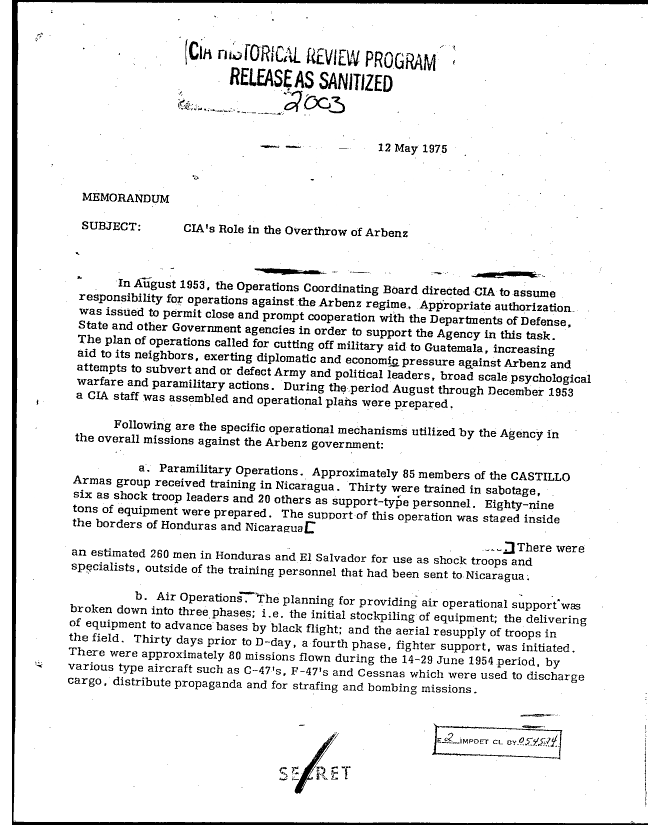
What came after is a fact that most Americans will live and die without ever knowing, and should know.
Guatemala did not go back to normal. Guatemala plunged into a sequence of military regimes and a civil war that ran, depending on how you count, from 1960 or 1962 until the peace accords of 1996.
When the war ended, the United Nations-backed Commission for Historical Clarification documented more than two hundred thousand people killed or disappeared. Eighty-three percent of the identified victims were indigenous Maya. The Guatemalan army destroyed six hundred and twenty-six villages. One and a half million people were displaced inside the country. More than a hundred and fifty thousand fled as refugees to Mexico. The Commission concluded that the Guatemalan state, over the course of the war, had committed acts of genocide against its own Mayan population. Ninety-three percent of the documented human rights violations were attributed to state forces and their paramilitary allies.
Two hundred thousand people dead and a generation of Maya communities destroyed, in part, because a fruit company wanted to keep its unused land.
What the coup showed, to anyone who was paying close attention, was the last and highest move in the blueprint.
True corporate power, in its most developed form, is not the ability to hire lawyers. It is not the ability to lobby Congress. It is the ability to intertwine your private profits so completely with the geopolitical interests of a superpower that the superpower will overthrow a democracy on your behalf and call it a national security operation.
The monoculture
To understand why United Fruit was so willing to overthrow a government in order to protect 85 percent of its land from being redistributed to poor farmers, you have to understand the plant it was growing.
The banana you eat is not, in any meaningful biological sense, a fruit. It is a genetically cornered plant.
Commercial bananas are triploid. Instead of having two sets of chromosomes they have three, which means the chromosomes cannot pair up properly during reproduction. The plant produces fruit without fertilization. That is what the condition called parthenocarpy refers to. No pollination, no seeds, no sexual reproduction. Those little black dots running down the center of a banana when you cut it in half are the remains of ovules that never developed. A commercial banana is a reproductive dead end.
The way you plant a new banana, therefore, is not by planting a seed. You dig down to the underground stem, called the corm, of an existing banana plant, cut off a piece, and stick it in the ground somewhere else. The new plant grows from the cutting. It is an exact genetic clone of the plant you took it from.
Which means that the variety of banana United Fruit built its entire empire on, a variety called the Gros Michel, was not a population of related plants. It was one plant, replicated millions of times across eight hundred thousand acres.
Every banana in every crate in every cargo hold of every Great White Fleet ship was genetically identical to the banana next to it. It was the largest continuous monoculture in the history of agriculture. Zero genetic variation. One plant, repeated forever.
This is an extraordinary business arrangement, and it has one obvious vulnerability that is visible to anyone who has ever taken a middle school biology class.
In a natural forest, if a pathogen attacks a plant species, some of the plants happen to have a genetic mutation that makes them resistant. They survive. They pass the resistance on. The species adapts. In a monoculture, there is no mutation. If a pathogen figures out how to kill one plant, it has the key to every plant on the continent.
Nature, given enough time, always figures it out.
In this case, nature was a fungus.
Its name is Fusarium oxysporum f. sp. cubense, Race 1. It became known as Panama Disease, because the first outbreak that got anyone’s attention happened in Panama. It works by entering the banana plant through its roots, colonizing the vascular system, and clogging the internal tubes the plant uses to pull water up out of the soil. The plant, sitting in a swamp full of water, dies of thirst.
Once the fungus is in the soil, it cannot be removed. Its dormant cells, called chlamydospores, survive in the ground for decades, immune to every fungicide ever marketed against them. A field infected with Race 1 cannot grow a Race 1-susceptible banana. Ever.
The company’s response to this was, in retrospect, its most revealing single habit. It did not invest in breeding resistant varieties. It did not try to fix the soil. It did not reduce the scale of the monoculture. It ran.

The practice is called shifting plantation agriculture, and it worked like this. When Panama Disease infested a plantation, the company abandoned the plantation. It moved twenty miles down the road into a patch of virgin rainforest, clear-cut the forest, drained the wetlands, built a new railroad spur to the coast, and planted the same Gros Michel clones all over again.
The fungus, in a season or two, would find the new plantation. The company would abandon that plantation and move another twenty miles down the road. For decades, the banana industry tried to outrun Panama Disease by destroying virgin rainforest at a pace the pathogen could not match.
By the 1950s it had stopped working.
The company ran out of accessible rainforest. The Gros Michel was, as a commercial product, functionally extinct. Every American grandparent who complains that bananas used to taste better is, in most cases, not wrong. That banana is gone.
The industry solved this problem the way it solved every other problem. It did not change the model. It found another clone.
The banana you are eating today is almost certainly a variety called the Cavendish. United Fruit initially hated the Cavendish. It had a thinner skin, bruised easily during shipping, and tasted, by most accounts, blander than the Gros Michel. But the Cavendish had one useful property, which was natural genetic resistance to Race 1 Panama Disease. You could plant it directly into infected soil and it grew fine. The company retooled its entire logistics pipeline, invented specialized cardboard boxes and refrigerated shipping, and replanted the global banana supply in Cavendish clones. Today, the Cavendish accounts for roughly half of all bananas grown in the world and over ninety percent of bananas exported to Europe and North America.
The industry replaced one genetic monoculture with another genetic monoculture. It learned nothing. It just found a new clone.
This is the moment where I have to stop and say the obvious thing out loud.
The corporate model is itself a monoculture. One crop. One supply chain. One mode of extraction, repeated everywhere. The response to failure, in both cases, is identical. Do not fix the underlying vulnerability. Find an ecosystem that has not yet been exhausted. Replicate.
When bananas fail, the company slash-and-burns its way to new rainforest. When a plantation workforce organizes, the company slash-and-burns its way to a new workforce that has not yet organized. When a country’s courts get ambitious, the company slash-and-burns its way to a country whose courts are more cooperative. The biological monoculture and the corporate monoculture are not analogies to each other. They are the same structure, in different materials.
There is a chemical footnote to the monoculture story that is worth knowing, because it shows up on the counter.
Because the Cavendish is a clone, and because a monoculture has no natural resistance, the Cavendish can only be kept alive through relentless chemical intervention. Synthetic fertilizers. Herbicides. Insecticides. Fungicides sprayed from airplanes up to forty times a year. And in the 1970s, the industry’s solution to a microscopic worm, called a nematode, that was eating the roots of banana plants, was a chemical called DBCP, short for 1,2-dibromo-3-chloropropane.
Roughly fifteen hundred Costa Rican plantation workers were exposed to DBCP, and nearly all of them became permanently sterile. The chemical destroyed their capacity to father children.
The chemical’s manufacturers, Dow and Shell, had internal toxicology data going back years that showed severe reproductive hazards in mammals. The data was concealed. Workers were handed the chemical, told to inject it into the soil, and given no meaningful protective equipment and no warnings. DBCP was banned in the United States in 1977, but American manufacturers continued to sell it in Central America for years after. Fifteen hundred men were permanently unable to have children, and their families were permanently wrecked, so that a grocery store in Ohio could have a perfect yellow banana at fifty-nine cents a pound.
This is the idea I keep circling, and it is the idea the price hides. A cheap banana is not actually cheap. The cost does not disappear. The cost is offloaded. It is paid by environmental destruction in the tropics, by the bodies of workers in the global south, by the violent histories of the countries the fruit is grown in. It is just paid somewhere else, somewhere you cannot see from the checkout counter.
The rebrand
The United Fruit Company does not exist anymore, and that is not an accident either.
In 1970, United Fruit merged with an American meatpacking holding company called AMK Corporation and became United Brands. In 1984, a Cincinnati financier named Carl Lindner Jr. took over and renamed the whole thing Chiquita Brands International. The name was the old marketing mascot, Miss Chiquita, a cartoon woman with a basket of fruit on her head. Light blue sticker. Bright smile. Friendly, harmless, entirely disconnected from the blood in the soil.
Underneath the sticker, the business kept doing what it had always done.
In the late 1990s and the early 2000s, Chiquita’s Colombian subsidiary, a company called Banadex, operated plantations in the banana regions of the department of Antioquia. Colombia at that time was in the middle of a long, horrific civil conflict involving left-wing guerrilla groups like the FARC and ELN and, by the mid-1990s, a sprawling right-wing paramilitary umbrella organization called the AUC, the United Self-Defense Forces of Colombia.
The AUC committed massacres. It tortured. It disappeared people. Its specific targets included trade union leaders, human rights workers, indigenous advocates, and political opponents. It was a death squad that operated, in practice, as private security for wealthy landowners and corporations, clearing the countryside of anyone who might organize labor or advocate for land reform.
On September 10, 2001, the United States government formally designated the AUC a Foreign Terrorist Organization. As of that date, it became a federal crime for any American corporation to engage in any financial transaction with the group.
Between 1997 and early 2004, Chiquita made more than a hundred payments to the AUC, totaling over $1.7 million. The payments continued for more than two and a half years after the terrorist designation. They were written down in Chiquita’s corporate books as “security services” and “security payments.” The Department of Justice’s factual proffer, filed in federal court when Chiquita later pleaded guilty, established that no actual security services were received in exchange. The payments funded AUC operations. Those operations suppressed labor organizing in the banana region.
In 2007, Chiquita pleaded guilty in federal court in Washington, D.C., to engaging in transactions with a designated terrorist organization. It paid a $25 million criminal fine. The fine went to the United States Treasury. The families of the Colombians killed during the period Chiquita was writing checks got nothing.
But the families did not stop. Represented by a group called EarthRights International and a handful of other human rights organizations, the victims’ families filed a series of civil suits in the United States using an old and strange legal tool called the Alien Tort Statute, a law that has existed in more or less its current form since 1789. The Alien Tort Statute allows foreign nationals to sue in American courts for human rights violations committed abroad, provided the defendant is sufficiently present in the United States.
For seventeen years, Chiquita fought the cases. Motions to dismiss. Appeals on jurisdiction. Arguments that no American court had the right to hear the claims. The company’s primary substantive defense, when it came to the substance, was a technicality about causation. Yes, it said, we gave the AUC millions of dollars. No, you cannot prove that a specific dollar paid for a specific bullet that killed a specific person, in a civil war with thousands of armed actors. We cannot be held civilly liable for the violence they committed.
On June 10, 2024, a federal jury in West Palm Beach, Florida, rejected the defense. After weeks of testimony, the jury found Chiquita civilly liable for the murders of eight of the nine victims whose cases were before the court. It awarded the families $38,300,000 in damages.
It was the first time in history a United States jury had held a major American multinational civilly liable for human rights abuses committed by a foreign paramilitary group that the corporation had financed. The jury specifically concluded that Chiquita had “knowingly provided substantial assistance” to the AUC, rejecting the extortion defense entirely.
In October 2024, the presiding judge denied Chiquita’s motion to reduce the damages and entered full judgment. Chiquita has appealed to the Eleventh Circuit, and the appeal is likely to take two years. Thousands of additional plaintiffs wait behind the first bellwether case for trials of their own.
Then, in July 2025, the story moved again, this time not in a Florida courthouse but in a Colombian one. A court in the department of Antioquia handed down criminal convictions against seven former Chiquita and Banadex executives, including two American nationals named Charles Dennis Keiser, who had directed Chiquita’s Colombia operations from 1990 to 2000, and John Paul Olivo, the controller for Banadex and Chiquita’s North American operations from 1996 to 2001. The sentence was eleven years and three months in prison, plus a collective fine of thirteen point eight billion Colombian pesos, roughly three and a half million dollars. Arrest orders were issued immediately. It was the first time, in the entire history of the banana industry, that the human architects of the paramilitary relationship had been criminally sentenced.
It is a remarkable moment. It is also worth being very careful about calling it a reckoning.
A $38 million verdict against a global fruit company is a rounding error. The $25 million criminal fine in 2007 went to the United States Treasury and never reached the victims. The July 2025 Colombian convictions, historic as they are, involve two American nationals who are currently on American soil, where extradition is a long and uncertain process, and whose sentences will, at best, punish a handful of managers for a set of decisions that the company itself, in the aggregate, is clearly designed to keep making.
The banana trade continues. Chiquita still buys, ships, and sells bananas. The supply chain it sits on top of still operates. If Chiquita itself were to collapse tomorrow, another multinational would buy the structure and the supply chain would keep running.
The blueprint is durable in a way that the companies that implement it are not. United Fruit did not die. It molted. United Brands. Then Chiquita. Whatever comes next will have different lawyers and a different sticker and the same operating model.
The fungus comes back
The other thing the industry does not want you to notice is that it is, right now, watching Panama Disease play out again in real time, and is responding to it exactly the way it responded the first time.
The current pathogen is called Tropical Race 4, or TR4. It is another strain of the same family of Fusarium fungus that killed the Gros Michel. TR4 was first identified in Southeast Asia in the 1960s. For decades it stayed in the Eastern Hemisphere. That is no longer true.
TR4 was confirmed in Colombia in 2019, in Peru in 2021. Venezuela declared a national phytosanitary emergency over TR4 in 2023. Peru’s agricultural health authority eradicated more than four hundred separate outbreaks in the early months of 2024 alone.
As of 2024, TR4 had spread to roughly twenty-three countries. In September 2025, the fungus was officially confirmed in Ecuador, the largest banana exporting country on Earth, which by itself accounts for about one third of the global banana trade.
There is no cure. There is no fungicide that works on it. The current response, when TR4 is found in a field, is to burn the field. The chlamydospores, as in the case of Race 1, live in the ground afterward for decades.
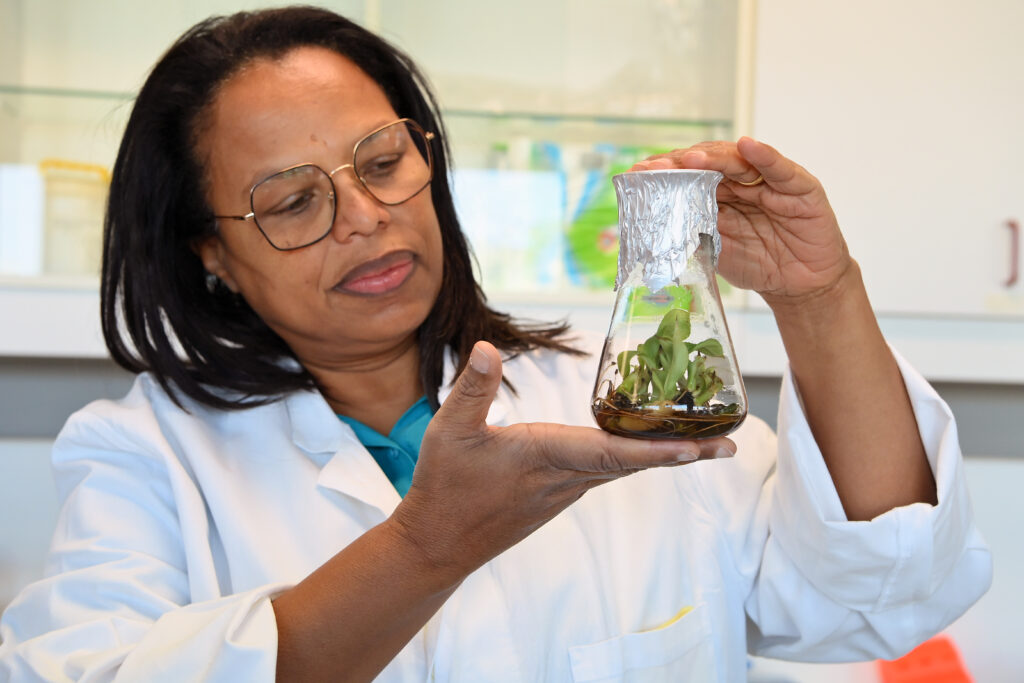
And the thing that is spreading TR4 the fastest, the mechanism by which it is leaping from continent to continent, is the supply chain itself.
TR4 travels on the soil clinging to a worker’s boots, to a tractor tire, to a shared irrigation pipe, to the underside of a shipping container. The global logistics infrastructure that Minor Keith and Andrew Preston built out of a coffee railroad and a Boston steamship company, the infrastructure that made the modern banana possible, is now the infrastructure that is delivering the pathogen that may end the modern banana.
The industry’s single largest vulnerability is a direct consequence of the structural choice it made a century ago to substitute scale for diversity. The industry’s response, at this moment in 2026, is to continue planting Cavendish monocultures and hope that the next clone is found before the current one collapses.
On the labor side, the picture is equally familiar. The most recent field research on Ecuadorian banana plantations, published in 2024 and surveying workers at 140 plantations in the province of El Oro, found that the national minimum wage for agricultural workers is about $460 a month, that workers report routine violations of basic labor standards, that paid holidays and social security enrollment are frequently absent, and that workers who attempt to organize are dismissed. In Ecuador’s El Oro province, where most of the country’s export bananas are grown, the documented unionization rate is roughly one percent.
One percent, in the largest banana exporter in the world, ninety years after the Great Banana Strike of 1934, in a country whose neighbors have spent a century litigating the legacy of the industry it runs on.
The banana on your counter, as of this writing, still costs somewhere around sixty cents a pound. That has not meaningfully changed in years. Nothing that has happened in the last hundred and fifty years, and nothing that is currently happening in Ecuador or Colombia or the soil of an infected plantation, is visible in the price.
The point is not that we should feel terrible every time we eat a banana. The point is that the price is a lie, and it is a specific and engineered kind of lie, and the engineering is the point I’ve been trying to make through this whole article.
The blueprint runs everywhere now
If the only story here were the banana, it would still be worth knowing. But it is not the only story here, and this is the part where, if you have been reading carefully, you probably already see the shape of what is coming.
The United Fruit Company figured out how to do six specific things in sequence, and those six things, performed in that order, constitute a repeatable method for how a corporation can replace a state without ever bothering to declare itself one.
Extract a concession on the infrastructure the country depends on. Use the infrastructure concession to lock up the land and the resources around it. Integrate vertically so that no outside competitor or regulator has a place to stand. Engineer labor dependency, and suppress any attempt at solidarity with whatever tools are handy, from racial segregation to the importation and later the abandonment of entire ethnic groups. Control the flow of information so that the outside world sees only the version of events you authorize. And, when any of the above is threatened, align your corporate interests so tightly with the foreign policy of a larger power that the larger power intervenes on your behalf and calls it the national interest.
Every one of those steps, without exception, is operating in the world right now. In many cases, in the same literal form.
The most direct modern example is a port in southern Sri Lanka called Hambantota. It was financed and built beginning in the 2000s with Chinese state loans as part of the Belt and Road Initiative. Sri Lanka, facing acute pressure on its foreign currency reserves, entered a renegotiation with China. The resulting agreement was signed on July 29, 2017, and under its terms, China Merchants Port Holdings received a ninety-nine year lease on the Hambantota port and a controlling equity stake in it.
A ninety-nine year lease. The lease Minor Keith got on the Limón railroad in 1884 was also a ninety-nine year lease. The structural similarity is not an accident. Sri Lanka’s government chose a lease-and-equity deal because it needed foreign exchange, and China was in a position to offer it. That is precisely the position Minor Keith was in when he sailed to London in 1882.
Amazon, on the American side, has received something in the neighborhood of $4.25 billion in various local and state subsidies for its fulfillment and distribution centers. North Andover, Massachusetts, kicked in $27 million for a single warehouse. Glenwillow, Ohio, granted a distribution center property-tax reductions of nearly half for fifteen years. The subsidies are pitched as economic development. The research, when it is done, suggests that the counties that host Amazon fulfillment centers do not, in fact, see broad economic growth; they spend roughly $43k in public money per job created. Not an economic engine for the community. An enclave that ships value out.
On the resource monopoly side, consider cobalt. Cobalt is essential for the batteries in your phone, your laptop, your electric car. Roughly 70% of the world’s cobalt comes out of one country, the Democratic Republic of the Congo. The vast majority of the DRC’s cobalt production, in turn, is controlled by three foreign corporations, principally the Chinese firm CMOC and the Swiss firm Glencore. The refining capacity that turns raw cobalt into battery-grade material is dominated by China. The supply chain between a Congolese mine and your phone is deliberately fragmented across intermediaries, refiners, and manufacturers, in a way that obscures the origin of any given gram of cobalt and fragments the legal responsibility for how it was extracted.
That is the same structural logic as UFCO’s railroad network that skipped over local towns, just digitized. The supply chain is designed to make the extraction invisible.
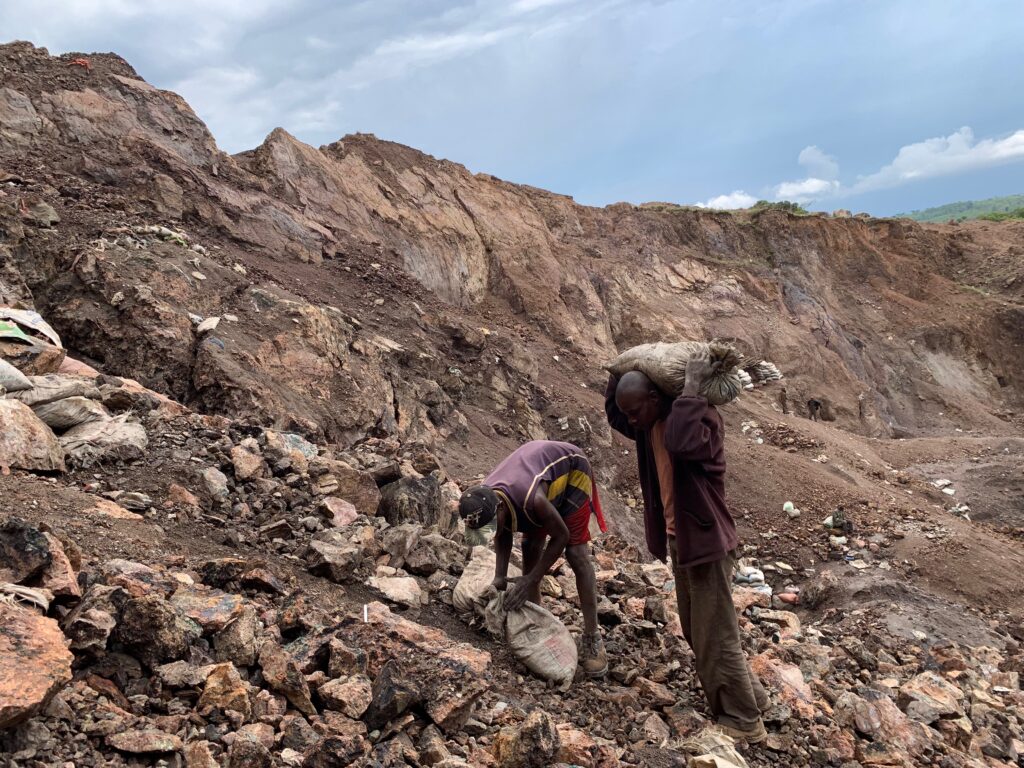
Revenue from mineral exports makes up a large portion of the Democratic Republic of Congo’s economy. While Congo is very rich in mineral resources, these deposits require extensive manual labor to extract, often under life-threatening conditions. Mining of cobalt is tied to human rights abuses, such as unsafe worksites, child labor, and forced Congolese labor, in addition to environmental degradation. [The International Institute for Environment and Development]
At the production-enclave level, consider Foxconn’s plant in Zhengzhou, China, known informally as iPhone City. The facility covers 5.6 square kilometers, about a tenth of the size of Manhattan. At full capacity it employs around two hundred thousand workers, who live in company dormitories, eat in company cafeterias, and produce, by most estimates, about half of the world’s iPhones. Wages at Foxconn average in the range of $1 to $2 an hour including overtime. Fifty-hour weeks and twelve-hour shifts are typical. In peak production periods, fourteen-hour days, seven days a week, have been documented by workers and labor researchers. The company has, for more than a decade, been shadowed by a series of worker suicides. The structure, from orbit, is a company town. The same structure the United Fruit Company ran in 1920s Limón, with better electronics.
On the information control side, the mechanism is no longer a telegraph cable. It is an algorithm. Meta, the parent company of Facebook and Instagram, changed its algorithm in 2018 to deprioritize news content in favor of content from friends and family. Between 2021 and 2024, user engagement with news on Facebook dropped by roughly 78%. In 2023, in response to a Canadian law called the Online News Act, which required platforms to pay publishers for hosting their content, Meta pulled news entirely from its Canadian platforms and, as of late 2025, had not restored it. A corporation that operates the primary means by which a majority of citizens in several countries receive information about current events can, and does, unilaterally decide how much news its users will see.
The analogue, for Americans, is United Fruit’s Tropical Radio and Telegraph Company, which in the 1920s owned every wire by which news left Central America. Today the cables are digital, and the cables are owned by three or four corporations.
On the political capture side, the revolving door is now public record. The firm Palantir, which holds billion-dollar contracts with the Department of Defense and more than two hundred million dollars in ICE contracts, has systematically hired former senior officials from the Pentagon office responsible for integrating commercial technology into military operations.
Specific individuals are publicly traceable. Greg Little, one of the first officials to run the Pentagon’s Chief Data and AI Office, joined Palantir as a senior counselor in August 2023. David Spirk, who was the Pentagon’s chief data officer, joined Palantir as a senior counselor in July 2022.
Big Tech as a whole spent more than $100 million on federal lobbying in 2025, the first time the industry crossed that threshold, with Meta alone spending over $26 million. Amazon, Meta, Google, and Microsoft each gave a million dollars to the inaugural committee of the current administration.
Amazon Web Services, meanwhile, has for more than a decade been the primary cloud infrastructure provider to the United States federal government. It runs the classified infrastructure used by the Central Intelligence Agency.
In December 2022, Amazon was one of four companies awarded shares of the Pentagon’s Joint Warfighting Cloud Capability contract, worth up to nine billion dollars through 2028. The Pentagon, at this point, could not easily switch cloud providers. Doing so would require rebuilding, from the ground up, the computing layer of significant portions of the American military. That is not a relationship of vendor and client. That is, by the functional definition, infrastructure dependency.
John Foster Dulles, in 1954, felt the need to hide his United Fruit stock holdings. His modern counterparts file quarterly disclosure forms, and nobody has to overthrow a country for their interests to be served, because the interests are already, legally, part of how the state operates.
El pulpo did not die. It digitized.
What is on your counter
After a long article, it is worth coming back to where we started, which is the banana itself.
That banana is fifty cents, or sixty cents, or maybe seventy cents a pound. It is the cheapest piece of produce in the store. It has been the cheapest piece of produce in the store for most of your life, and for most of your parents’ lives, and for most of your grandparents’ lives.
It did not become cheap because the industry figured out how to produce it more efficiently. It became cheap because the industry figured out how to offload the cost onto people who could not fight back.
A railroad in a swamp paid for in four thousand lives. A civil war in Guatemala paid for with two hundred thousand lives. A labor force in Limón raised up and then legally abandoned. Fifteen hundred men in Costa Rica whose children were never born. A decade of payments to a death squad in Colombia. An industry-wide monoculture that is now watching a second extinction play out in real time because it could not stand to rethink the model.
That is what is on your counter. Not produce. A receipt. A blueprint.
And the receipt is not only for the banana. That is the point I’ve been working my way toward in this article.
The receipt, if you read it carefully, is for a pattern, and the pattern is everywhere, and the pattern did not stop when United Fruit became Chiquita or when Chiquita lost in federal court.
The pattern lives in Sri Lankan ports and Congolese mines and Chinese factory cities and American warehouses and Pentagon data centers. It lives in the boxes it is not visible from.
When you can see the pattern, you cannot stop seeing it. You start to notice, for instance, that the question “who owns the infrastructure between me and the thing I need” is not an abstract question in a policy paper. It is the question. It has been the question, in one form or another, since 1884 (and longer, really).
There is a useful way to hold all of this, and it is the thing I want you to walk out of this article carrying.
We are accustomed to thinking about power as something that wears a uniform and carries a flag. We think about elections. We think about armies. We think about the big, visible organs of the state. Those things are still real, and they still matter.
But what a banana company learned, and what every corporation that learned from it has since refined, is that the deepest form of power does not have to wear a uniform. It does not have to pass a law. It just has to own the road and the port and the wire.
When you own the road and the port and the wire, the government on paper continues to exist, and the sovereignty on paper continues to exist, and the citizenship on paper continues to exist, and all of those things become a little bit thinner than they were before. Not by much, at first. Over a century, by a lot.
The banana on your counter is not a metaphor for this. It is the oldest running example of it.
If the article ends with a question, which is the form I usually take with these, the question would be this: What kind of country, what kind of citizenship, what kind of life is actually available to a person when the critical infrastructure of their country, the logistics and the communication and the computing and the food, is owned by a handful of private entities whose legal obligations are to their shareholders, and not to them?
This has been the question for a hundred and fifty years.
It is the question Costa Rican’s asked themselves in the 1920s and the Guatemalan farmers asked themselves in 1953 and the West Indian workers in Limón asked themselves in 1935. The answer they got, each time, was written in someone else’s ledger.
The banana is on your counter, whatever you decide to do about it. The history is in the banana. So is the future, if you know where to look.