The Price of Being Alive in America
There is probably an unopened envelope on a counter in your house. You know what’s in it before you open it, which is part of the reason you haven’t.
It is a medical bill, or an electric bill, or a rent notice, or an insurance statement, or a school invoice, or a property tax adjustment. The number inside is bigger than it should be, bigger than it was last year, bigger than the version of you who first signed up for the service was told it would ever be. You will pay it. You will be a little angrier than the last time. You will not, on the day you pay it, do anything else about it. There is no anything else to do.
That envelope is the smallest unit of American politics in 2026.
I want to suggest something that sounds like a complaint but is actually a description. The price of your hospital visit, your apartment, your insulin, your electricity, your child care, and your tuition all rose for the same reason, and the reason is not inflation.
It is that the people who set those prices have captured the institutions that were supposed to check them.
The result is a country that runs on a quiet bargain almost no one would sign if it were written out plainly. Government promises affordability. Government delivers, instead, a stable environment in which the cost of staying alive can be raised every year by the people best positioned to raise it. Then it runs a campaign about how angry you are about prices.
This is not a failure of governance. It is a form of governance.
The system is succeeding. Not at the thing it advertises. At a different thing, which it does not advertise, but which can be reverse-engineered from the results.
If you want to know what a system is for, look at what it produces.
American health care produces the most expensive medical outcomes in the developed world and the highest per-capita administrative overhead, and that is not a bug. It is what you would build if your goal were to keep a hospital sector, an insurance sector, a pharmaceutical sector, and a private equity sector all profitable at the same time, with patient outcomes as a constraint rather than a goal.
American housing produces a permanent shortage in the cities where the jobs are, and that is not a bug either. It is what you would build if your goal were to protect the asset values of the people who already own homes in those cities.
American energy produces electricity prices that rise faster than inflation in a country sitting on more natural gas than it can use, and that is what you would build if your goal were to let utilities earn a guaranteed rate of return on capital expenditure no matter what the capital expenditure was for.
None of this is hidden. The rate cases are public. The zoning hearings are public. The pharmaceutical benefit manager contracts are not public, but their existence is. The capture is on the record. It is just not on the news.
Here is the part that I think matters most, and the part I have not yet figured out how to say without sounding like I’m scolding someone, which I am not. Both parties run on affordability. Both parties have run on affordability in every election I have been alive for. And in the period during which both parties have been running on affordability, the share of household income going to housing, health care, child care, and education has gone up, not down.
That is not a coincidence and it is not a mystery. It is what happens when the price-setters and the rule-writers are the same people, and when the rule-writers’ campaigns are funded by the price-setters, and when the voters’ only available response to the resulting prices is to vote for the next round of the same people.
Gallup found in February that twenty-nine percent of Americans named government and political leadership as the most important problem facing the country, the largest single block of responses and the continuation of a pattern that has held for most months since the current administration took office. That is not a number about ideology. It is a number about exhaustion.
Pew found a few months later that the issues Americans say they care most about cluster tightly around the same theme: money in politics, the affordability of health care, inflation, partisan dysfunction, and the federal deficit. You can read those numbers as five issues, or you can read them as one. I read them as one.
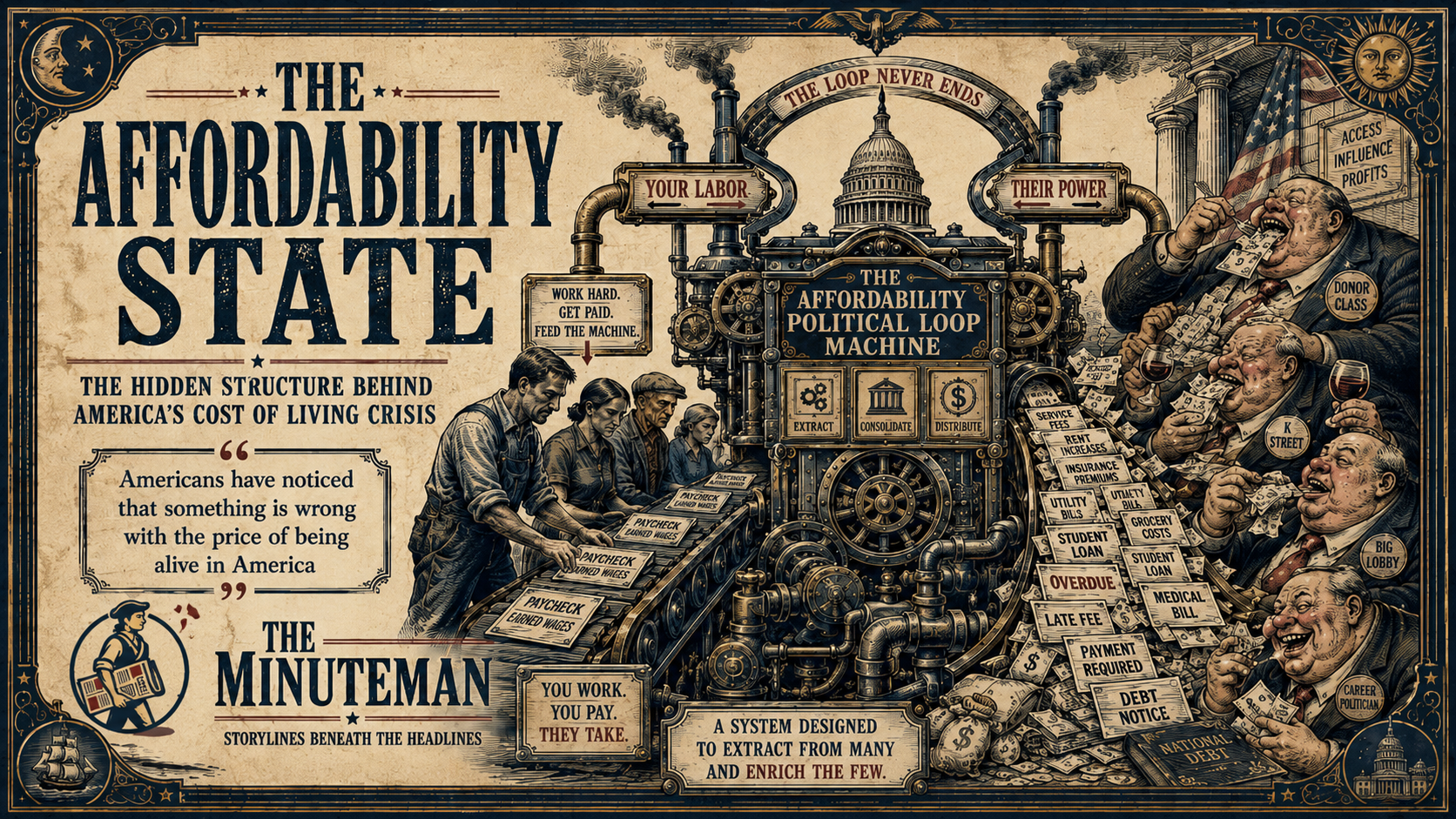
Americans have noticed that something is wrong with the price of being alive in America, and they have noticed, separately, that something is wrong with the institutions that were supposed to address it, and they have not yet been given the language to connect the two noticings.
Call it the affordability state.
A country in which the formal job of government is to deliver services and the actual job of government is to absorb the cost of protecting whoever already has market position.
The affordability state is not a conspiracy. It does not require a meeting. It requires only that the people who run the relevant committees, who write the relevant regulations, who sit on the relevant boards, and who fund the relevant campaigns share a set of incentives that point in the same direction. They do.
The direction is: prices go up, supply stays scarce, the people who already own the assets keep owning them, and the public is told that the resulting hardship is a story about inflation, or immigration, or technology, or the other party, or the cost of doing business in a complicated world.
It is a story about who is allowed to charge whom how much for what, and who writes the rules that say so.
Consider what an affordability state looks like in practice.
Hospital consolidation has produced markets in which one or two systems control most of the inpatient capacity in a region, and those systems negotiate prices with insurers that pass the cost through to employers who pass it through to workers in the form of lower wages and higher premiums. That is not a market failure. It is a market succeeding at what it has been allowed to become.
Pharmacy benefit managers, which were introduced as middlemen to bring drug prices down, now sit between drug companies and patients in a way that has made drug prices higher, not lower, because the three large PBMs and the insurance companies that own them have an interest in higher list prices that generate larger rebates that they capture and do not pass on. The FTC, after a multi-year investigation, found that the three largest PBMs marked up specialty generic drugs by hundreds and thousands of percent and generated over seven billion dollars in excess revenue from 2017 to 2022.
Local zoning boards in productive metropolitan areas vote down apartment construction year after year because the people who show up to those meetings are the neighborhood defenders who already own homes in those zones, hold overwhelmingly negative views of new construction relative to their broader communities, and are dramatically overrepresented among the older, wealthier homeowners who set local land-use policy.
Utility commissions approve rate increases because the utilities are the only entities at the hearing with full-time staff, and the consumer advocates who are supposed to counter them operate, on average, with roughly ten percent of the staff and budget of the commissions themselves.
None of these are scandals. That is the point. A scandal is when the system breaks the rules. The affordability state is what the system produces when it follows the rules, because the rules were written by the people who profit from following them.
I want to be careful here, because the obvious next move is to say “and therefore the answer is X,” and I do not think the answer is” X.” I think the answer is a series of things, most of them boring, none of them resolvable in a single news cycle, and almost all of them requiring the rebuilding of capacity inside government that has been deliberately allowed to atrophy.
The affordability state did not happen because of one party or one administration. It happened because, across forty years and both parties, the country chose to let the regulatory state become smaller, slower, and more dependent on the industries it was supposed to regulate, and the industries used the resulting slack to write themselves better deals. That choice was not put to a vote in those terms. If it had been, it would have lost.
The thing called “the cost of living” is not an accident of the economy.
It is the operating budget of the institutions that govern you. Every time a hospital system raises a price, the price funds the system that lobbies for the rules that let the price be raised.
Every time a utility wins a rate case, the resulting revenue funds the regulatory and political apparatus that won the rate case.
Every time a zoning board protects an existing homeowner from new neighbors, the protected asset value funds the next campaign of the next candidate who promises to protect it again.
The cost is the budget. The budget is the cost. The two are the same number, looked at from two ends of the same transaction.
This is the part the standard frame misses. When commentators talk about affordability, they treat the cost of living as an output, a thing the economy produces, a number that goes up or down for reasons. When you treat the cost of living as a budget, as the funding stream for the institutions that set the cost, the politics get sharper, fast.
You start asking different questions. Not “why are prices high,” but “who is being paid by the prices being high, and what are they doing with the money.” Not “why can’t government fix this,” but “which parts of government are funded by the thing not being fixed.”
I do not think most people in those institutions are villains. I think they are people doing their jobs inside a structure that rewards a particular kind of job.
The hospital administrator is not evil for negotiating the highest rate her system can extract. She is evaluated, promoted, and retained on her ability to do exactly that.
The utility executive is not corrupt for filing for the largest rate increase his lawyers think he can win.
The zoning board member is not malevolent for voting the way the neighbors who elected her want her to vote.
The senator is not a hypocrite for taking the donation and writing the carve-out, because the donation and the carve-out are how the senator stays a senator.
The system selects for the behavior. The behavior produces the prices. The prices produce the politics. The politics elect the people who keep the system running.
That is the loop, and the loop is the thing. Not any single villain inside it. Not any single party. The loop is what the affordability state is.
It is self-sustaining, in the technical sense, which is that the outputs feed the inputs. Higher prices generate larger margins which generate larger political contributions which generate more favorable rules which generate higher prices. The loop does not need a steering committee. It needs only that no one with the power to interrupt it has an incentive to interrupt it.
So when both parties promise to lower the cost of living, they are not lying, exactly. They are operating in a system whose first job is to convert that promise into the next campaign. The promise is the product. The delivery of the promise would break the product.
You cannot run on affordability if you have actually delivered affordability, because then the issue is solved, and the donors who were paying for the issue to remain salient are paying for nothing. The political class has a structural interest in keeping the cost of living unresolved. So does the donor class. So, in a strange way, does the media class, which is funded by attention to the unresolved problem.
I am liberal, and I will say plainly that my party has not figured out how to talk about this in a way that is true to the structure.
There is a tendency, on the left, to treat affordability as a problem of mean rich people who must be defeated and replaced with kind rich people. That is not what is happening. The problem is not the personalities. It is the architecture. Replacing the personalities without replacing the architecture leaves you with new personalities doing the same things, because the same things are what the architecture pays them to do.
There is also a tendency, on the right, to treat affordability as a problem of government being too big, and to propose, as the solution, making it smaller and slower and more dependent on the private sector, which is the condition that produced the affordability state in the first place.
Neither party has the frame. Both parties have the vocabulary, which is not the same thing.
The fight is not between left and right.
It is between the people who pay the bill and the people who write the rules that generate it.
That sentence is going to read to some people as populism, and I want to be clear that I do not mean it that way. Populism, in the current usage, points at a group of villains and proposes their removal. I am not pointing at a group of villains. I am pointing at an architecture. The architecture has people in it. Some of them are villains. Most of them are not. The architecture works the same regardless.
So what would it look like to interrupt the loop? I do not know in full, and I am skeptical of anyone who claims to. But a few things are true that the standard conversation does not allow you to say.
It would require rebuilding the regulatory capacity that was allowed to wither, which is slow, expensive, and politically thankless. It would require funding regulatory agencies enough to hire people who are not waiting for jobs at the firms they regulate, which is the opposite of what every recent budget has done. It would require ending the use of the tax code to subsidize the rents that the affordability state extracts, which means going after categories of deduction and depreciation that have powerful defenders. It would require building public capacity at the state and local level, in zoning, in utilities, in health systems, in the boring infrastructure of who is allowed to do what to whom, because that is the level at which most prices are actually set. It would require Congress to do its job, which is the part I am least optimistic about, because Congress is the institution most thoroughly captured by the loop and the institution with the most power to break it.
None of that is a slogan. That is why it is hard. The affordability state is held in place by the gap between the simplicity of the problem and the complexity of the fix, and by the steady production of simpler-sounding fixes that fail in ways that increase trust in the loop and decrease trust in government as a whole.
Every time a politician promises to lower drug prices and fails, the failure is not just a failure. It is an advertisement for the proposition that government cannot lower drug prices, which is exactly the proposition the affordability state needs the public to believe in order to keep operating.
I want to come back to the envelope.
You are going to open it. You are going to pay what is inside it, or arrange to pay it, or fight a small losing fight about a piece of it that was billed in error, and then pay the rest. You are going to do this in the same week that you read a story about a political fight over the cost of living, and the story is going to be framed as a fight between two parties about whose policies would do more to reduce the number inside the envelope.
You will notice, if you are paying attention, that the number in that envelope has been going up regardless of which party is in power, and you will feel the small private flicker of cynicism that all of us are now expected to feel at exactly that moment, and you will move on, because there is laundry to do.
I am asking you to hold that flicker a beat longer. The flicker is correct. It is not a sign that politics is broken, or that you are jaded, or that nothing matters. It is a sign that you have noticed something true about the structure of the country you live in, which is that the number on the envelope is not an accident, and the political fight about the number is not a fight about the number, and the people who would benefit from the number going down are not at the meetings where the number is set.
That is the affordability state. The next question, the one I want to spend the next year of this newsletter trying to answer, is what we do with the noticing.
The number on the envelope is the budget. The budget belongs to a system. The system can be named. Naming is where the work starts.