

ICE and the Immigration Equation: How Targeted Priorities Can Restore Trust—and Strengthen a Country Built by Newcomers
On December 23, 2025, a very American argument played out in public: Florida’s Catholic bishops urged the White House to pause immigration enforcement over Christmas, describing fear in immigrant communities and calling for compassion; the White House rejected the request.
That tug-of-war—between enforcement and humanity, between “rule of law” and “who counts as our neighbor”—isn’t just a culture-war flashpoint. It’s also a practical question with real economic stakes:
If immigration is one of the country’s biggest long-term advantages, what should Immigration and Customs Enforcement (ICE) actually do to support that advantage—rather than undermine it?
The answer starts with a clearer picture of what ICE is, what it isn’t, and how immigration’s benefits depend on an enforcement system that’s credible, targeted, and fair.

What ICE is (and what it isn’t)
ICE is a federal law-enforcement agency within the Department of Homeland Security (DHS). In broad terms, ICE says its mission is to protect the United States through criminal investigations and immigration enforcement tied to national security and public safety.
ICE is often spoken about as if it “runs immigration,” but the U.S. immigration system is split across agencies:
- USCIS (U.S. Citizenship and Immigration Services) adjudicates many benefits (green cards, naturalization, work authorization, asylum decisions in some processes).
- CBP (Customs and Border Protection) handles border/ports-of-entry enforcement.
- ICE handles interior enforcement and certain criminal investigations related to cross-border crime.
Within ICE, two components matter most:
- ERO (Enforcement and Removal Operations): identifies, arrests, detains, and removes certain noncitizens, and runs alternatives-to-detention programs.
- HSI (Homeland Security Investigations): conducts criminal investigations (think: trafficking, smuggling networks, document fraud, certain financial and cyber-related cross-border crimes).
This distinction is important because the most constructive role ICE can play in a pro-immigration America looks a lot more like smart investigation and targeted enforcement than like indiscriminate dragnet tactics.

[Library of Congress Prints and Photographs Division]
Why immigration is a net strength for the U.S.
America’s immigration debate often gets reduced to a single question: “Is immigration good or bad?” But the more useful question is: good for what, for whom, and over what time frame?
A few big-picture points show why immigration is widely viewed by economists and budget analysts as a major long-term asset:
Immigration grows the workforce in an aging country
The U.S. population is aging. Labor-force growth is harder to sustain when more people retire and fewer working-age people replace them. Analyses from groups like the Migration Policy Institute (drawing on Census and other data) describe immigration as a major driver of labor-force growth in recent decades—and increasingly important going forward.
Immigration increases economic output
The Congressional Budget Office (CBO) has estimated that recent higher immigration would increase the size of the labor force and boost GDP materially over the coming decade in its projections.
The fiscal picture is complicated—but NOT “immigrants are drains”
The National Academies’ landmark synthesis found that immigration tends to have positive long-run growth effects; fiscal impacts vary by level of government, with costs often concentrated at state/local levels (especially education), while the second generation is among the strongest contributors.
None of this means there are no local pressures (schools, housing, short-term service needs) or no labor-market friction in specific sectors. It does mean that, at the national level, immigration is closely tied to growth, dynamism, and workforce resilience—the boring stuff that makes everything else possible.
Why enforcement exists in a pro-immigration country
A pro-immigration stance doesn’t require pretending borders don’t exist or that laws don’t matter. In fact, the opposite is often true:
Public support for generous legal immigration is easier to sustain when the system is orderly and credible.
Enforcement can serve several legitimate aims:
- Public safety and national security (removing people who pose serious risks; disrupting criminal networks).
- Integrity of legal pathways (deterring fraud, document mills, exploitative recruitment schemes).
- Basic fairness (a predictable system is fairer to people waiting in legal lines and to employers trying to follow rules).
But “enforcement” is not one thing. It’s a bundle of choices: who is prioritized, how arrests are made, how long people are detained, what process they get, and how transparently the government reports outcomes.
Those choices determine whether ICE functions as:
- a stabilizing institution that supports an immigration system people can trust, or
- a fear engine that pushes communities into the shadows and erodes cooperation with law enforcement and civic life.
What ICE actually does, in numbers
ICE’s own FY 2024 annual report (the most recent complete annual report available on ICE’s site) gives a sense of scope:
- ERO administrative arrests: 113,431 (including at-large arrests)
- ERO removals: 271,484 (with a subset having criminal histories, per ICE’s reporting)
- HSI criminal arrests: 32,608
Detention, meanwhile, has become a central point of controversy. Independent tracking using ICE data (TRAC) reported 65,735 people in ICE detention as of November 30, 2025, and that 73.6% had no criminal conviction (not the same as “no criminal history,” but a meaningful distinction in public debate).
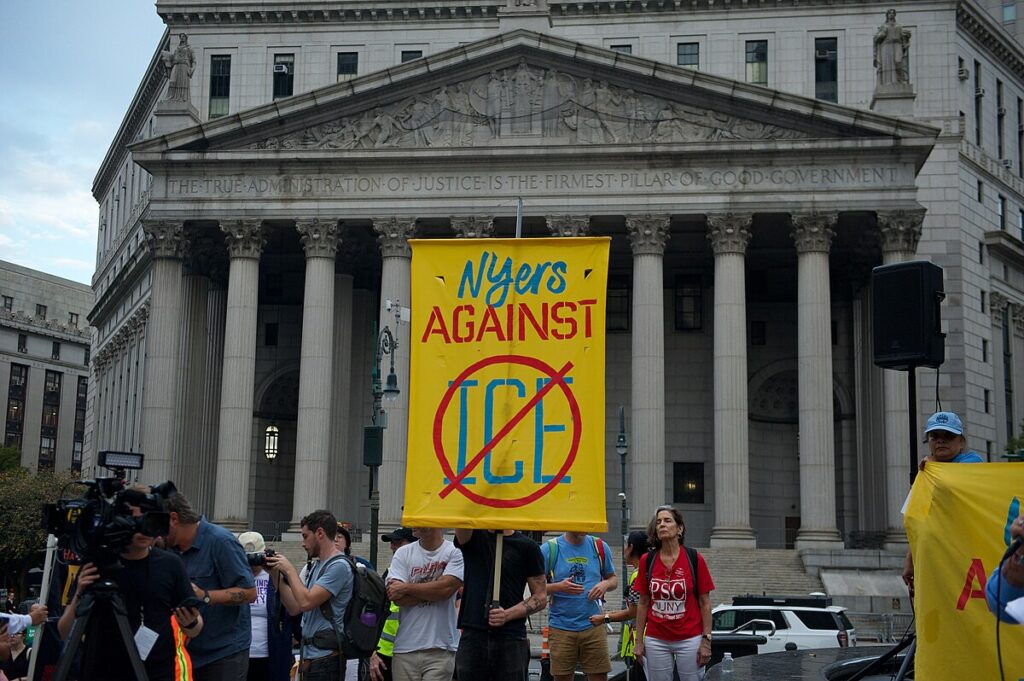
This gap—between “we’re targeting dangerous people” rhetoric and a detention population largely without convictions—is a major reason ICE sits at the center of America’s moral and political conflict over immigration.
The flashpoints: how enforcement choices reshape trust
If you want to understand why ICE is perpetually controversial, look at where enforcement intersects with daily life:
Courthouses, hospitals, and “sensitive locations”
Illinois’ new laws limiting certain civil immigration arrests around courthouses and requiring safeguards in places like hospitals and universities triggered a federal lawsuit in December 2025. Supporters argue these protections prevent people from avoiding courts and medical care out of fear; opponents argue states are obstructing federal enforcement.
This is the pattern: enforcement tactics that feel like deterrence can also function as a public-health and public-safety tax if people stop reporting crimes, cooperating as witnesses, or seeking care.
Immigration court and fast-track removal
Reuters reported that the administration is pursuing dismissals of some asylum cases in immigration court, potentially channeling people into faster deportation processes and removals to third countries.
To the average person, this sounds procedural. In practice, procedure is the point: immigration enforcement isn’t just who gets removed—it’s what process stands between a person and removal, and how much error the system is willing to tolerate.
Spectacle and messaging
The Washington Post reported on ICE’s use of social-media-style raid content and internal communications around viralizing operations—raising questions about whether enforcement is being used as political theater rather than a narrowly tailored public-safety tool.
Whatever one thinks of enforcement levels, “enforcement as performance” tends to reduce public trust—because it suggests outcomes are being chosen for optics, not effectiveness.
Where ICE can genuinely support a pro-immigration America
If immigration is a national advantage, then the role of enforcement should be to protect the conditions that let immigration work: legality, safety, and social cohesion. That points toward four priorities.
1) Make ERO laser-focused on serious threats, not maximum volume
A system that sweeps up many people with no convictions (again: convictions aren’t the whole story, but they’re a critical signal) fuels a perception that ICE is punishing community presence rather than addressing danger. TRAC’s breakdown shows why this issue has become so central.
A pro-immigration enforcement posture would:
- prioritize terrorism, violent crime, serious repeat offenses, and verified threats,
- use arrest authority proportionally,
- and treat “interior enforcement” as a scalpel, not a net.
2) Put HSI at the center of the “law-and-order” story
If Americans want safety and immigration at the same time, the strongest overlap is criminal investigations: human trafficking, fentanyl and weapons networks, child exploitation, large-scale document fraud, and transnational organized crime.
HSI exists for exactly this reason—and ICE’s own annual reporting shows the scale of HSI criminal arrests relative to other activity.
3) Build credibility through transparency and metrics that matter
One reason the debate is so toxic is that reliable, consistent reporting is often scarce or politicized. ICE does publish dashboards and annual reports, and GAO has evaluated ICE enforcement data over time—this kind of measurement is essential for democratic oversight.
A healthier system would track and publish:
- error rates (wrongful arrests/detainers),
- detention length and outcomes,
- access-to-counsel indicators,
- and whether targeting claims match reality.
4) Reduce fear spillover that undermines civic life
Even some people who favor robust enforcement worry about tactics that deter court attendance, reporting crime, or seeking medical care—because those outcomes weaken communities and can make everyone less safe. The Illinois dispute highlights how sharply this issue divides states and the federal government.
Enforcement that supports immigration’s benefits should minimize collateral fear—especially around institutions people need to function in public life.
The bottom line
Immigration is one of America’s most durable competitive advantages—fueling workforce growth, economic output, and long-run dynamism.
ICE sits inside that equation whether it wants to or not. When ICE focuses on serious threats, criminal networks, fraud, and exploitation, it can strengthen public confidence in a rules-based immigration system—the kind that makes broad legal immigration politically sustainable. When enforcement becomes broad, opaque, or performative, it can fracture trust, chill civic participation, and turn immigration—an asset—into a permanent internal conflict.
A pro-immigration America doesn’t require less enforcement so much as better enforcement: more precise, more transparent, and more aligned with the simple national interest of welcoming newcomers while protecting the public.
How a Surveillance State Gets Built: Palantir, ICE, and Your Private Data
Sanctuary Cities, Federal Power, and the Real Fight Behind the “Ban”