The Wrong Thief
The Country Was Already Being Taken
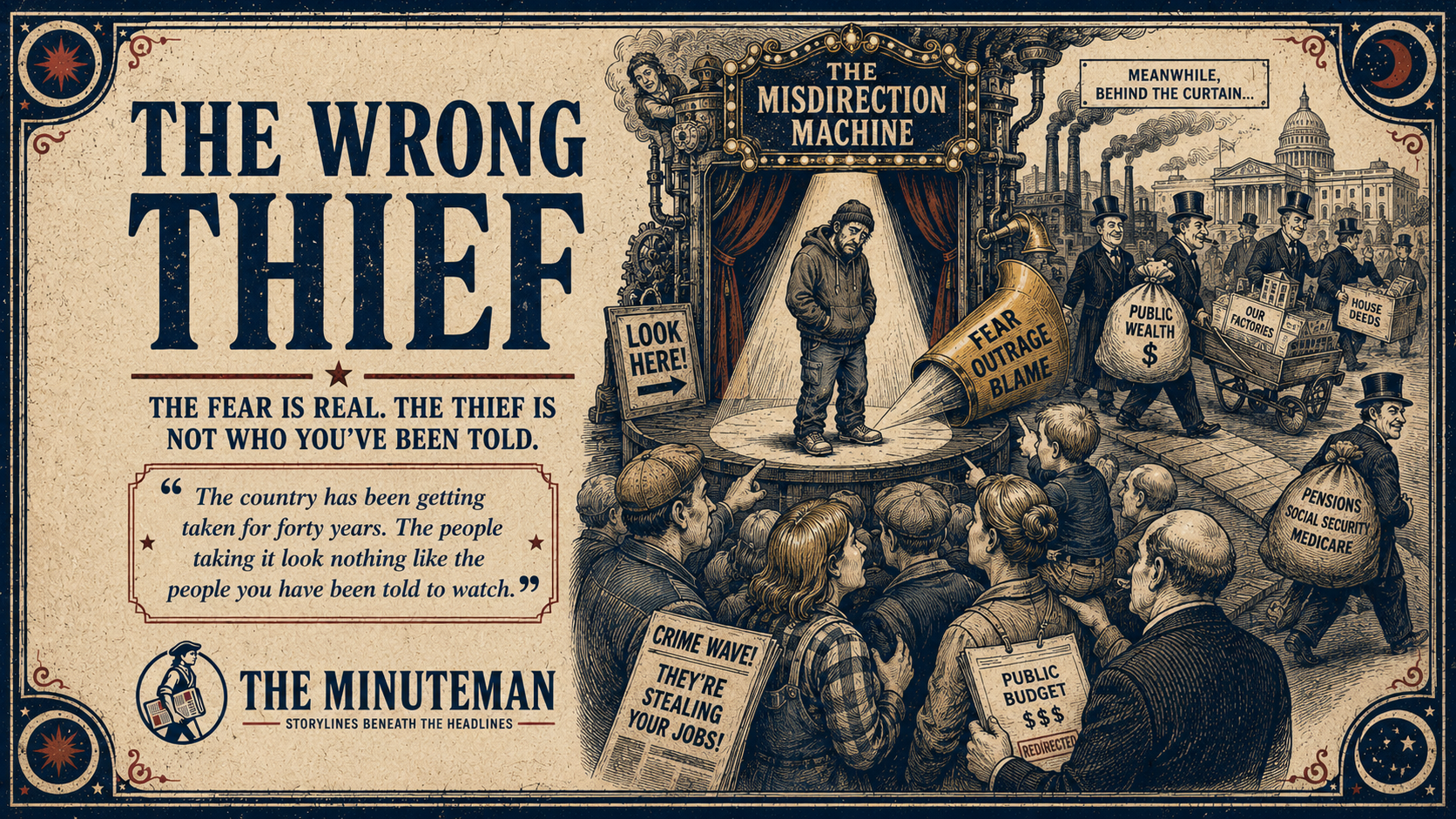
The fear is real. The thief is not who you’ve been told.
This is the economic impact of immigration that the public debate keeps hiding: immigrants are not taking the country from working Americans. They are being used to distract from who already did.
There is a man somewhere in Pennsylvania who is one paycheck from losing the house his grandfather bought outright in 1962.
The grandfather worked in a factory that does not exist anymore. The factory closed because the company that owned it merged with a larger company that merged with a larger company that paid out billions to shareholders and then offshored the line to bring the price of the part down by four cents per unit.
The man does not know any of this. He knows his rent went up. He knows his insurance went up. He knows his grocery bill went up. He knows that when he turns on the television, someone is shouting at him about a caravan.
He is right that something has been taken from him.
He has been handed the wrong thief.
In 1982, employee compensation accounted for 66.6% of American GDP. Corporate profits accounted for 8%.
By the end of 2024, employee compensation had fallen to 61.9% and corporate profits had climbed to 15.85%.
That is not a small adjustment. That is the largest gap between what workers earn and what owners keep since the data has been recorded.
The economist who flagged it called the chart that shows the divergence “the revolution chart.” A friend of hers said the same thing in fewer words. It is the chart that ends with beheadings.
Something is being taken. The fear is not paranoia. The fear is the body registering a fact the news will not name.
The question is who is doing the taking. And the answer, when you actually trace it, is not the family that walked across a desert with two changes of clothes and a phone number written on a piece of paper.
The man in Pennsylvania is being robbed by people who fly.
Consider what the Congressional Budget Office actually projects. Across the 2024 to 2034 window, the recent immigration surge is expected to add $8.9 trillion to American GDP. The same surge is projected to reduce the federal deficit by $900 billion. The labor force in 2033 will be 5.2 million people larger than it would otherwise have been.
The Dallas Fed and the San Francisco Fed have run the numbers from different angles and arrived at the same conclusion. Beginning around 2033, deaths in this country will exceed births. From that point forward, every additional American comes from somewhere else.
Without immigration, the working-age population would have started shrinking in 2012. Hospitals would have closed earlier. Schools would have consolidated faster. Whole towns would have already emptied out.
I think there is something almost embarrassing about how the public conversation skips this.
The numbers are not contested. The Congressional Budget Office is not a left-wing think tank. The Federal Reserve banks of Dallas, San Francisco, Minneapolis, and Kansas City are not advocacy groups. They are running the math the same way an actuary runs the math on a life insurance policy. And the math says the country needs the people. The math says the people are paying in.
The math says the alternative is a slow demographic collapse that no tax policy can patch.
So why doesn’t it land?
Because the man in Pennsylvania is not arguing with the math. The man in Pennsylvania is arguing with a feeling. And the feeling is correct.
He has less than his father had. His father had less than his grandfather had. His son will have less than he has. The chart that the economist called the revolution chart is the shape of that feeling, drawn over forty years.
The feeling is real. The diagnosis was sold to him.
In 1849, a secret society called the Order of the Star-Spangled Banner formed in New York City.
Within a few years it was a national political party, briefly the third-largest in America, holding more than 100 congressional seats and eight governorships. Its members called themselves the American Party. Everyone else called them the Know-Nothings, because when asked what they stood for, they were instructed to say they knew nothing.
What they stood for, in fact, was that Irish and German immigrants, mostly Catholic, mostly poor, were taking the country.
The cartoons of the era depicted the new arrivals as drunken election thieves, hauling barrels of whiskey and stolen ballot boxes. The riots in Philadelphia in 1844 burned two Catholic churches and killed at least fourteen people. By 1855, immigrants outnumbered native-born Americans in Chicago, Detroit, and Milwaukee.
The historian Tyler Anbinder, who wrote the book on the period, points out that the Irish were arriving at ten times their previous rate because they were starving to death at home. The famine had killed a million people. Another million had fled. They came here because the alternative was a coffin.
The Know-Nothings collapsed in 1855, not because their voters changed their minds, but because slavery became a more pressing question than the Pope. The fear they organized never went away. It just waited for the next set of arrivals.
It waited for the Italians. It waited for the Chinese. It waited for the Eastern Europeans. It waited for the Japanese. It waited for the Mexicans. It is still waiting, because the fear is structurally useful, and as long as someone profits from pointing it at the door, someone will keep pointing it at the door.
This is the part of the story that doesn’t get said out loud.
The country has been getting taken for forty years. The people taking it look nothing like the people you have been told to watch.
They look like the executives at the company that closed your grandfather’s factory and used the savings to repurchase its own stock.
They look like the private equity firm that bought your hospital and then cut the maternity ward to improve margins.
They look like the holding company that owns four of the five grocery chains in your county and raised prices in lockstep through three years of cooling inflation.
They look like the landlord who is actually an algorithm operated by a software company that recommends rent increases to thousands of buildings at once.
They look like the lobbyists who wrote the tax code that made labor expensive and equipment deductible.
They look like the donors who funded the campaigns of the politicians who passed the laws that let all of this happen.
I feel that this is the largest political contradiction in the American present, and almost nobody names it.
The movement that has worked itself into a fever about immigration is led, funded, and operated by the same class of people whose policy preferences have produced the wage compression, the housing crisis, the medical debt, and the corporate consolidation that are actually grinding the man in Pennsylvania down.
The immigrant is the substitute. The substitute does not have a lobbyist. The substitute does not own a network. The substitute cannot fight back. The substitute is what you blame when you cannot afford to blame the person who is actually doing it, because the person who is actually doing it owns the building you work in.
The Substitution is what happens when an economic injury is real, the cause is politically protected, and the public is handed a powerless body to blame instead.
And there is a second contradiction inside the first one.
The Minutemen were the border crossers.
The men who fired the first shot at Lexington in 1775 were not defending a border. They were defying a king.
The country that those men founded did not exist yet. There was no America to take. There was an empire, and there were colonists, and the colonists decided that the empire’s authority over them was illegitimate, and they took agency from a tyrant by force.
The Declaration of Independence is the most famous document of unilateral border defiance in modern history. It is a piece of paper in which a group of people inform a distant power that they are no longer governed by it.
They wrote the paper because they were already breaking the law. The paper made the breaking official.
The flag that the modern restrictionist movement waves was designed by people who would not have qualified for a green card in their own country.
The Minutemen the right invokes were not standing guard at a frontier. They were the frontier. They were the people the empire was afraid of.
The empire called them lawless. The empire was correct. They were lawless. That was the point.
Lawful inside the empire’s terms would have been to remain subjects. They refused.
The movement that now claims their name has inverted everything they did.
It calls itself the party of the founders and operates as the party of the king.
It uses the language of independence to defend concentrated power.
It invokes the flag of revolution to oppose the conditions under which revolution becomes thinkable.
The contradiction is so total that it would be funny if it were not currently being used to detain children.
I am not saying the man in Pennsylvania is a fool. I am saying he has been handed a story that explains his pain in a way that protects the people causing his pain. The story is older than him. The story has been told before, in slightly different costumes, every time the actual taking has gotten this bad.
The Know-Nothings told it in 1854. The Chinese Exclusion Act told it in 1882. The Immigration Act of 1924 told it about Italians and Jews and Slavs. The story always works for a while, and it always ends badly, and the people who profited from the story always survive the ending.
What gets remembered backward is what allows the present to keep happening.
If the founding is the founding of a closed country, then closing the country is patriotic. If the founding is the founding of an open one, then closing the country is the betrayal.
The history is unambiguous on which it was.
The colonies were demographically dependent on continuous arrival. The country that wrote the Constitution was 80% rural, mostly immigrant or one generation removed, and structurally hostile to the very idea of a sealed border, which was both impossible to enforce and contrary to the economic interests of the seaboard merchants who needed the labor.
The first federal immigration law of any consequence was not passed until 1882, more than a century after independence. For its first hundred years, the United States operated on something close to an open door, not because its leaders were sentimental, but because the math required it.
The math still requires it.
The man in Pennsylvania needs more neighbors, not fewer. He needs the tax base that comes with population growth. He needs the customers for the small business his daughter might open. He needs the workers who will keep the hospital where his mother is dying from closing its emergency room. He needs the construction crews that might bring the housing supply back into something resembling balance with demand. He needs the agricultural labor without which his grocery bill, already crushing, would double. He needs the demographic floor under his Social Security check.
He is being told that he needs a wall.
I think the fear that has been organized around immigration in this country is one of the most successful political operations of the last half century.
I think it has succeeded because the people running it correctly identified that the man in Pennsylvania feels something has been taken from him, and they correctly identified that he was going to look for somewhere to put the feeling, and they made sure the place he put it was not their door.
I think the people who designed this operation know exactly what they are doing. I think a great many of the people repeating it do not. I think that distinction matters, because the second group is reachable, and the first group is not.
The fight that actually decides whether the man in Pennsylvania keeps his house is not at the border. It is at the IRS. It is in the tax code. It is in the antitrust division of the Justice Department. It is in the labor board. It is in the rules that govern how easily a company can break a union, how quickly capital can be written off, how much medicine can cost when one company owns the patent and the pharmacy and the insurer all at once.
None of that fight has anything to do with the family from Honduras. The family from Honduras is mowing the lawn of the man who is suing to keep wages low. The family from Honduras is not the man’s enemy. The family from Honduras is, in the actuarial sense, the only thing keeping the man’s Social Security check from arriving smaller each year for the rest of his life.
I do not know how to make this land in a country where the loudest voices have a financial interest in keeping it unlanded.
I do not know how to undo forty years of substitution in a single article, or a single election, or a single generation.
I am not sure anyone does.
But I know what the math says. The math says the country is not being taken by the people walking in. The math says the country was taken, slowly and legally, by the people who own it. The math says the fear is real. The math says the diagnosis is wrong.
The Minutemen took agency back from a king.
The grandchildren of the Minutemen are being asked to defend the king.