The Machine That Captured the State
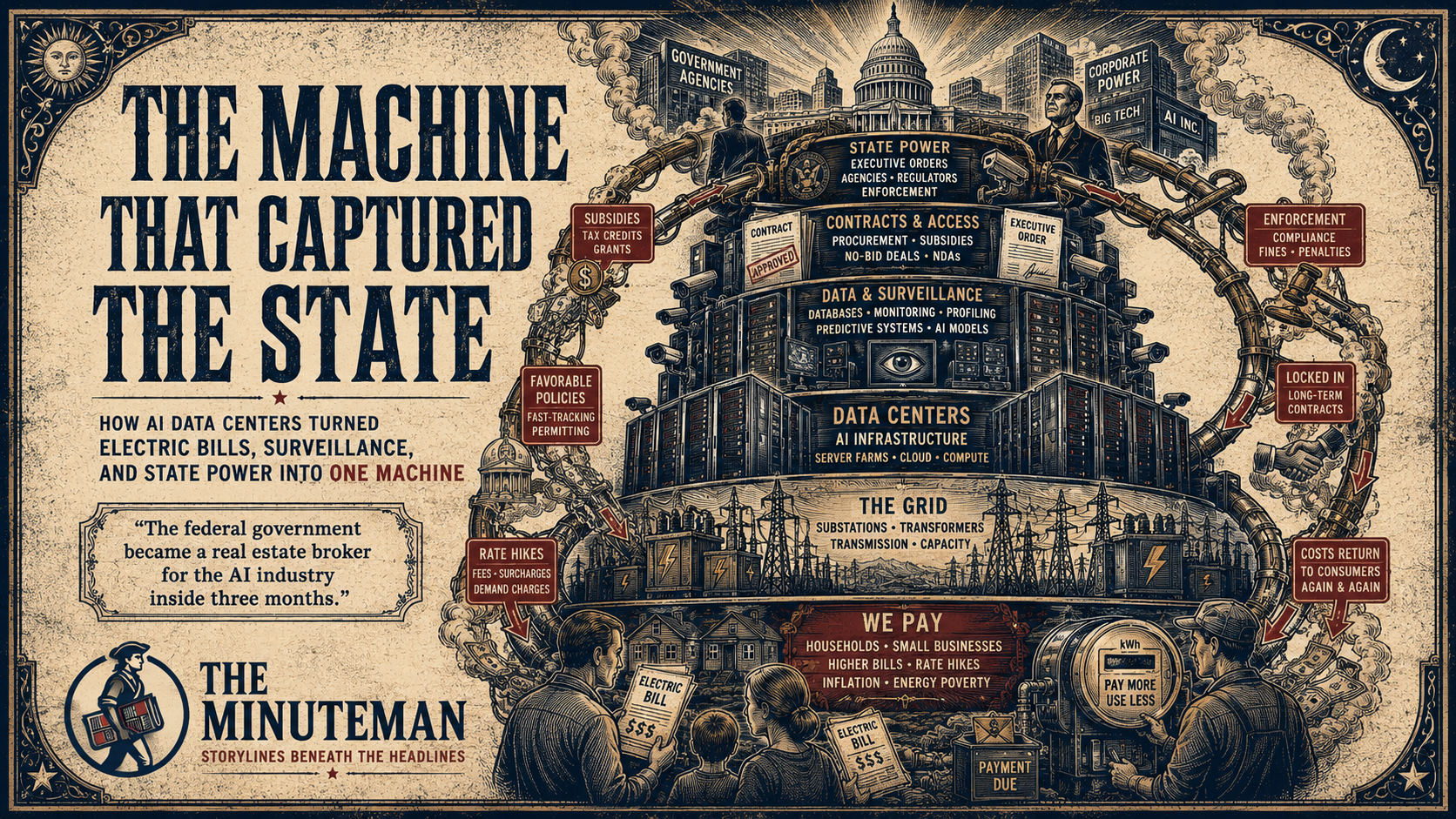
How the data center, the electric bill, the federal contract, and the surveillance state became one machine.
The Loop
The AI conversation, almost everywhere you look, is happening in pieces.
One week it is a story about your electric bill. The next week it is a story about ICE using a private database to map neighborhoods. The week after that it is a story about the federal government opening military bases to data center developers. Then a story about Three Mile Island restarting. Then a story about a tax break in Texas. Then a story about a law firm replacing half its associates with software. Each story arrives on its own, with its own headline, its own three-day cycle, its own comment section. None of them ever sit on the same desk at the same time.
They are the same story. They are one loop, and you are inside it.
Your electric bill is going up because of the data center. The data center is being built because the federal government designated it a matter of national security. The national security designation exists because the data center runs the software the military uses to identify targets and the software ICE uses to find people in your neighborhood. Because that software is now woven into law enforcement and defense, the data center cannot be turned off, which means the energy demand cannot come down, which means your bill cannot come down. The companies profiting from this spend millions lobbying Congress for laws that keep the cycle going, including tax incentives that make it cheaper to replace workers with machines, which means the bill that keeps climbing is harder for you to pay. And the workers being replaced are the same people whose government records, their Social Security files, their tax returns, their Medicaid data, are being fed into the same system that tracks and removes people.
That is the loop. Everything that follows is the proof.
Your electric bill went up. You probably blamed the weather.
Somewhere in Virginia (or New Jersey), a building the size of a regional airport is drawing the equivalent of a small city’s worth of power. It does not have employees on most floors. It does not have windows. It has servers, and the servers are computing something for someone in a way that requires more electricity than some countries will use in a year.
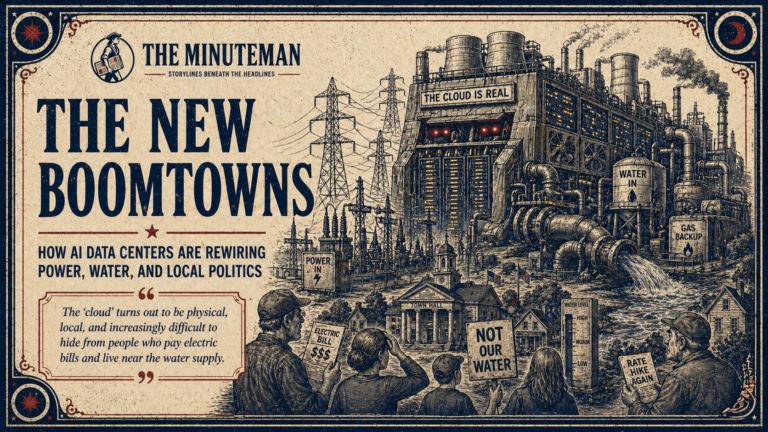
In the United States right now, data centers account for roughly half of all new electricity demand. Residential electricity prices have risen forty percent since 2021. In Virginia, where data centers consume more than a quarter of all power generated in the state, the regional grid auction price jumped 833 percent in a single year. A homeowner in Manassas opened his January electric bill and found $281 where the previous month had been $100. He has lived in the house for forty years. The house did not change. The grid did.
Between 2020 and 2024, residential electricity rates rose twenty-five percent. Commercial rates rose three percent. Industrial rates fell two percent. The people consuming the most power got the biggest discount. The people consuming the least absorbed the cost.
That cost has a cause, and the cause has an address, and the address was chosen for you by a chain of decisions that leads directly to Washington.
The federal government cleared the land.
The word “cloud” was always a marketing decision. Clouds are weightless and free and belong to no one. The actual infrastructure is heavy, expensive, and belongs to four or five companies. It needs land. It needs power. It needs water. It needs permits. And starting in 2025, it got all of them at once.
In July 2025, the White House issued an executive order designating large data centers as projects of national security importance. That designation accelerated federal permitting. It opened federal land for construction. It directed the Department of Commerce to provide loans, grants, tax incentives, and offtake agreements. It told environmental reviewers to find categorical exclusions that would let projects skip the usual public process. The day after the order was signed, the Department of Energy named four federal sites available for data center development. By October the Air Force had opened five military bases to bids. The Idaho National Laboratory, Oak Ridge, the Paducah Gaseous Diffusion Plant, Savannah River, Edwards Air Force Base. The federal government became a real estate broker for the AI industry inside three months.
Then came a second executive order in December. This one directed federal regulators to identify state AI laws considered “obstructive” and to deny those states federal broadband funding. States that tried to write their own rules could lose money the federal government had previously committed to give them.
At least thirty-six states had already built subsidies of their own. Virginia gives up close to a billion dollars in sales tax revenue every year and does not disclose which companies benefit. Texas revised its annual subsidy estimate from $130 million to $1 billion inside the same fiscal year. Twelve states with data center programs do not publish what they cost.
Then came the One Big Beautiful Bill, signed on July 4, 2025. Among its provisions: permanent 100% bonus depreciation for data center hardware. GPUs, CPUs, networking equipment, HVAC systems, electrical infrastructure. Buy a server, deduct the full cost in year one. The law also restored R&D expensing and expanded interest deductions for debt-financed data center projects. The effect was a twenty percent discount on the cost of building a data center, written into the tax code.
The seven largest tech companies are now projected to spend $740 billion in capital expenditures this year. The land was cleared. The permits were fast-tracked. The subsidies were stacked. The tax code was rewritten. Your bill went up. Now look at what the buildings are running.
The same servers run the chatbot and the deportation map.
The data centers being built on federal land, subsidized by federal money, powered by a grid you pay into, do not just compute. They run enforcement.
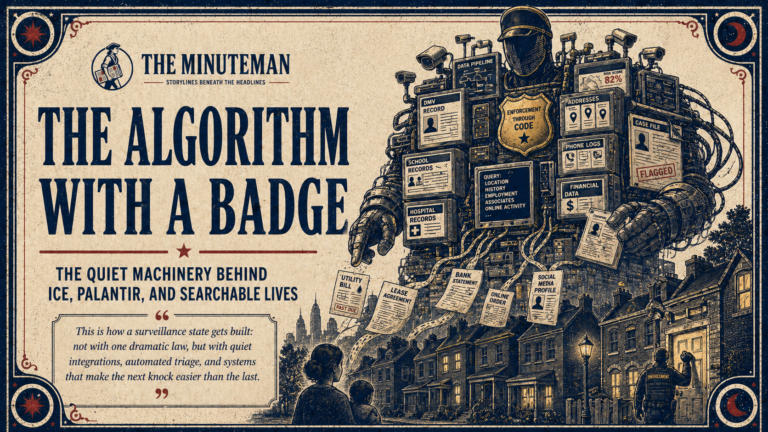
Palantir, which has provided pattern-matching software to U.S. Immigration and Customs Enforcement since 2008, holds over $145 million in ICE contracts. Its platform, ImmigrationOS, pulls data from passport records, Social Security files, IRS tax returns, license-plate readers, and the Department of Health and Human Services to map neighborhoods, build dossiers, and rank deportation targets in something close to real time. A separate tool, ELITE, lets agents enter a zip code and receive a heat map of where suspected noncitizens are likely to be found. ICE’s Palantir system runs on Amazon Web Services. Amazon is the same company building data centers on federal land under the same executive order that designated AI infrastructure as a national security priority.
The data flowing into these tools is growing. In April 2025, the Department of Government Efficiency pushed through a data-sharing deal with ICE over the objections of top IRS officials. DOGE is building what CNN has described as a “master database” for immigration enforcement, pulling records from the IRS, the Social Security Administration, and Health and Human Services into a shared repository. Palantir is constructing the API that connects it. Medicaid data, originally collected to administer health coverage, has reportedly been routed into the same system. The IRS data that helps catch a tax fraud is now helping locate a deportation target. The Social Security record that tracks a retirement benefit feeds a platform designed to remove the person who earned it.
All of this runs on the same cloud infrastructure, in the same data centers, drawing from the same grid, subsidized by the same tax code, that your electric bill is paying for.
The same infrastructure runs the military. That is why it can never be turned off.
The national security designation was not a figure of speech. The Pentagon signed agreements with Microsoft, Amazon, Google, OpenAI, NVIDIA, and SpaceX to deploy AI on its classified networks. These are Impact Level 6 and Impact Level 7 environments, meaning secret and highly restricted data running on commercial cloud platforms. Microsoft operates dedicated DoD cloud regions in Des Moines and Northern Virginia. Amazon runs similar classified environments at undisclosed locations. The Joint Warfighting Cloud Capability program, a $9 billion contract awarded to Google, Oracle, AWS, and Microsoft, has already issued more than $3 billion in task orders.
Palantir’s Maven Smart System, an AI targeting platform that uses computer vision and machine learning to identify objects in satellite and drone feeds and flag targets for human approval, was designated an official program of record by the Pentagon in March 2026. The designation mandates integration across all five branches of the military by September 2026. The contract ceiling was raised to $1.3 billion in 2025. A separate $10 billion Army enterprise agreement, signed in July 2025, consolidated 75 existing Palantir contracts into a single framework. Scale AI holds a $500 million Pentagon contract for military data processing. Microsoft holds a $170 million sole-source Air Force cloud contract awarded in January 2026. In late March 2026, the Army selected companies to build hyperscale data centers on military installations at Fort Bliss and Dugway Proving Ground, backed by Wall Street financing.
Then the question of whether data centers are military infrastructure stopped being theoretical. In March 2026, Iranian drones struck Amazon Web Services data centers in Bahrain and the United Arab Emirates. It was the first time in history that a nation deliberately targeted commercial data centers during wartime. The strikes cost Amazon an estimated $150 million in service refunds alone. The reason they were targeted: the same facilities that run civilian messaging apps, banking systems, and streaming services also handle defense workloads. An enemy does not need to distinguish between your Netflix account and a military targeting system when they share the same building.
This is the lock. A data center that runs a chatbot can be turned off. A data center that runs a chatbot, a deportation map, and a military targeting system designated as a program of record across all five branches of the armed forces cannot. The energy demand is permanent. The coal plants from the 1970s being held open past their planned retirement are permanent. The nuclear restarts, including the second reactor at Three Mile Island, are permanent. The country needs an estimated forty-nine additional gigawatts of generation through 2028 to meet projected demand, and that projection assumes no further expansion of military or enforcement use.
Your bill cannot come down because the system it powers cannot be switched off.
The companies that profit from the lock lobby to keep it locked.
Palantir’s U.S. government revenue grew 104 percent year over year in the first quarter of 2026. The company is sole-source for ICE. It is a program of record for the Pentagon. It is building the API for the DOGE master database. Its contracts are structured so that the agencies it serves cannot replace it without losing their ability to perform their own core functions.
The eleven largest tech companies spent $20 million on federal lobbying in the first three months of 2026. That is $226,000 a day. AI-specific lobbying totaled $92 million in the first three quarters of 2025. AI companies have funneled nearly $200 million into super PACs ahead of the 2026 midterms. During the first half of 2025, the industry pushed a provision in the president’s spending bill that would have stripped states of the power to regulate AI for ten years. The Data Center Coalition, the trade group representing data center developers, posted its biggest-ever lobbying quarter in early 2026, more than tripling its spending year over year.
The lobbying produces legislation. The legislation produces subsidies and tax breaks. The subsidies and tax breaks produce more buildout. The buildout produces more demand on the grid. The grid demand produces higher bills. And it produces something else.
The same tax code that subsidizes data center construction makes it cheaper to replace a worker with a machine than to keep the worker. A company that buys a server can deduct the full cost in year one. A company that hires a person absorbs payroll taxes, benefits, training costs, and legal exposure with no equivalent write-off. Economists Daron Acemoglu, David Autor, and Simon Johnson have argued that the U.S. tax code places a heavier burden on firms that hire workers than on firms that invest in automation. The largest tech companies saved an estimated $14 to $18 billion on their tax bills in 2025 from the bonus depreciation provision alone. OpenAI itself has proposed shifting the tax base away from payroll and toward capital gains, and levying taxes on automated labor, because even the company building the replacement technology recognizes that the current incentive structure is accelerating displacement.
The person whose electric bill is climbing is also the person whose job the tax code is helping eliminate. The bill goes up. The paycheck goes down. The loop tightens.
The people being replaced are the people in the database.
The workforce the AI industry needs to build the physical infrastructure, the electricians, the HVAC technicians, the controls engineers, cannot be automated. The White House AI Action Plan published in July 2025 calls for federal apprenticeships in skilled trades for exactly this reason. The country does not have enough electricians to wire the data centers the industry says it needs. The hands that build the boxes will be human.
The work being done inside the boxes, increasingly, will not. And the workers being displaced by that work are not an abstraction. They have Social Security numbers. They have IRS records. They have Medicaid files. Those are the same records now being routed through DOGE into a master database, connected by a Palantir API, fed into ImmigrationOS, and used by ICE to locate people.
The same system that replaces a worker also catalogs that worker. The same government data that tracked their earnings, their health coverage, their retirement contributions, now feeds an enforcement tool running on infrastructure their electric bill helps pay for. The person is on both sides of the loop. They fund it and they fill it.
The loop.
A surveillance state used to require informants. A notebook. A filing cabinet. A clerk to file the paper. A courier to deliver it. A supervisor to read it. A decision to act. The cost of finding a person was high. The cost of building a list was higher. The cost of acting on the list was higher still. That cost was the friction inside which civil liberties survived.
The cost is now near zero. The filing cabinet is a cloud platform. The clerk is an algorithm. The courier is an API. The list builds itself. And the person paying to keep the system running is the person on the list.
Your electric bill funds the grid that powers the data center. The data center was built on federal land with federal permits and federal subsidies and a federal tax break. The data center runs the software that uses your government data to map your neighborhood. The software is sole-source, integrated into law enforcement and defense, and cannot be replaced. Because it cannot be replaced, the data center cannot be turned off. Because it cannot be turned off, the energy demand cannot come down. Because the demand cannot come down, your bill cannot come down. The companies that profit from this lobby Congress for more subsidies, more tax incentives, more buildout. Congress passes the laws. The laws include provisions that make it cheaper to replace you with a machine. The machine that replaces you runs on the same data center. Your employment records, your tax returns, your health data, flow into the same system. The loop closes.
Every week another story arrives. An electric bill. A deportation raid. An executive order. A tax provision. A lobbying disclosure. A contract award. A layoff.
They are the same story. They have always been the same story. The building you cannot see is the thread that connects them, and the light you left on in your house is a small, forgettable fraction of what it costs to keep running.
Someone, somewhere, is counting on you to keep reading them as separate headlines.