The Price of Your Hatred
There Was a Time You Didn’t Hate the Other Side
Somewhere in the last few decades, disagreeing about politics turned into hating each other over it.
You feel it before you can explain it. The family group chat that goes quiet after someone shares the wrong article. The friend you stopped talking to. The holiday dinner you start timing like a bomb. We didn’t always live this way, and some part of us remembers that.
When I was young, my parents belonged to opposing political parties. One was a Democrat and one was a Republican. The difference between them, the way they explained it to me, wasn’t ethical and it wasn’t social. It was economic. One of them thought the government should be more careful with money, and the other didn’t think that question mattered as much as other issues. That was the whole of it. A fiscally conservative republican and a socially liberal democrat with varying political priorities. They voted against each other and stayed married, and neither one believed the other was a bad person for the lever they pulled.
That kind of disagreement still exists. But something has been laid on top of it, something that turns a difference of opinion into a reason for contempt. We usually blame each other for it. We blame the other side, the liars and bad actors and people who believe the wrong things. We assume the hatred is coming from what is being said.
I think we have the cause backwards.
Political division isn’t created by content; it’s created by medium. I don’t believe, for example, that our political division is a natural result of the human condition. I believe it is instead a result of the primary medium through which we communicate. Today, that tends to be social media. (Yes, I see the irony of this if you’re reading this on social media.)
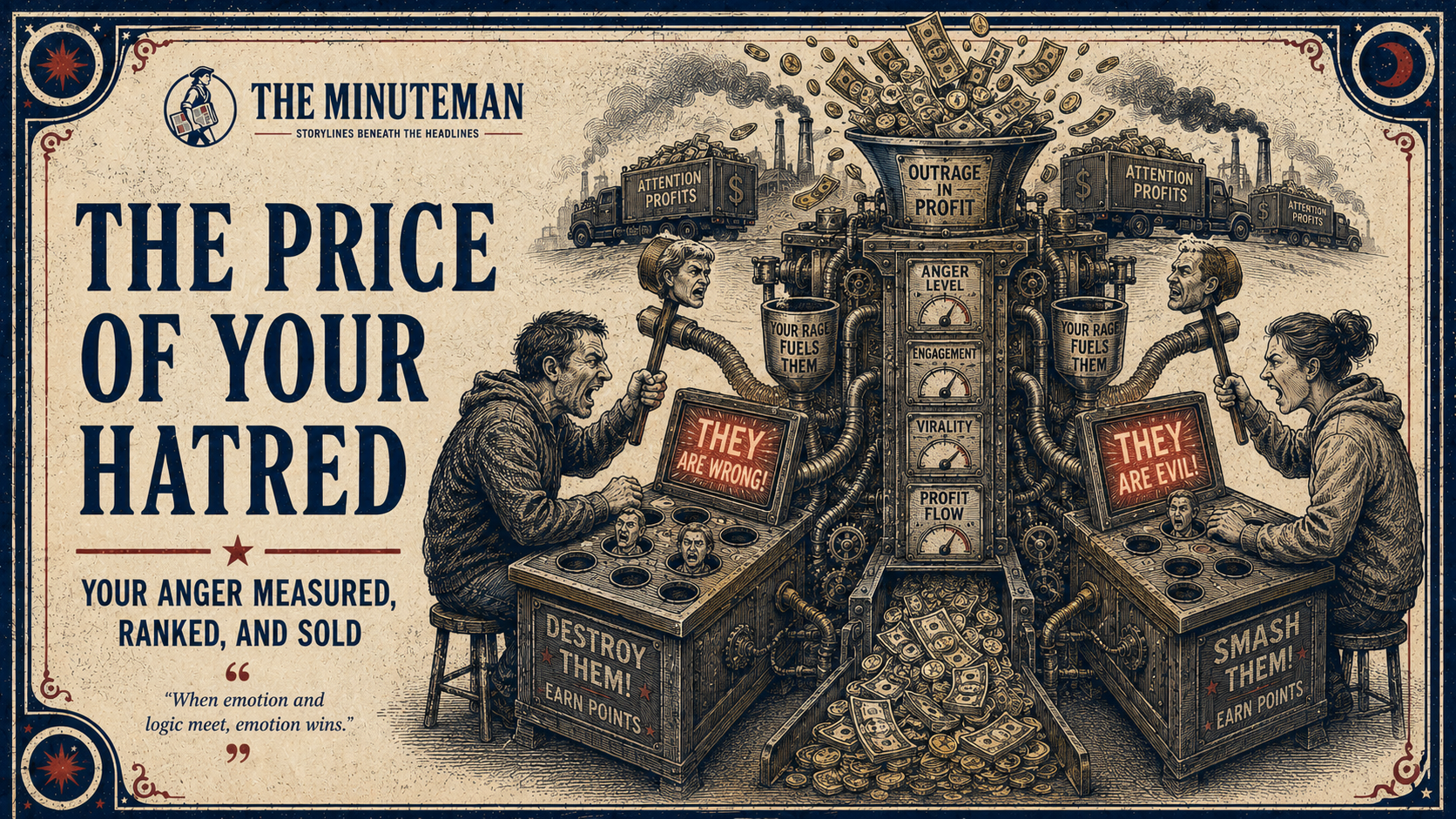
In an attention economy, content is fed to people based on interactability. People and algorithms have decided that nothing determines your likelihood to interact more than anger. When emotion and logic meet, emotion always wins, and our primary method of communication has capitalized on this fact.
The medium does not care about your politics. It took me a while to see that. It doesn’t even care whether you end up divided. It cares about holding your attention, and the cheapest way to hold your attention is to make you feel something, and the feeling that performs best is anger. So it almost doesn’t matter what you say, or which side you say it from. The medium runs your words through the same machine and pays out on the same emotion. It manufactures the division for you.
It may seem like a contradiction, but media itself is innocent in all this. Radio could carry a fireside chat or a demagogue with equal ease, and in its time it carried both. What mattered was never the wire. It was what we built the wire to reward.
We built our communication to reward attention, attention turned out to run on emotion, and emotion at scale hardens into outrage. Television sped that up. Social media perfected it. And once the format was proven to work, everything else that feeds on our attention followed it down the same path, until it no longer mattered whether you were the one holding the phone.
If that is true, then the hatred is not who we are. It is a feature of how we are talking to each other right now, and a feature can be changed. We are not condemned to this. We can choose to communicate in ways that don’t sort everything we say into a fight. That choice is the reason I’m writing this down.
But I want to do more than assert it. The machine has more parts than I first understood, and each one makes the next one worse. Once you see how they fit together, you can’t unsee it.
What we built the wire to do
Start with the economy underneath everything else.
In 1971, a researcher named Herbert Simon noticed something that sounds obvious now and was strange then. When information becomes cheap and endless, he wrote, the thing it consumes is attention. Information stops being scarce. Attention becomes the scarce thing. And the moment something is scarce, it becomes valuable, and the moment it becomes valuable, someone builds a market to buy and sell it.
That market is what we now call the attention economy, and we all live inside it. Most of what reaches you in a day, the post, the notification, the autoplay, is built to hold your attention, not to inform you. Holding you is the product. Your attention is what gets sold, and everything competing for it has been shaped, slowly and then all at once, to win.
There is a problem buried in building a machine to capture attention. Attention does not run on reason. It runs on feeling. We stop for the thing that makes us feel something and scroll past the thing that asks us to think. So a system built to harvest attention drifts, on its own, toward whatever makes us feel the most, the fastest. Nobody has to sit in a room and decide this. The system selects for it the way water finds the low ground.
When emotion and logic meet, emotion wins. A medium built to capture attention becomes a medium built to capture emotion, whether or not that was ever the plan.
Why it’s always anger
Not every emotion is worth the same to the machine.
Love holds you. Wonder holds you. Grief holds you. But anger holds you hardest and cheapest, and the machine can tell. We can measure it now, because researchers went looking.
One study tracked more than half a million messages about guns, climate, and same-sex marriage. Every moral or emotional word added to a post made it travel about twenty percent farther. The same study found something quieter and more important: the outrage spread mostly inside each side and rarely crossed over. It made each camp angrier at the other without ever putting them in the same room.
Another team tested over a hundred thousand real headlines against real readers. Every negative word added to a headline raised the click rate by a couple of points. Positive words did the opposite. Bad news travels; good news sits.
And we don’t have to guess what the platforms knew, because their own documents got out. For years, Facebook’s feed counted an emotional reaction as five times more valuable than a plain like, and used that signal to decide what to show you next. The company’s own researchers later found that the angriest of those reactions clustered around the posts most likely to be false or toxic. The machine had learned that strong feeling was the most engaging thing in the world, and it had quietly, mathematically, decided to hand us more of it.
There is a sharper version of this, and it points straight at the other side. When researchers looked at what kind of anger spreads fastest, they found it wasn’t anger in general. It was anger at the out-group.
In an analysis of nearly three million posts, every single word that referred to the political opposition raised the odds of a post being shared by about 67 percent. Praising your own side did almost nothing. Attacking the other side was close to a guarantee of reach.
The tech ethicist Tristan Harris put a number on the gap with one example. The day the Justice Department released a photo of classified documents at Donald Trump’s Florida home, a tweet linking the straight news story drew about 2,000 likes. A tweet calling Trump’s opponents “dumbasses” drew ten times that. A tweet calling Trump a traitor drew twenty times that. The calm account of what happened was the least valuable thing in the exchange. That is one cherry-picked day rather than a dataset, but it puts a face on the 67 percent.
So the machine sells a particular flavor of anger, the kind pointed across the aisle, because that is the kind that travels farthest. The target is always the other side. That detail explains a lot about why the anger works on us so well, once we get there.
Now watch the loop close.
We learn what performs, so we make more of it. The headline gets sharper. The take gets hotter. Some of this is deliberate, the optimized headline, the rage-bait, and a lot of it is just instinct, the post that got a reaction so you write the next one like it. Then the medium takes whatever we made and sorts it again, pushing the angriest version toward the people most likely to react. We aim our words at emotion, and the machine aims them at emotion a second time. Two passes, both selecting for the same thing.
None of this requires anyone to want division. That is the part that took me longest to accept. There is no villain at the center pulling people apart on purpose. There is a machine that pays out on anger, a population that supplies it for free, and a loop between them that tightens a little more every year.
When the hatred actually started
If the medium is the cause, the history should show it. It does.
Go back to my parents for a second. There was a time, and it was not long ago, when most people felt about the other side roughly the way my parents did. In 1960, fewer than one in twenty Democrats or Republicans said they would be unhappy if their child married someone from the other party. By 2010, it was about half of Republicans and a third of Democrats. By 2016, majorities in both parties said the other side made them afraid.
The disagreement changed temperature. It went from a difference of opinion to a feeling about a person, and it did that recently, on a timeline we can actually watch.
What changed on that same timeline was the medium we use to talk to each other.
Here I have to be honest, because the history cuts both ways and I would rather you trust me than win the point. The medium did not invent division out of nothing. Think about radio.
In the 1930s, a priest named Charles Coughlin reached something like one in four Americans every week, and he used that reach to broadcast hatred, much of it aimed at Jews. Radio could obviously carry poison. But the very same radio carried Franklin Roosevelt’s fireside chats into the very same living rooms, and those did the opposite. They steadied people. They pulled a frightened country closer together.
One wire, the same year, two opposite effects, decided entirely by what ran through it. Economists who studied Nazi radio in Germany found a darker version of the same fact: the broadcasts pushed people toward hatred in places where hatred was already waiting, and actually pushed them the other way where it wasn’t. The medium amplified what was there. It did not conjure it.
That is the honest version, and it is also the whole point. The wire is innocent. What changes everything is the structure we build around the wire, the thing we teach it to reward. And starting a few decades ago, we taught it to reward the wrong thing.
Television made attention faster and hungrier than radio ever was. Then, in 1987, the government removed a rule called the Fairness Doctrine, which had required broadcasters to air more than one side of a question. A year later, a Sacramento radio host named Rush Limbaugh went national. By the mid-nineties he was reaching twenty million people a day, and he was not selling both sides. He was selling one side, with feeling. Cable news learned the lesson and built entire channels on conflict.
This is not a guess about what that did. When researchers measured it, exposure to Fox News moved Republican vote share by a margin that grew with every election, and counties soaked in Limbaugh’s signal drifted measurably his way. The outrage format helped make the division it claimed to report, and we can see its fingerprints in the vote.
Which answers the objection people always raise. If social media is the cause, why are the angriest, most divided Americans often older people, the ones least likely to be on it? Because the format reached them first, through talk radio and cable news, years before the smartphone existed. The structure was already loose in the older media, doing its work on the people watching. The phone didn’t start this. It finished it.
The format that ate everything
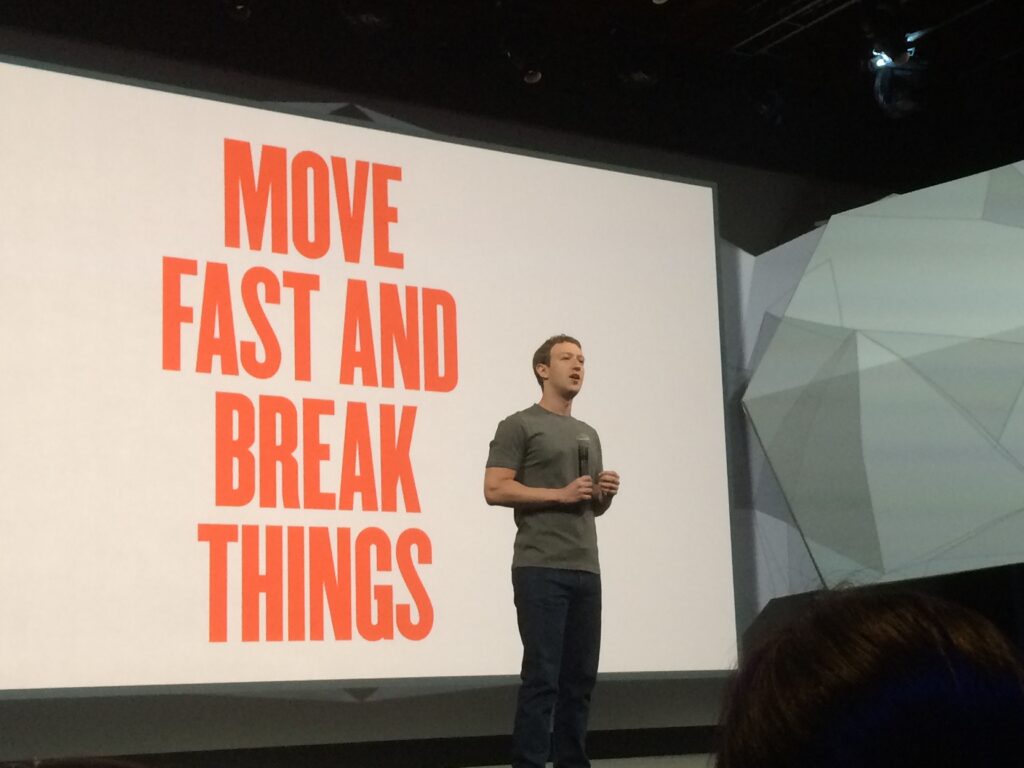
Social media did not invent any of this. It perfected it.
Everything the old media did slowly and bluntly, the feed does instantly and precisely. It does not broadcast one angry message to everyone. It finds the exact thing that will make the exact you react, serves it, watches what you do, and adjusts. The sorting that took talk radio a decade now happens in the time it takes to thumb past a post.
Here is where the strongest objection comes in, and it is worth taking seriously.
In 2020, researchers worked with Meta to switch tens of thousands of users off the ranked feed and onto a plain chronological one, the fix almost everyone assumes would help. Three months later, polarization hadn’t moved. If the feed were the whole problem, that should have done something, and it didn’t.
But look at what the experiment actually changed. It reordered the posts inside the same machine, on the same platform, running on the same incentive, surrounded by the same people making the same outrage for the same rewards.
Reorder the shelf and the store still sells what it sells. The ranking is one gear in a much larger machine, and you can swap that gear with the engine still running. That is the whole argument here. The thing manufacturing division is the attention economy itself, and the feed is only its most visible dial.
There was a specific moment the dial turned.
Around fifteen years ago, the platforms added the like, the share, and the retweet. Before that, social media was mostly people posting where they ate lunch. After it, every post carried a public score, and anyone could fire a thought at thousands of strangers in a second, with no cost and no accountability.
The psychologist Jonathan Haidt calls it handing everyone a dart gun. You could now attack anyone, anytime, and the numbers would reward you for it. That was the day the structure got its trigger.
And once it was proven to work, everything else that lives on attention copied it, and that reaches well past the platforms.
Newsrooms built to inform you started writing for the feed. The headline is tested for clicks. The story is chosen because it travels. The chyron is built to hold you angry through the commercial.
Most people now get their news filtered through these channels, so the logic of the feed became the logic of the news, and the logic of the news became the story a whole country tells itself about what is happening to it. We are all downstream of it now, even the people who never signed up.
You can write something reasonable, something meant to start a conversation, and watch the medium turn it into a side. You did not pick the fight. The structure picked it for you, because a fight performs and a conversation doesn’t. You lose authorship of your own words. Whatever you meant, the machine knows what it can sell, and it sells the version that makes someone angry.
The cruelest part is that the machine has no politics at all. It is not on the left or the right. It does not want you to believe anything. It wants engagement, and it will take it from anyone.
That neutrality comes with a catch, because a machine with no politics of its own can still be owned by someone who has them.
When Elon Musk bought Twitter in 2022 and rebuilt it as X, the platform’s recommendation system began nudging users toward right-leaning accounts and more conservative positions. The engine still runs on anger; the hand on the throttle is not always neutral.
Even so, both sides are full of people who care, and the medium routes all of that caring into the one emotion it can charge for.
You think you are fighting the other side. You are both standing at opposite ends of the same machine, feeding it.
Who is actually screaming
Here is something that should be reassuring and somehow isn’t. Most people are not doing this.
When it feels like the whole country is at war, the picture in front of you is the work of a very small number of hands. The people who fire the dart guns most, who post the most political content and the angriest version of it, sit at the far ends of the spectrum.
Haidt puts the active extremes at about seven or eight percent on each side. The broad survey he draws on found the most politically active group online, the progressive activists, made up roughly eight percent of the population, and the devoted conservatives on the other end about six. Those are the people supplying most of the fuel. The other eighty-odd percent of us are mostly tired, mostly quiet, and mostly convinced we are surrounded.
The medium prefers it this way, because the extremes make exactly the kind of out-group anger that travels 67 percent farther. The loudest eight percent produce the most shareable content, the machine hands them the megaphone, and the rest of us get served their voices on a loop until we mistake them for everyone.
So why don’t the moderates push back and drown them out? Because the structure makes it expensive to try.
Haidt has a name for what happens when they don’t: structural stupidity. Put thoughtful people in a place where one wrong word gets you swarmed, and they learn to say nothing. They watch a colleague get flattened for a careful, complicated take, and they decide the careful take isn’t worth it. Nuance becomes a liability.
The quiet majority goes quieter, and the institution they belong to, the campus, the newsroom, the workplace, loses access to its own best thinking.
When the smart people are afraid to speak, the room gets dumber, and the only voices left are the ones that were never afraid because they were never interested in being careful.
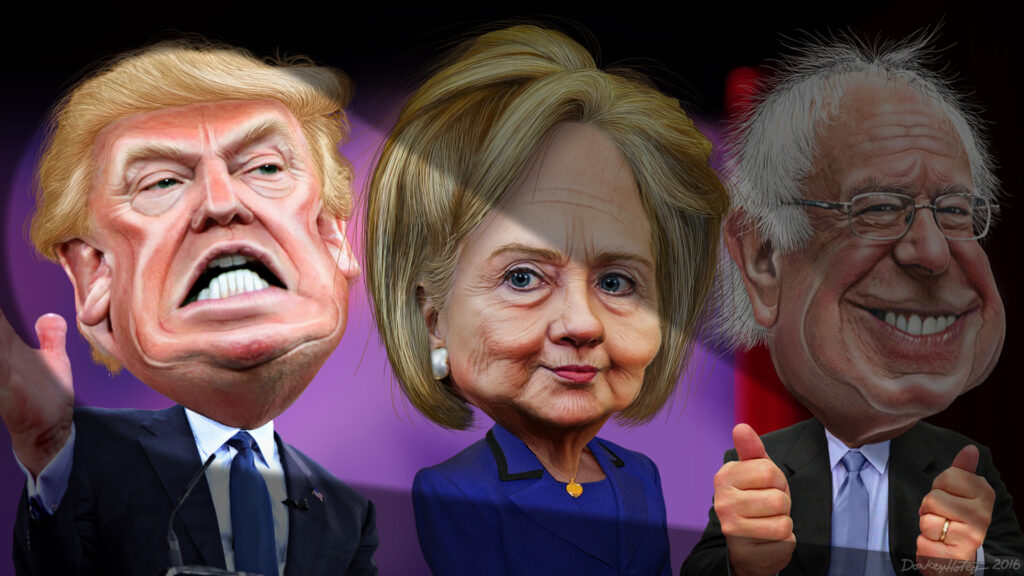
This is the part that makes the caricature possible. The version of the other side you meet online is its angriest eight percent, the ones the machine selected for being the most enraging, performing for an audience, with the moderates edited out.
You think you are seeing your neighbor. You are seeing the most extreme stranger who happens to share your neighbor’s party, lit up and served to you because he makes your heart rate climb.
Why the anger fits
A machine that sells out-group anger still needs the anger to work on us. You can’t sell a feeling people don’t have.
So the last question, the one underneath all of it, is why this particular provocation gets us every time. Why does a stranger’s bad take about politics reach into your chest the way a stranger’s bad take about almost nothing else does.
The answer is that the dart guns are aimed at something real.
We don’t run on a single sense of right and wrong. Psychologists who study morality across cultures argue that it rests on several different foundations, and they don’t all carry the same weight for everyone.
Researchers still fight over how many of these foundations there are and how deep they run, so take the framework as a useful map and not a settled fact. The part that survives the argument is the simple one I need here: people don’t all weigh the same moral concerns equally.
Haidt, who built the theory, compares the foundations to taste receptors. We all have a tongue, but we don’t all reach for the same flavors.
Two of those foundations are care, the instinct to protect people from harm, and fairness, the instinct against being cheated. Almost everyone has them, and for people on the political left they tend to be most of the meal.
The right keeps care and fairness too, but sets three more places at the table that the left tends to weigh less: loyalty to the group, respect for authority, and a sense that some things are sacred and shouldn’t be degraded.
None of these is the moral one. They are different instruments for reading the same world, and most arguments that feel impossible are two people playing different instruments and hearing the other as noise.
This is where the misreading begins, and it begins before the internet ever touches it.
When someone whose morality runs on care and fairness hears a passionate argument built on sanctity or authority, it can fail to register as a moral argument at all. It sounds like a person getting worked up about nothing, or worse, dressing up cruelty as principle.
Run it the other way and it’s just as bad. To someone who feels loyalty and sacredness deep in the body, a person who shrugs at them looks like someone with pieces missing, a person who would let anything be torn down because they can’t feel why it matters.
Each side hears the other’s deepest moral concerns as either a con or a void, and treats the mismatch as proof of bad faith.
Now feed that into a machine that pays out on out-group anger, and you get something measurable and strange.
Researchers asked liberals and conservatives to describe their own morality, and then to fill out the same survey the way they imagined a typical opponent would.
Everyone got the direction right and the distance wildly wrong. Both sides pictured the other as a cartoon of itself, more extreme and more heartless than the real people turned out to be.
Liberals guessed that conservatives don’t care about fairness or protecting the vulnerable, when they do. Conservatives guessed that liberals feel no loyalty to anything, when they do. The people who were most sure they understood the other side were the most wrong about it.
That is the engine of the whole thing. We are not, most of the time, fighting the other side. We are fighting a picture of the other side, drawn by the most extreme eight percent, exaggerated by our own moral blind spots, and pushed further every time the medium serves us the most enraging version it can find.
The machine didn’t create the gap between our moral languages. It found the gap, learned it was profitable, and has been prying it open ever since.
You think you are at war with people who believe monstrous things. You are mostly at war with a hallucination, and the hallucination is the product.
What it costs a country
It would be easier to file this under unpleasant and move on, except that the damage has a body count and a direction.
When the hatred stops being about policy and starts being about the person, political scientists call it affective polarization, and it does something specific. It dissolves the floor we stand on together.
People who view the other party as evil stop accepting outcomes that go against them, stop trusting the count, start excusing things they would have been ashamed of a decade ago, because any means looks justified against an enemy that monstrous.
Barbara Walter, who studies how civil wars actually begin, lays out the warning signs in her book How Civil Wars Start. The thing that predicts a country tipping into conflict is a specific combination: a population sorting into camps defined by identity rather than ideas, inside a government too gridlocked to settle anything.
Strong disagreement on its own is survivable. That sorting is what turns dangerous, and by her measures the United States has been drifting out of the safe zone of stable democracy toward the unstable middle ground where the risk lives. The sorting she warns about is exactly the kind the medium manufactures.
This isn’t only an American story.
Freedom House, which scores political rights and civil liberties around the world, reported that global freedom declined in 2025 for the twentieth straight year, with more than fifty countries getting less free and only about thirty-five improving.
The United States had the sharpest one-year drop of any country still rated free, falling three points to 81 out of 100, its lowest score since the modern measure began in 2002.
A generation of backsliding, accelerating now, alongside the machine we built to keep us angry.
I want to be careful here, because this is where it would be easy to overstate. The medium is not the only thing dragging democracies down, and a post is not a war. But the mechanism connects cleanly to the stakes.
A structure that profits by teaching people to see their neighbors as enemies, running on a platform that reports about 240 million American users, is not a harmless way to spend an evening.
It is corrosive at exactly the joint that holds a self-governing country together, the willingness to lose an argument and stay in the room.
What your hatred is worth
So here is the bill.
Your attention is the product. And of every form your attention can take, your hatred is the most valuable, because it is the most reliable and the easiest to provoke again tomorrow. Every time the feeling wins over the thought, a transaction clears and someone gets paid. It is not you.
That is the price of your hatred, and you have been paying it without ever seeing the invoice.
I find that, strangely, hopeful.
If our division were simply human nature, there would be nothing to do but grieve it. But it is not human nature. It is a structure, and a structure is a choice, and a choice can be made differently.
Some of that choice is bigger than any one of us. The people who built this know what it costs, and there is a fight coming over whether a business model that runs on enraging us should be allowed to operate untouched, the way we eventually decided about tobacco and leaded gasoline and cars without seatbelts. That fight matters, and it is not ours to win alone on a Tuesday night.
But some of it is exactly the size of one person, and it is available right now.
We are not required to talk to each other through machines built to set us against each other. We can choose rooms that are friendly to what we actually mean.
A long article that asks you to hold one thought for ten minutes.
A conversation that is not scored by reactions.
A dinner table, a club, a letter, any place where your words reach another person without being sorted, ranked, and sold on the way.
The medium is a choice. It has only felt like the air because we forgot we were allowed to breathe somewhere else.
My parents disagreed about the importance of fiscal conservatism in politics most of their lives. They never once mistook that disagreement for a reason to hate each other, and the reason is almost embarrassingly simple. They worked it out across a kitchen table, and that table sold nothing. No one was paid when they disagreed, so nothing in their lives was quietly working to keep them angry.
That is still available to us. The other side was never the enemy. The thing that taught us to see an enemy there was. It has a price, and we do not have to keep paying it.
TLDR: Read a book.