The Whole World Runs on Rocks Nobody Wanted to Mine
In May of 2026, the chief executive of an American company most people have never heard of got on a plane to China to ask for permission to buy a metal most people have never heard of.
The company was Coherent, one of a handful of firms that make the optical chips inside the data centers everyone keeps talking about, the ones that train the AI that is supposed to change your life.
The metal was indium phosphide. You will not find it in a headline about the future. You will find it in the part of the supply chain nobody photographs, the part with the trucks and the acid baths and the tailings ponds.
China had tightened its grip on indium phosphide in February of 2025, and since China makes around 70% of the world’s indium, the request was less a negotiation than a polite knock on a door that Beijing now controls.
That is the shape of the thing we have been calling a “chip war.”
We call it a war because the word fits the visible parts. There are tariffs. There are export bans. There are bipartisan letters from Congress and proxy tensions in the Taiwan Strait and a genuine fear, shared in Washington and Beijing, that this ends badly.
All of that is real. But walk the supply chain from the rock to the device in your pocket, and a different picture comes into focus, one that is harder to fit on a cable-news chyron.
Almost no one in this fight can hurt the other side without bleeding themselves.
The same lines that look like weapons on a map are also the only thing keeping everyone fed. The system that could start a war is the same system that has, so far, kept one from happening.
And the strangest part is what it all rests on.
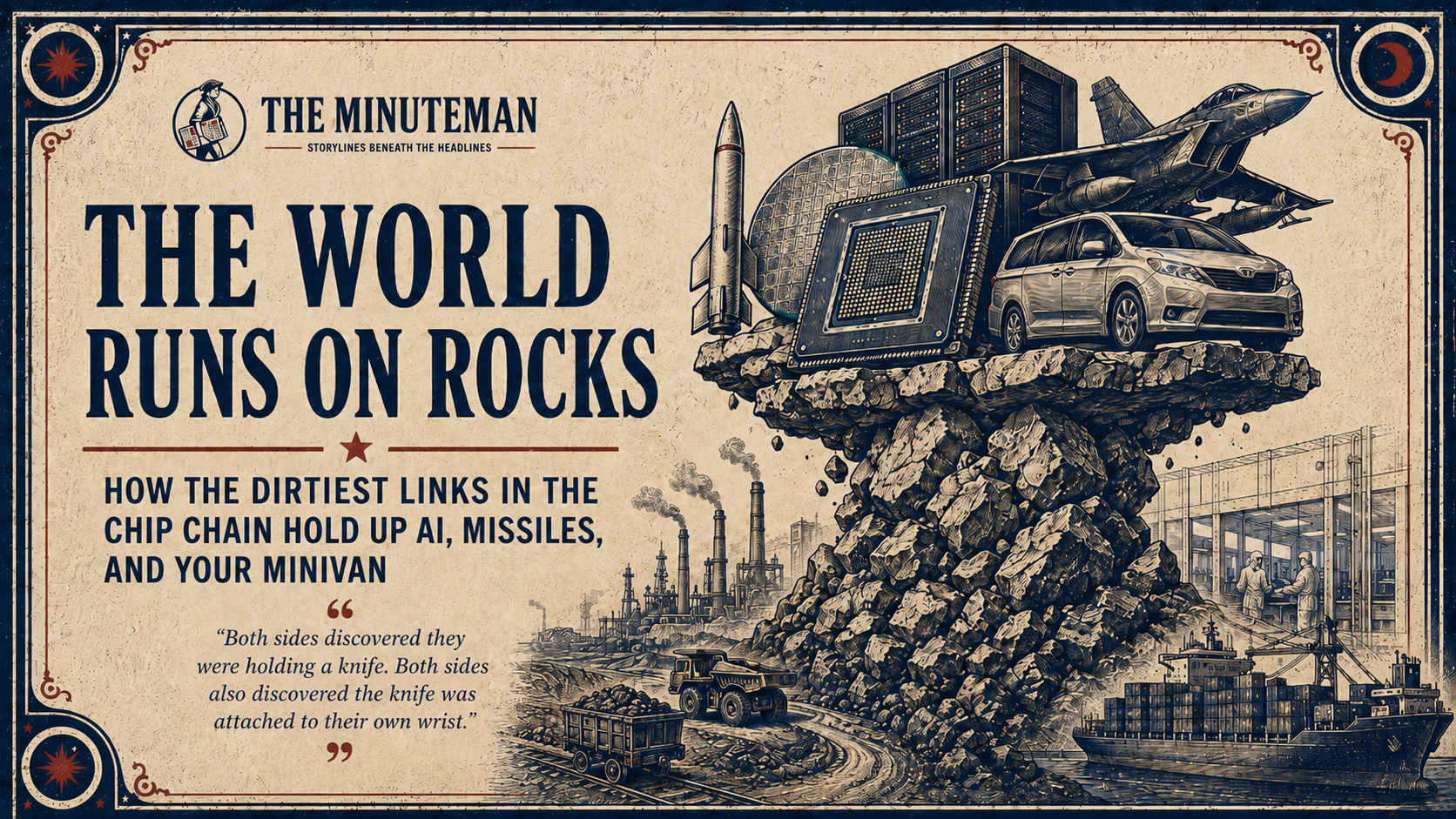
The whole structure balances on the cheapest, dirtiest, least profitable work in the chain, the digging and the refining that the ‘rich world’ spent thirty years deciding it was ‘too good’ to do.
The brilliant chip designs and the trillion-dollar companies and the gleaming fabs all sit on top of that. China noticed. China made a bet that whoever owned the bottom of the chain would one day own the top. We are now living inside that bet.
So how did a few rocks end up holding the whole world together? And if no one can win, why does it still feel like we are all losing?
What a chip is actually made of
Start with the chip itself, because almost everything you have heard about it is half true.
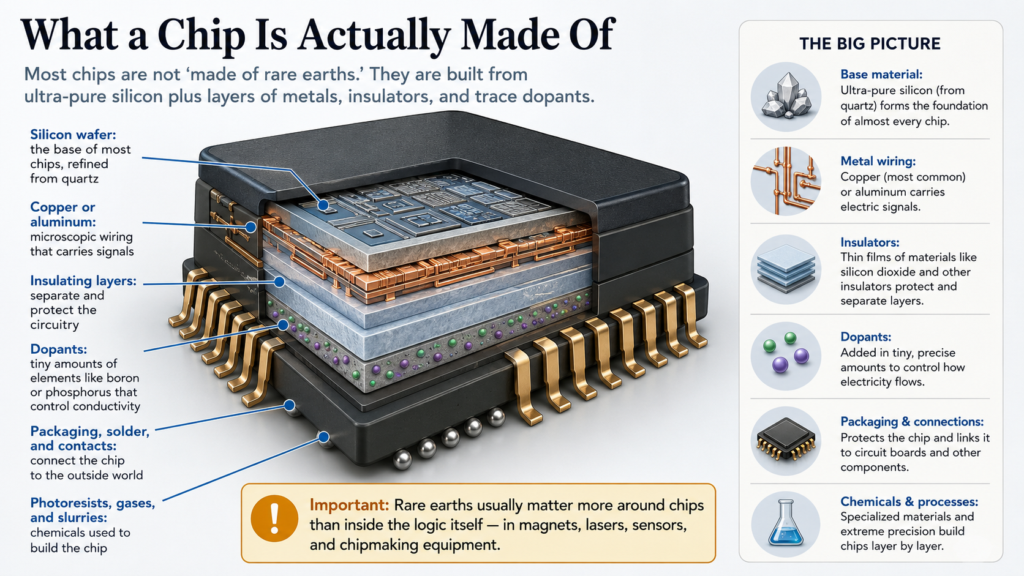
A semiconductor is a sliver of material, usually silicon, etched with circuitry so fine it is measured in billionths of a meter.
To make one, a fab runs a wafer through hundreds of cycles of laying down material, printing patterns with light, etching them away, and doping the result with impurities to control how it conducts electricity. Then the finished wafer is cut, packaged, and tested.
The OECD lays the process out like this: design, fabrication, then assembly, testing, and packaging.
No single country does all of it, though, and no single rock makes the whole thing. The popular story says chips are “made of rare earths,” and that China has a “monopoly.” Both are close enough to feel true and wrong enough to lead you astray.
The truer version is a long shopping list.
Silicon, the base of most chips, starts as quartz, refined to a purity where fewer than ten atoms in a million are anything else. The USGS notes there is no economic substitute for high-purity quartz in most of its uses, which means the quality of the sand matters as much as the quantity.
Then come the specialty gases, nitrogen trifluoride and tungsten hexafluoride and the noble gases like neon and argon. The photoresists, the light-sensitive coatings that let patterns be printed. The polishing slurries, some of which contain a rare earth called cerium.
The copper and gold and silver in the wiring, the substrates in the packaging. Gallium and germanium show up too, not to replace silicon but to do jobs silicon cannot, in the compound chips that run fiber optics, radar, and the optical guts of a data center.
Rare earths are on the list, but mostly for the magnets and lasers and sensors that sit around the chips, in the motors and the missiles and the MRI machines, rather than inside the logic itself.
The lesson is in the length of that list. Every link on it is a place where a single country can squeeze.
Where the squeezing happens
Here is the map, link by link, and it is worth slowing down for, because the geography is the whole story.
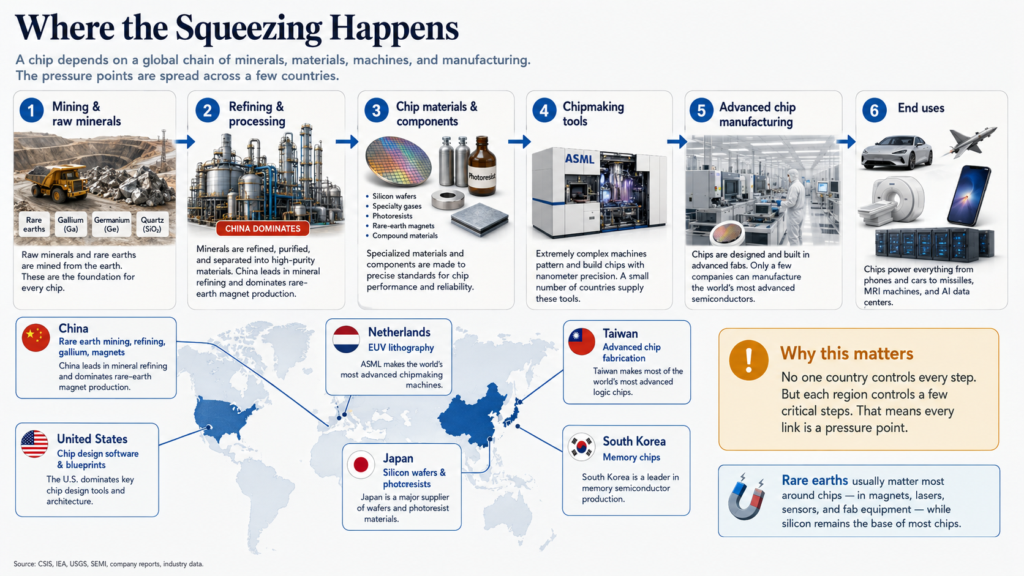
China sits at the bottom, in the dirt.
The International Energy Agency reported in 2025 that China was the leading refiner for nineteen of the twenty strategic minerals it tracks, with an average market share around 70%, and that this concentration had gotten worse, not better, between 2020 and 2024.
In rare earth mining, the USGS put global production at 390,000 tons in 2025, of which China accounted for 270,000. For some of the heavy rare earths, American buyers got 100% of their terbium, holmium, and lutetium from China. For gallium, the USGS found China made more than 98% of the world’s supply, and the United States imported all of it.
And the grip tightens as you move from the dirt to the finished part: China mines a bit over half the world’s rare earths but makes more than 90% of the world’s rare-earth magnets, the actual working components that turn up in motors, missiles, and the fab equipment itself.
Taiwan sits at the top, in the clean rooms. The advanced logic chips, the ones below twenty nanometers that run phones and AI, are made almost nowhere else. An industry study found that essentially all of the world’s most advanced manufacturing capacity, below ten nanometers, was in Taiwan and South Korea, with Taiwan holding 92%.
One company, TSMC, held more than 70% of the entire global foundry market in late 2025. When you read that Nvidia or Apple or AMD designed a chip, TSMC almost certainly built it.
And then there are the chokepoints nobody expects.
The machines that print the finest circuitry, called EUV lithography, are made by exactly one company on Earth, ASML, in the Netherlands.
Taiwan can dominate the most advanced manufacturing in the world and still grind to a halt if a Dutch supplier stops shipping. More than half the world’s silicon wafers come from two Japanese firms, Shin-Etsu and SUMCO. Japan also dominates photoresists. South Korea leads in the memory chips that store everything.
And the United States, even as its share of physical manufacturing fell from 37% in 1990 to 10% by 2022, still controls the design software and the blueprints, where three firms, Cadence, Synopsys, and Arm, account for more than 60% of one market and 70% of another.
A Semiconductor Industry Association and Boston Consulting Group study counted more than fifty points in this chain where a single region holds over 65% of the market. Fifty separate places where one hand is on one throat. No country holds all fifty. Every country holds at least one.
That is the web. A dozen borders, a dozen single points of failure, and every one of them load-bearing.
The bet China made
Now back to the rocks, because this is where the web turns into something almost elegant, in the way that a bear trap is elegant.
For most of the last half-century, the richest countries in the world treated mining and refining as work beneath it. The margins were thin. The pollution was terrible. The labor was hard. So we sent it away, to whoever was willing to build the refineries and live alongside them, and we kept the “clean” part, the design and the branding and the software, where the money was. It felt like the smart move. You keep the Apple logo, somebody else keeps the open-pit mine.
China took the part we threw away. It built the refineries, absorbed the pollution, subsidized the losses, and waited.
The genius of the position is that it sits upstream of everything. You cannot quickly design your way around a gallium shortage. You cannot write code that conjures terbium. The most sophisticated chip in the world still begins as a rock that someone has to dig up and purify, and if only one country is willing to do that at scale, then that country has its hand on the tap for the entire rest of the chain.
We saw the tap turn.
China put export controls on gallium and germanium in August 2023, then banned both to the United States outright in December 2024. In April 2025 it announced controls on a list of medium and heavy rare earths, the ones that go into the magnets in fighter jets and electric motors.
By June 2026, a U.S. business group reported that some of these minerals had become “nearly unobtainable,” and that rebuilding supply outside China could take more than three years. The cheapest links in the chain turned out to be the ones that could choke it.
The United States did the same thing from the other end. When Washington restricted China’s access to the most advanced chips and to ASML’s machines, it was reaching for its own chokepoint, the top of the chain instead of the bottom.
Both sides discovered they were holding a knife. Both sides also discovered the knife was attached to their own wrist.
Why no one can let go
This is the part that keeps the war cold.
China can choke off the minerals, but China still cannot make the most advanced chips, because it cannot buy the Dutch machines or the American software to do it. Its engineers have reportedly built prototypes based on ASML’s technology, but reproducing that hardware at scale has proven brutally hard. So China needs the West to keep the top of the chain running.
The United States can choke off the advanced chips and the tools, but it cannot make a car, a missile, an MRI machine, or a data center without the minerals at the bottom, which it does not produce and cannot quickly learn to. The Pentagon’s magnets, the kind in guidance systems and motors, run on exactly the rare earths China just restricted. So America needs China to keep the bottom of the chain running.
And both of them need Taiwan, which makes the chips, and which sits barely a hundred miles off the Chinese coast in the most dangerous strait on the planet. If that island stops producing, the Boston Consulting Group and SIA estimated that building fully self-sufficient regional supply chains would cost at least a trillion dollars up front and raise chip prices by 35 to 65%.
That is the cost of leaving the web. It is so high that almost no one is seriously trying. Instead, everyone is trying to diversify a few of their own links while staying inside the larger structure, which is another way of saying everyone has decided, for now, that mutual dependence is safer than independence.
That is the paradox at the center of all this.
The web is what makes the conflict so dangerous, because every line is a pressure point. The web is also what makes the conflict survivable, because cutting any line cuts yourself.
We have built a system where the people most able to destroy each other are the people who most need each other to get through the week.
It is mutually assured production, and like the nuclear version, it holds right up until someone decides it doesn’t.
It is already in your driveway
None of this would matter to you if it stayed in the refineries and the clean rooms. But it doesn’t.
The federal government’s own supply-chain review found that semiconductors are fundamental to virtually every military system and essential to critical infrastructure, the power grid, the hospitals, the banks.
A Commerce Department survey found that the average car contained more than 1,700 chips, and that 84% of the products it studied likely contained a chip made in China.
When chips ran short during the pandemic, the auto industry lost an estimated $110 billion and nearly four million vehicles in a single year. That was a hiccup compared to what a real rupture in the mineral supply could do.
The European Central Bank modeled a stringent but partial Chinese rare-earth squeeze lasting eighteen months and found it could cost the United States between 0.3 and 0.6% of total output, with the damage landing hardest in the same places, automotive and electronics. That sounds survivable, and it is, which is exactly the point. The web bends before it breaks. The cost is not collapse but everything getting slower, scarcer, and pricier at once, for as long as the squeeze holds.
So the chain runs straight from a Chinese refinery to your driveway, your doctor’s office, your electric bill, the phone you are likely reading this on. When you hear that a metal is “nearly unobtainable,” the eventual translation is a longer wait for a car, a pricier appliance, a delayed medical scanner, a defense system that costs more and arrives later. The distance between a tailings pond in Inner Mongolia and your kitchen table is shorter than it has ever been.
It runs to your neighborhood, too.
The response to all of this is being poured, in concrete, across the Northeast.
GlobalFoundries is expanding its plant in Malta, New York, backed by up to $1.587 billion in federal CHIPS Act money against roughly $14 billion in investment.
Micron is building near Syracuse, a project so large the state had to approve a new two-mile high-voltage transmission line just to power it.
In Albany, a new national research center opened in 2025 to work on the exact EUV technology the whole advanced chain depends on.
Princeton Plasma Physics Laboratory in New Jersey, better known for fusion energy, now holds federal awards to study the chemistry inside the reactors that make chips.
ASML, the Dutch company holding the most exclusive chokepoint in the industry, employs more than 3,200 people in Wilton, Connecticut, and is spending $200 million to grow there.
The global fight over rocks and chips is also a local fight over jobs, water, power lines, and tax dollars, happening within driving distance of a lot of people who have never thought about gallium once.
What we are actually deciding
The honest answer to “who wins the chip war” is that the question is built wrong.
You do not win a web. You either keep it intact or you tear it, and tearing it costs everyone, including whoever swings the scissors.
What we are actually deciding is something quieter and harder.
We spent decades acting as if the clean work was the valuable work, and the dirty work could be handed to whoever wanted it. We were wrong about which end of the chain held the power, and a rival government understood our mistake before we did. Now the bill is coming due, in the form of three-year timelines to rebuild what we gave away, and a daily dependence on a country we are also trying to outmaneuver.
There is something almost hopeful buried in the danger, if you are willing to look for it. A world this tangled is a world with reasons to keep talking.
Every supply line is a thread that someone on the other side does not want cut either. The same interdependence that makes us vulnerable is the closest thing we have to a peace treaty nobody signed.
The risk is that we forget that, that one side convinces itself it can pull a thread cleanly, and learns too late that the thread was tied to its own hand.
The whole modern world, the AI and the missiles and the minivans, turns out to be balanced on a pile of rocks that nobody, until recently, thought were worth the trouble of digging up.
We should probably start paying attention to the rocks. Everyone else already is.