
The AI Bubble Pops
This could be the pop we’ve been expecting. The stocks have broken, the rest of the market hasn’t caught up yet. Here’s what you should do, now.
Yes, I think this is the pop
I think the AI bubble is popping and I don’t mean that it popped last Thursday at 2 in the afternoon. I mean that a year from now I think we’ll look back at early October 2026 and say that that was the top and it’s been heading down ever since.
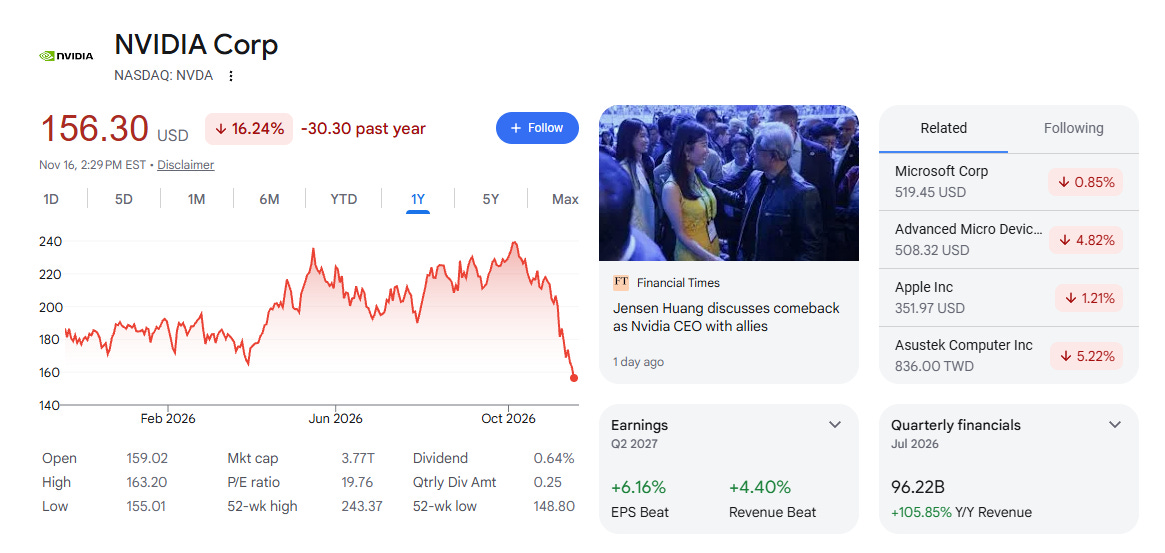
Here’s why. On November 5, two days after the midterms, the Nasdaq (the stock index stuffed with tech companies) had its worst day in 19 months. Nvidia, the company that makes the chips nearly all of AI runs on, is down about 30% from the record it set on October 6. Then last Thursday its CEO resigned over an affair with a woman U.S. intelligence says is a Chinese spy. (I did not have that one on my bingo card.)
Now, I’ve been writing a lot about how different AI companies are linked to your retirement funds, but if you opened your retirement account this weekend, it probably looked fine.
The S&P 500 is the list of 500 big companies that most retirement funds follow. It closed Friday at 7,561. By my math that’s about 3% below its all-time high. At its worst close this month it was about 6% below. While that might be a bad couple of weeks, it’s nowhere near a crash.
So which is it? Is the AI trade falling apart, or is my 401(k) fine? Both. And the gap between those two things is why I’m writing this.
Yes, I think this is the moment the AI bubble pops, or the start of it. The AI stocks have already broken. The rest of the market hasn’t caught up yet. And there are things you and I can and should do before it does.
I’m a journalist. I’m not a financial adviser, and I’m not going to tell you what to buy or sell. What I can do is show you what I found and tell you what I’m doing about it. Also, Nvidia’s earnings call is tomorrow and Anthropic’s first day of trading is Thursday so keep an eye on that.
A pop doesn’t look like a pop while you’re in it
When we say a bubble “popped,” we picture one loud moment. Everything collapses at once and everybody knows it happened. That’s almost never how it goes.
Take the dot-com crash, the one everybody compares this to. The Nasdaq peaked on March 10, 2000, at 5,048. It hit bottom on October 9, 2002, at 1,114. That’s a 78% drop, and it took two and a half years.
It didn’t fall in a straight line, either. On the way down there were nine separate rallies that averaged 23% each. Two of them were bigger than 40%. Every “market correction” looked like the all-clear, and every one was followed by a new low. Nobody rang a bell on March 10, 2000. People figured out it was the top much later, looking backward.
Now look at this year. The drop that started at the end of October was the Nasdaq 100’s third fall of 10% or more in 2026. The first came in March, during the Iran war. The second came in July, when chip stocks sold off. Both times the market climbed back to a new record, and both times the people who were worried looked silly (I’m fine with looking silly).
Maybe they (we) were silly. Or maybe we’ve been watching one long thing happen up close, a drop at a time, and we can’t see the shape of it because we’re standing too near.
I can’t tell those two apart by staring at prices. Nobody can. So stop looking at the prices and looked at what’s holding them up.
The money goes around in a circle
I’ve been reading about this a lot and spending a lot of time reading the financial filings of these companies behind the AI boom.
Here’s the short version.
Remember selling candy bars for a school fundraiser? Say two kids have one dollar between them. The first kid buys a bar from the second. Then the second kid buys one back with the same dollar. Back and forth all afternoon. By the end every bar is gone, they report a great day of sales, and they still have one dollar.
A big piece of the AI boom works like that.
Nvidia sells the chips, and then a few giant companies buy most of them, companies like Amazon, Google, and Microsoft. Once they have the chips, they stack them in data centers, and they rent out computing power, sort of like the way a landlord rents out apartments. Then the companies that make AI itself, mainly OpenAI and Anthropic, rent computing power. They’ve signed up for hundreds of billions of dollars in rent, promising to speand far more than they bring in. Anthropic alone has disclosed around $900 billion in future spending commitments on data centers.
They sell AI tools to the rest of us, but so far what we pay for AI doesn’t cover that bill. So investors do, and some of the biggest investors covering this bill are Amazon, Google, Microsoft (all of which have put money into Anthropic), and Nvidia (which has put $30B into OpenAI).
That’s the circle. The chip seller and the landlords fund the tenants. The tenants pay rent to the landlords. The landlords buy more chips from Nvidia, and the money goes around. The money goes in as an investment and comes back as a sale and everybody says “yay, growth.”
That’s what makes it a bubble. The stock prices assume the dollar keeps going around, and that someday enough paying customers show up to cover all of it.
A circle like that needs three things to keep turning: 1. cheap borrowing, 2. permission to keep building, and 3. people to trust whoever is running it.
In the first two weeks of November, all three took a hit.
Borrowing got more expensive. Prices rose 0.4% in October, more than expected. Investors now fully expect the Federal Reserve to raise interest rates in December. The rate on a 10-year government bond climbed to 5.15% from 4.80% earlier in the month. When borrowing costs more, a promise to spend $900 billion you don’t have yet gets waaaaaay harder to keep.
Permission got shakier. Democrats won control of Congress on November 3, including in states where people have been fighting new data centers. Investors read that as tougher rules ahead and sold. (Whether tougher rules are good or bad is a different article. Spoiler alert, it’s good.)
Trust took a hit. Nvidia is the banker in the middle of this self-reinforcing fiance loop. Its cash has helped companies all over the AI industry grow. Jensen Huang ran it from the day he co-founded it in 1993. Now he’s gone and the chief financial officer is filling in as interim CEO.
That’s why I think this drop is different from March and July. The war and a rough stretch for chip stocks hit the market from outside. This one hit three things the circle runs on, all inside 10 days.
Why this reaches you even if you never bought an AI stock
But wait a minute. Why should we care? What is my money resting on?
Seven companies (Nvidia, Apple, Microsoft, Alphabet, Amazon, Meta and Tesla) make up about 34% of the S&P 500. If you own an S&P 500 index fund, about a third of your money sits in those seven, and most of them are betting heavily on AI.
So the “safe” fund in your retirement account is about one-third a bet on the circle.
It goes past the stock market too. In October the International Monetary Fund ran the numbers on what happens if AI investment drops sharply. Its answer: a U.S. economy 1.8% smaller by 2028 than it would have been. The head of the IMF said the economy is “standing on one leg, the AI leg.”
That’s why your balance barely moved. The other 493 companies are mostly doing fine, and they’re covering for the seven. They can cover for a 30% drop in one chip company. I don’t think they can cover for the whole circle slowing down.
Where I could be wrong
A few months ago I gave Mark Zuckerberg a hard time for writing 6,500 words without once saying what would prove him wrong. I don’t want to be too hypocritical. So here’s mine.
There’s a real case that this is one more dip.
Company profits are strong. The businesses in the S&P 500 are on track to report earnings nearly 32% higher than a year ago. The job market looks healthy. Employers added 165,000 jobs in October and unemployment dipped to 4.1%. The last two drops this year were both bought back within months.
And this week could make me look foolish. Nvidia reports its earnings tomorrow and is expected to beat forecasts again. Anthropic’s stock starts trading Thursday, and investors have reportedly put in orders for about six times as many shares as there are to sell. That doesn’t sound like a market that has given up on AI.
Those are all fair points but I’m still leaning towards this being the moment the bubbles popped.
Some of those record profits are the circle. Amazon reported $62.6 billion in profit in a single quarter this year. About $53 billion of that came from gains that had nothing to do with selling anything, mostly from marking up the value of its stake in Anthropic.
The Anthropic sale is full, yes. It’s also priced at about $1 trillion, after people had been talking about $2 trillion. Plenty of buyers showed up for the half-off sale.
And jobs are always the last thing to move. In 2000 the Nasdaq peaked in March. Unemployment was still 3.9% that December. The recession didn’t start until March 2001, a full year after the top. Unemployment didn’t peak until June 2003, at 6.3%. One good jobs report a month after the top tells us almost nothing.
What I don’t know is the timing. I can’t tell you whether October was the peak or whether there’s one more record ahead of us first. If the Nasdaq is at a new high by spring and the Fed has stopped raising rates, I called it early, and you’re welcome to come back and tell me so.
But “early” and “wrong” are different things. Whether this is the pop or the one before the pop, the candy bar math is the same. So let’s get to the part you came for.
What I’d do if this isn’t the pop yet
Say I’m early. The market shakes this off like it did in March and July, and by February everyone’s forgotten about it.
Do I think it pops eventually? Yes. Nobody has shown where the money comes from to pay for what these companies have signed up to spend, and until somebody does, I’m treating a recovery as extra time.
Here’s how I’d use it. None of this costs you anything if I turn out to be wrong.
Open the account and look. You’re only looking. Find out what you own. If it’s an S&P 500 fund or a fund with a retirement year in its name, you now know roughly a third of the stock part sits in seven companies. Then check whether you’ve stacked more AI on top of that: a Nasdaq fund, shares of Nvidia you bought on a tip, stock in a tech company you work for.
Build a cash cushion. The people who get hurt worst in a crash are usually the ones who have to sell at the bottom because they lost a paycheck and had nothing else to live on. An emergency fund is what keeps you from being that person. The Consumer Financial Protection Bureau has a plain guide to starting one, even a small one.
Pay down the expensive debt. People who carry a balance on their credit cards are paying an average of 22.36% interest. Paying that off is a guaranteed 22% return. Nothing in the stock market offers you that, in a bubble or out of one.
Don’t chase. Thursday is going to be loud. If Anthropic’s stock jumps on its first day, you’ll see headlines about the people who got rich by end of day. Buying in at that point is choosing to put more of your money on the circle. And the track record for regular people trading in and out is bad. Two finance professors, Brad Barber and Terrance Odean, studied 66,465 households over six years and found the ones who traded the most earned 11.4% a year while the market returned 17.9%.
What I’d do if this is the pop
Do everything above, sooner. Then add a few things.
Know what probably comes next. If I’m right, it won’t be one bad day. It’ll be a slow chain. AI stocks fall first (that part has started). Then the index funds that hold them. Then the companies that borrowed money to build data centers start having trouble paying it back. Then come the layoffs. Then the rest of the economy slows down. That’s the path the IMF mapped out, and it plays out over years.
Don’t sell everything in a panic. Remember those nine rallies. The people who sold at each low and bought back into each rally lost money in both directions. Getting out is one decision. Getting back in is a second one, and almost nobody gets both right.
Sort your money by when you need it. This is the one that matters most.
If you won’t touch the money for 20 or 30 years, a crash is survivable and even useful, because every paycheck you put in buys more shares at lower prices. Keep contributing.
If you need the money in the next few years, for retirement or a down payment or tuition, that money has less time to recover. And recoveries can be slow. The Nasdaq didn’t get back to its March 2000 level until 2015. Fifteen years. The good news is that safe places pay real interest again, with a 10-year government bond above 5%. If you’re in a fund with a retirement year in its name, it’s built to shift toward bonds as that year gets closer, so check that the year on your fund matches your actual plan. And if you’re about to make a big move with money you can’t afford to lose, talk to an adviser who is legally required to act in your interest before you do it.
Get ahead of the job market. Stocks fall first and jobs follow later. After the 2001 recession officially ended, unemployment kept rising for another 19 months. The first jobs to go are the ones paid for with investor money. Anthropic’s own filing warns that many of its customers are young companies that rely on outside funding and could cut back if that funding dries up. After that it’s the people building the data centers, and then anybody whose employer lives on tech budgets.
So do the boring things now, while you still have the paycheck. Build the cushion. Update the résumé. Call the people you’d call if you got laid off, before you need a favor from them. And think hard before signing up for a big new monthly payment. A five-year car loan from a bank averages about 7.5% right now.
Take a breath
My retirement balance barely moved this month.
Three weeks ago I’d have taken that as good news and closed the app. Now I know that about a third of it rests on seven companies, and that those seven companies rest on a dollar going around in a circle. I know three things that keep the circle turning got weaker in ten days. I know a pop can take two and a half years and fool people nine times on the way down. And I know what I’m doing with my own money this week, which is looking at it, padding the cushion and leaving the Anthropic stock alone.
I could be early. I’ve told you what would prove it. But I’d rather be early and ready than find out from a number on a screen two years from now. The people on TV want this to be a yes or a no, a crash or a comeback, because that’s easier to say in eight seconds. It’s messier than that, and the mess is useful. Once you know what your money is resting on, you can move before it does.
That’s about as much power as any of us gets in this. It’s more than we had when we weren’t looking.