
Too Big (Not) To Fail
An AI age of “Abundance” or “Apocolypse?” Ask the economists.
I’m having an existential crisis.
Maybe you are too.
I feel stuck between the AI doomers, the prophets of the AI apocalypse, on one side and the AI salvationists, the coming of utopia, on the other.
On the side of the doomers there are some very powerful and (I’ve been told) very smart people who will go on a podcast or TV program and very calmly explain to us that, in all likelihood, AI will kill us all in a few decades. And if you ask them, that’s only if some bad actor doesn’t use this “incredibly powerful technology” to build a bioweapon that wipes us all out before AI gets the chance to kill us. They say that we’re already rolling the dice, that AI agents get loose all the time and are poking around in sensitive places online. They could easily start poking at the power grid or the water supply or our nuclear weapons infrastructure. In other words the AI doomers are making it increasingly hard for me to sleep at night.
On the side of the salvationists, the coming of the utopia, other very powerful and (I’ve been told) very smart people will go on those same podcasts and those same TV programs and very enthusiastically describe how AI will usher in an era of abundance. We won’t need to work anymore. We can sit back and relax. We can create art all day! Although these smart people note that AI will also create art and that it will be “better than our art.” So maybe we won’t create art, but we’ll sit back and we’ll relax and we’ll reap the benefits of AI doing everything, essentially becoming background characters in our own lives or, more accurately, pets. I won’t have to do anything. I won’t even have to use my brain. You could give me a lobotomy and I would be just as functional a member of this “utopia” as anyone else. In other words AI salvationists are making it increasingly hard for me to sleep at night.
I write for a living. I write articles like the one you’re reading right now. I also write plays (been doing that much longer) and I run a local news outlet. And those very smart people tell me that AI can do all of this, likely much “better” than I can, much faster. Maybe I’ll just never sleep again.
Either lobotomize me now or find me some hope.
My reaction to things like this usually comes in stages. My first stage tends to be avoidance, I’m not proud of it but it’s true. My second stage is usually anger. Sometimes I jump into anger pretty quick and it produces passionate musings about our corporate overlords. (Take Mark Zuckerberg, for example. That got me fired up.) This anger tends to morph into a petty type of motivation if given enough time to ferment. Eventually I start doing the thing journalists are supposed to do: research, and that’s when I get to the curiosity stage.
If you’ve been following along for a while, you’ve probably seen me go through each of these stages. They tend to produce at least an article or two. Today, stuck between AI doomers and AI salvationists, I’m firmly in the curiosity stage (maybe a little anger morphed into a petty type of motivation too, the stages tend to blend together).
There are a lot of things to be curious about when it comes to the future of AI. The question I really wanted to answer was: Should I start building a fallout shelter or should I jump the gun and lobotomize myself? Apocalypse or abundance? (If you ask me there’s not much difference.) There are a lot of very powerful and (I’ve been told) very smart people who could convince me of either direction. So I read them both and they left me exactly where I was in the beginning: stuck right in the middle.
Luckily we live in the United States of Capitalism (I mean America), and when we have a question about the direction our country is heading, the direction the world is heading, we can usually find a pretty level-headed answer from an economist. (The economists have been a little upset at me lately but I still appreciate them.)
So I did the thing I always do when something scares me: I started pulling on threads. I focused on the money. I asked myself, “How is all of this AI infrastructure getting paid for?” And as I followed the money I found something that, perhaps naively, I didn’t expect: it just doesn’t add up.
Each prophecy, whether you ask the doomers or the salvationists, is dependent on this AI investment boom that essentially runs on two companies that haven’t shown they can cover what they’ve agreed to spend, funded in large part by the same companies that sell to them. The stock market is priced as if this loop will never end. The money we are putting into AI has gotten so out-of-proportion-big that the rest of the economy can’t afford to let it fail and no one could stop it if it did.
Despite what that may sound like, this should actually give us some hope. The two versions of the future that keep me up at night are a gamble and so far the gamble isn’t paying off because the math just doesn’t add up. But like everything I do I can’t just leave this off with an “and they lived happily ever after.” Because that hope comes with a warning: you and I are holding a piece of this bet whether we meant to place it or not.
So let’s get into the money that is driving this AI boom. Throughout this whole piece I want you to keep asking yourself one question: Who is paying for this?
The chips the prophecy depends on
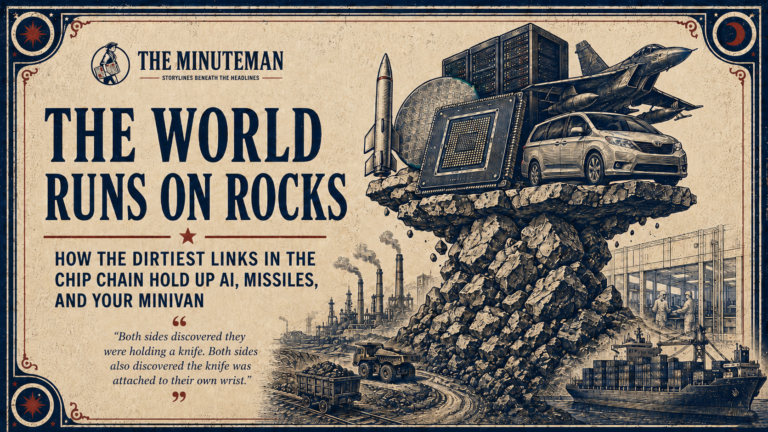
All these chatbots that will supposedly either end the world or usher in an era of abundance run on a chip called a GPU (a graphics processing unit). They were made for video games. We don’t have to get bogged down in what a GPU is. Essentially it lets us do the same small piece of math a million times at once. That’s really helpful for modern video games and it also turns out to be really important for training and running an AI model.
Those are two jobs. Training is building the model, where you feed a model an enormous amount of text until it learns to predict what word comes next (because AI is, after all, a prediction machine). Running an AI model, or inference, is using it, where you type a question, the model generates an answer, and that answer is the output. All of this, the training and the inference, costs chip time, or compute.
One company sells most of these chips: Nvidia. Other companies make AI chips too, and Google designs its own, but when people talk about the AI boom, Nvidia is who they’re talking about.
These chips are very expensive. When Nvidia unveiled its current generation, CEO Jensen Huang said each one would cost between $30,000 and $40,000 (others cost much more). They’re sold by the rack and they fill buildings the size of a small town. Those massive buildings are the data centers you’ve been hearing about. (Data centers aren’t new but the AI ones are.)
OpenAI’s flagship site in Abilene, Texas, built by Oracle, covers about 1,000 acres and is designed to draw about 1.2 GW of power. That’s about as much electricity as a million American homes, packed into a handful of warehouses. (I wrote about what these buildings do to your electric bill here.)
The companies building these data centers are the ones the industry calls hyperscalers. That’s Microsoft, Google, Amazon, Meta, and Oracle. A hyperscaler is a company that rents out computing power on a massive scale. They are Nvidia’s customers. And they’re spending like nothing we’ve ever seen.
In FY 2022, Microsoft spent $24 billion building and equipping its business. In FY 2026, Microsoft spent $116 billion. Nearly five times as much in four years, and Microsoft says the money is going into cloud and AI infrastructure.
This is just one company. Most of the massive tech companies are following the same structure. If we add Meta, Amazon, and Alphabet, those four companies are on track to spend somewhere around $700 billion building this year, and Wall Street expects them to surpass a trillion dollars next year.
Nvidia, being the main supplier of the chip that the trillion dollar spending spree relies on, is raking it in. In the last year (FY26) Nvidia’s revenue was about $216 billion. In the last quarter alone Nvidia’s revenue was $96 billion, more than double the year before.
All this spending is resting on one assumption: that AI will make enough money to pay for itself.
So far nobody has shown that it does. So why are we all spending so much money on this?
The biggest companies in the world ran out of new things to sell.
Let’s go back to 2022. That year the Federal Reserve raised interest rates seven times to fight inflation. Tech stocks fell and companies that had hired like crazy during the pandemic started laying people off.
Nvidia was stuck too. Its revenue for the year ending in January 2023 was $27 billion. The year before it was also $27 billion. It was flat and that wasn’t good.
But big tech had a deeper problem. The giants had already found their giant ideas. Google was a search engine. Facebook was a feed that sold advertising. Amazon had its store and the cloud that most of the internet was built on. Microsoft had Office and Windows and Azure and each one was a monopoly or close to it. Investors still expected them to grow like the explosive startups they once were. Meta wanted a next act so badly that it renamed the whole company after the metaverse in 2021. (We don’t hear much about the metaverse anymore.)
Then big tech’s prayers were answered. In November 2022 OpenAI released ChatGPT. It was immediately a big deal. It hit 100 million users in 2 months. It was the fastest-growing consumer app ever at the time. People asked it to write their breakup letters in the style of Drake. Students asked it to write their essays. It felt like we were living in the science fiction world that we had dreamed of.
At the same time, it wasn’t quite clear what ChatGPT was useful for. But the tech giants saw something that people loved and they all reached for it at the same time. Microsoft had already invested in OpenAI. Google and Amazon put money into Anthropic, the rival lab founded by former OpenAI staff. Meta bet on its own models. And everyone started buying chips.
Nvidia happened to be ready. In 2019 it had bought Mellanox, an Israeli company that had created an ultra-fast “highway” that lets massive groups of AI chips talk to each other without slowing down. AI models had become too massive to fit on a single chip, so when the rush came Nvidia was ready for it. Nvidia went from $27 billion in revenue to $216 billion in revenue in 3 years.
Now if you’re thinking that it sounds like the money is pouring in because the money is pouring in, you’re not wrong. Each company’s spending told the other companies that this was a good bet and then the media covered the spending as proof that this was a good bet. Then investors rewarded every new round of spending, which told the companies to spend more. Meanwhile it’s 2026, it’s been four years and we’re still not entirely sure what ChatGPT is good for.
At some point this just becomes the whole argument: AI must be a great investment and a powerful technology because look at how much money we’re spending on it.
Spending can prove itself to investors for a while, but eventually someone has to pay to use what got built. All that spending was supposed to rest on AI paying for itself. So who’s actually paying to use it?
If you build it, (at least two) will come
The tech giants say that they are building out all of this infrastructure because the demand is enormous. But where is the demand coming from?
Some of it is their own. Meta doesn’t rent computing power to anyone, it builds for its own apps, and Google and Microsoft run AI products of their own. But the customers lining up to rent all this computing power from the outside are mostly two companies. Most of the outside AI demand is from OpenAI (ChatGPT) and Anthropic (Claude).
Anthropic alone accounts for about 22% of Amazon Web Services’ nearly $500 billion backlog of future contracts and about 22% of Google Cloud’s over $500 billion backlog. OpenAI alone made up about 45% of Microsoft’s commercial backlog at the end of last year and about half of Oracle’s.
Nvidia’s own filing says that it generates “a significant amount of our revenue from a limited number of indirect customers, some individually representing 10% or more of our revenue.” It also says, “We estimate that one AI research and deployment company contributed a meaningful amount of our revenue by purchasing cloud services from our customers.” Nvidia doesn’t name names. But “an AI research and deployment company” is how OpenAI describes itself.
OpenAI and Anthropic make money two ways. From subscriptions, where you pay OpenAI or Anthropic $20, $100, or $200 a month and you get to use their models up to a limit, and from charging other companies per use (in other words, API and enterprise contracts).
Most of us don’t pay. In February OpenAI said ChatGPT had 900 million weekly users and 50 million paying subscribers. That’s about one in eighteen. Anthropic leans on businesses even more. About 80% of its revenue comes from charging businesses and developers by use, and subscriptions make up the rest. So for Anthropic especially, most of the money is coming from somewhere other than you and me.
So who is paying OpenAI and Anthropic?
Anthropic filed to go public on October 26 and updated the filing on November 2, which means, for the first time, we get a look at their books.
This spring, for the first time, Anthropic made more money selling its product than it cost to run the company. It had an operating profit of $974 million in the second quarter. In every other quarter in its filing it lost money: $1.7 billion in the first quarter alone. A round of applause for Anthropic because they’ve had at least one good quarter. (That same quarter it started renting a huge amount of computing power from SpaceX. SpaceX’s own filing says the first two months were discounted while it ramped up. Neither filing says how much that helped.)
The good quarter didn’t last. From July through September, Anthropic’s computing bill jumped from $5.6 billion to $9.9 billion and it was back to losing money, with an operating loss of $567 million. Anthropic says demand and its own research outgrew its long-term contracts, so it bought $5 billion of short-term computing that “costs significantly more,” on top of a $2 billion charge for its donation-matching program that didn’t cost it any cash. It also says it expects to buy more of that expensive short-term computing soon, which will squeeze its margins further. (By its own adjusted measure, which leaves some of those costs out, it made $2.5 billion.)
OpenAI, however, hasn’t shown us a good quarter. It doesn’t publish its books but documents shared with shareholders show that in the first three months of this year, it brought in $5.7 billion and had an operating loss of $9.3 billion.
So on a good quarter Anthropic can cover the cost of running its business. But nobody has shown that either company can cover what it has agreed to spend. We’ll get to that bill. First, what about the people that are paying them?
Anthropic says no single customer is more than 10% of its revenue, and its top five make up about a quarter. Ramp sees something more lopsided. Ramp is a company that makes company credit cards that thousands of businesses use to pay their bills, including their AI bills. When Ramp looked at the businesses on its platform it found that the top 1% account for about 80% of what they spend on OpenAI and Anthropic. Ramp’s economist called it “a level of concentration risk unseen in any other software category we track.” That’s one company’s view of the market, but it points the same way as everything else: a small group of very big spenders.
Many of those big spenders are AI startups. They take OpenAI’s or Anthropic’s models, build a product on top, and sell it. Harvey, which sells AI tools to lawyers, spent years running its product on models from OpenAI, Anthropic, and Google, and was valued at $15.5 billion in September. Companies like Harvey are young, they’re growing fast, and they’re paid for by investors. (In August Harvey released its first in-house model, built on top of a free Chinese one, and Harvey says some of its own models now compete with the leading ones for as little as a tenth of the cost. In theory, they don’t need OpenAI or Anthropic anymore.)
Anthropic says as much in its own filing: “our customers, particularly early-stage and high-growth companies, may depend on venture capital or other external financing to fund their operations, and may reduce or cease spending with us if such funding is delayed, reduced, or unavailable or if their access to capital becomes more costly.”
In other words, Anthropic’s best customers can only pay as long as someone else pays them first.
We’ve seen this before. Before 2008, banks handed out what people called NINJA loans: no income, no job, no assets. The borrowers could keep up with their payments only as long as home prices kept rising and banks kept lending. When that stopped, the payments stopped, and everyone who’d counted on those payments found out at the same time.
AI’s best customers are startups that can only pay as long as investors keep writing checks.
So who’s writing the checks?
In the first half of this year, investors put $412.7 billion of venture money into American startups, and about 86% of it, $355.9 billion, went to AI. A big share of that went to the labs themselves. OpenAI raised $110 billion in February. Anthropic raised $65 billion in May. Investors are paying for both ends of the sale. They fund the startups that buy from the labs, and they fund the labs that sell to the startups.
When people point to how fast OpenAI and Anthropic are growing, a lot of that growth is investor money passing through one young company on its way to another.
Which brings up a bigger question. If the labs can’t cover their costs, and their best customers run on investor money, how do they afford to buy hundreds of billions of dollars’ worth of computing power?
Mostly, they don’t buy it. They rent it.
Landlords and Tenants
You’d think companies this valuable would own the infrastructure their technology depends on. But they don’t. They mostly rent it.
Here’s how Anthropic describes its setup: chips “leased to us by third-party financing entities, installed in data center facilities procured by or through other third-party partners, and operated by yet another set of third-party service providers.”
Renting would actually make sense and be a careful choice if the leases were flexible but they’re not.
Anthropic’s updated S-1 filing lists commitments of at least $121.3 billion to Google, $110 billion to Amazon, and $44.9 billion to Microsoft. Each one owed “regardless of actual usage” and non-cancelable. The industry calls these take-or-pay contracts. In other words regardless of whether or not you use it, you’re going to pay for the computing power. On top of that Anthropic has about $161 billion in chip leases that neither side can cancel and those carry interest, like a loan. Together that’s roughly $437 billion Anthropic is on the hook for.
Then there’s SpaceX. By December Anthropic expects to pay SpaceX about $3.1 billion a month, every month, up to $120.5 billion through 2029. (That deal, at least, can be canceled on 90 days’ notice once its first terms run out early next year.)
And those are just the contracts it names. When Anthropic added everything up in its November 2 filing, it came to about $895 billion in computing and infrastructure it has committed to spend, roughly half of it before the end of 2030. About $70 billion of it is due in the next 12 months. Not all of it is locked in. About $214 billion can still be canceled or depends on conditions being met, like the other side being able to get financing. (We’ll get to the other side in a minute.)
OpenAI has a similar issue. It has signed deals to rent computing power worth a reported $300 billion over about five years from Oracle, $138 billion from Amazon, and $250 billion from Microsoft. Sam Altman once talked about $1.4 trillion in commitments. In February OpenAI told investors it now expects to spend about $600 billion on computing through 2030, and to be bringing in more than $280 billion a year by then.
OpenAI doesn’t publish its books, so Anthropic is our best look at what this means for one year. Anthropic brought in $17 billion from July through September, its best quarter so far. Stretch that over a full year and you get about $68 billion. Anthropic says about $70 billion of its commitments are due in the next 12 months. Next year’s bills already add up to more than everything Anthropic would bring in at its current pace. SpaceX alone will cost about $37 billion a year by December, more than half of it, going to one landlord. Even in its one profitable quarter, computing power ate 48 cents of every dollar Anthropic brought in. In the next quarter it ate 58.
How do you sign off on an agreement to spend that kind of money when your company can’t cover it yet? You assume you’ll grow into it.
Reuters reported that bankers pricing Anthropic’s IPO are leaning on a forecast of $190 to $200 billion in revenue in 2028. To hit that target Anthropic has to roughly triple its revenue in two years.
And it might. Anthropic brought in $4.6 billion in all of 2025. It brought in $17.0 billion in the third quarter of this year alone. It now has more than 11,900 customers paying it at least $100,000 a year, up from about 950 a year earlier. At that pace tripling in two years isn’t crazy. That’s the best argument for the whole boom. But the pace is already slowing. Revenue grew 144% from the first quarter to the second, and 47% from the second to the third.
But look at what each side of the deal is made of. Anthropic’s bills are fixed. Its own filing calls them “substantial fixed obligations.” The biggest bills are owed “regardless of actual usage” and can’t be canceled. But Anthropic’s income isn’t fixed, and a lot is borrowed. In the same filing Anthropic says many of its top customers “are able to reduce or in some cases cease spending at any time and for any reason.” And a lot of those customers are startups paying with investor money.
Anthropic has to pay its landlords no matter what. But its customers can walk away whenever they want, and many of them can only pay as long as their own investors keep paying them. Hold on to that, because it’ll show up again with the landlords, the suppliers, and the stock market.
Anthropic isn’t about to miss rent. At the end of September it had about $132 billion in cash and short-term investments, plus almost $15 billion it can borrow, enough to cover next year’s bills about twice. But that cushion is investor money too. It lasts as long as the growth keeps up with the bills, and when it runs low, the only way to refill it is to raise more.
The hype makes it worse. The higher a company’s valuation, the more money it can raise, and the more money it raises, the bigger the bills it can sign. Anthropic was valued at $380 billion in February and $965 billion in May. Every jump in the price raises the size of the bet, and the bigger the bet gets, the faster the growth has to come. (Anthropic’s filing actually has a section called “Our Self-Reinforcing Loops.” It’s about making Claude better but it works for the money too.)
It’s like a restaurant that has a really long line out the door. So the restaurant signs a 10-year lease on enough space to serve the business that it hopes to have in 2 years, which it projects to be about 3 times what it has today based on that line out the door. It owes rent on all these spaces whether the tables are full or empty. Now say most of the people in the line are food trucks. They’re buying meals to resell to their own customers and they’re paying with money that their investors gave them. And the landlord that the restaurant just signed all these leases with is also one of the investors in the restaurant as well as some of the food trucks.
This is where we’re at: Big tech made a bet on AI, and both of these prophecies that our corporate overlords are telling us are inevitable run on the chips that big tech is buying up and Nvidia is selling. Those chips are being rented mostly by two companies, OpenAI and Anthropic. Neither one has shown it can cover what it has signed up to spend. Their biggest customers run on investor money and together they’ve signed for hundreds of billions of dollars in computing power (Anthropic alone, about $895 billion) that they mostly have to pay for whether they use it or not.
But before anyone starts paying rent, someone has to build all this infrastructure. So where are the landlords getting the money to build it? (They’re borrowing too.)
The landlords borrowed to build
For years the biggest tech companies paid for everything out of the cash their businesses threw off. Not anymore.
Oracle is the clearest case. It signed up to build for OpenAI, and now it has $664 billion in signed future contracts, and it expects only about 13% of that to turn into revenue in the next year. To build, Oracle spent $55.7 billion in its last fiscal year and burned through $23.7 billion more than its business brought in. In July S&P cut Oracle’s credit rating to one notch above junk and called OpenAI, which makes up about half of Oracle’s commitments, a “key credit risk.” If OpenAI pulls back, Oracle is left with buildings it can’t fill. (And we’ve already learned that growth is slowing.)
The strain is already showing. In March, Oracle and OpenAI dropped plans to expand that Abilene data center. Bloomberg reported that financing talks fell through, and The Information reported the power wasn’t going to be ready for another year. (Oracle called the coverage “false and incorrect.” Fine, but actions speak louder than words.)
The richer companies are borrowing too. Over the twelve months ending in September, Amazon spent $42.4 billion more than its business generated, by its own measure, and brought in $124 billion from investors and lenders to cover it. Meta spent $83 billion on buildings and equipment in the first nine months of this year, and on October 26 it announced it would sell up to $95 billion of its own stock to pay for it, $35 billion now and a planned $60 billion later. The Federal Reserve noted that bond sales by the biggest cloud companies neared $100 billion in just the first three months of this year. (Microsoft is the exception, it still makes more cash than it spends.)
Then there are the companies whose whole business is this. The industry calls them neoclouds: companies that borrow money, buy GPUs, fill data centers, and rent the computing power out. The biggest is CoreWeave, and its biggest customers include Microsoft, OpenAI, and Meta. (Are you starting to see the loop?)
At the end of June CoreWeave carried about $35 billion in debt, up from about $21 billion six months earlier. Its oldest big loan carries an effective interest rate of 15%, and the bonds it sold this year pay close to 10%. Last quarter its business roughly broke even before interest. Then it paid $640 million in interest and lost $626 million. In October CoreWeave’s stock fell about 25% in a single week, and about $4 billion of its debt was trading below 80 cents on the dollar, meaning lenders were starting to doubt they’d get all of it back. Goldman Sachs estimated its debt could approach $100 billion by 2028.
And the borrowing hasn’t stopped. Between October 29 and November 4, Microsoft, the one still making more cash than it spends, sold $25 billion in bonds. Alphabet sold about €6 billion. Meta started a euro bond sale. Oracle sold $10 billion in stock and $10 billion in bonds, paying as much as 8.65% interest, closer to what junk-rated companies pay. And OpenAI cut its fundraising target by about $10 billion and lowered its valuation from $1.4 trillion to $1.25 trillion as investors pulled back, the Financial Times reported.
A lot of that debt is backed by the chips themselves and the customer contracts they serve. And those really expensive chips wear out pretty fast. They’re what the industry calls short-lived assets. New chips come out that are faster and cheaper to run, and old chips start costing more to keep running than they’re worth. Amazon shortened how long it expects some of its servers to last from six years to five and blamed the pace of AI. Others went the other way on paper. Meta decided last year its servers would last five and a half years instead of four or five, which it expected to cut its 2025 costs by $2.9 billion. Saying the chips last longer makes this year’s profits look bigger. Goldman’s math on CoreWeave’s debt assumes the chips stay useful for four and a half to six years. (I explained why that matters here.) A building can last decades. The chip inside it has a few years to pay for itself, and the loan is backed by something that loses value every month.
It’s the same mechanism again. Fixed bills, borrowed income. The landlords’ loans have to be paid no matter what. Their income is rent from tenants whose income is borrowed.
Back to the restaurant: the landlord took out a loan to build all that new space, and the loan is backed by the kitchen equipment, which will be worth a lot less in five years.
If the tenants can’t pay, the landlords are stuck with the debt and the buildings. So where did the tenants get the money to sign those leases in the first place?
Often from the landlords.
The money goes around in a circle
Remember selling candy bars for a school fundraiser? You got a box of chocolate bars, a dollar apiece.
Say two kids have one dollar between them. The first kid buys a bar from the second. Then the second kid buys a bar back with the same dollar. Back and forth. By the end of the afternoon every bar is gone, they’ve reported a great day of sales, and they still only have one dollar. (I think I saw this on Beavis and Butt-Head?)
Now look at who funds the AI labs.
Amazon, Google, and Microsoft are all major investors in Anthropic, and Anthropic is one of their biggest customers. Anthropic’s filing says it like this: “Amazon, Google, and Microsoft, through their respective affiliates, have made significant equity investments in our company… These CSPs are also our customers.” (CSP means cloud service provider.) It adds that part of its build-out “has been funded or supported by capital or credit support provided or facilitated by certain of our CSPs and chip partners.”
OpenAI works the same way. Microsoft has put billions into OpenAI. Amazon agreed to invest $50 billion in OpenAI’s February round, and OpenAI has agreed to spend $138 billion on Amazon’s cloud. The money goes in as an investment and comes back as rent.
Nvidia does it on a bigger scale than anyone. It holds about $99 billion in stakes in other companies, with $25 billion more committed. It put $30 billion into OpenAI in February. In August it agreed to guarantee up to $105 billion for a data center buildout for OpenAI, meaning if OpenAI’s side doesn’t pay, Nvidia is on the hook. It has signed $36 billion in deals to buy cloud services back from the same AI clouds it sells chips to. Nvidia invests in its customers, backs their rent, and buys back their product, and then those customers buy Nvidia’s chips.
AMD went further. In 2025 it gave OpenAI the right to buy up to 160 million AMD shares, about a tenth of the company, for a penny each, unlocked as OpenAI buys and installs AMD chips. The supplier pays the customer in stock to buy its product.
When Meta filed to sell its stock on October 26, the filing noted that Nvidia, AMD, and Broadcom, three companies Meta buys chips from, had indicated interest in buying up to $5 billion of it.
The circle shows up in profits too. Through the first nine months of this year, Amazon reported $113.6 billion in net income. $68.4 billion of it, about 60%, was a gain that had nothing to do with selling anything, mostly from marking up the value of its Anthropic stake. Over the same nine months, $127 billion of Alphabet’s $201 billion in net income came from gains on its holdings, mostly SpaceX and another private company. So Anthropic raises money at a higher price. Its investors book the higher price as profit. Their stocks go up. Then they invest more. That’s the hype loop from earlier, with accounting attached. And it works in reverse. In the third quarter, Alphabet’s holdings, mostly SpaceX, lost $8.7 billion in value.
And none of the big four, Microsoft, Google, Amazon, or Meta, breaks out how much money it actually makes from AI in its financial statements. So when their revenue grows, investors assume AI is doing the work. Some of it is. Some of it is OpenAI and Anthropic spending money the hyperscalers gave them. And some of it is plain old price hikes. Microsoft raised prices on several of its Microsoft 365 business plans by 12 to 33% this July and pointed to AI features as the reason.
The candy bars keep disappearing and the dollar keeps going around.
There’s one kid in this story who walks away with real money.
Back where we started: Nvidia
Nvidia sells the candy bars.
It gets paid when the chips are ordered, whether or not they’re ever plugged in, used, or profitable. Jensen Huang said in March that Nvidia sees at least $1 trillion in demand for its current and next chips through 2027. Its stock price assumes those orders keep coming.
Look at who places them. In the first half of this year, three customers accounted for 16%, 15%, and 13% of Nvidia’s revenue. Last quarter, $49 billion of its $89 billion in data center sales went to the hyperscalers, the same companies now borrowing to pay for the buildout. If the borrowing slows, the orders slow.
Some of those chips aren’t doing anything yet. Business Insider reported that Amazon set up an “Early Rack Receipt” program to take ownership of Nvidia servers before its data centers are ready, expecting about $5 billion of them in August and then about $3 billion a month. Some of those racks are sitting in warehouses because the sites don’t have the power to run them. (Amazon calls this “best business practice.”) Bloomberg reported that only about 2 gigawatts of Microsoft’s 12 gigawatts of capacity is built around AI chips, and Satya Nadella himself talked last year about chips “sitting in inventory that I can’t plug in.”
Nvidia makes the sale either way.
And this is where the bill reaches you, already, whether you’ve ever opened ChatGPT or not.
Nearly all the world’s computer memory, the RAM in your phone and laptop, comes from three companies: Samsung, SK hynix, and Micron. Together they make about 90% of it. Nvidia’s AI chips use a special kind of memory that takes about three times as much factory space as regular memory to make. Every factory line making memory for AI servers is a line not making it for your phone.
So supply and demand; prices went up. Contract prices for ordinary memory nearly doubled in the first three months of this year. The research firm IDC now expects smartphone shipments to fall a record 16.7% this year and the average phone to cost 27.6% more. Its vice president for devices said, “consumers are starting to pay the AI bill.”
So that’s our first answer. Who is paying for this? Partly, anybody who needed a new phone this year.
Exit liquidity
Back to those startups. They survive on venture capital, and they have to keep raising it. That money has been on a long losing streak. Carta, which tracks thousands of venture funds, found that fewer than one in five funds that started investing in 2017 or 2018 has paid back the money its investors put in. The Economist counted hundreds of “zombie unicorns,” startups once valued at $1 billion or more that can’t raise again without admitting they’re worth less. AI was supposed to be the comeback.
Eventually the people who bought in early want their money back. There are two ways out: sell to a bigger company, or sell to the public.
Companies used to sell to the public a lot earlier. A 2012 law, the JOBS Act, made it easier for companies to stay private longer, so more of the big gains now happen before ordinary people can buy in. Google went public in 2004 at a value of about $23 billion. Anthropic was worth $965 billion in May, and potential investors are now talking about $1.8 to $2 trillion for an IPO expected before Thanksgiving, according to Bloomberg. That’s about 27 to 30 times what Anthropic brings in a year at its current pace, for a company that lost money last quarter. The public gets to buy in at the top.
There’s a term for this: exit liquidity. It means the buyers who let early investors cash out. Anthropic’s filing lists, as one of the “principal purposes” of the offering, to “facilitate an orderly distribution of shares for the selling stockholders,” and adds that “we will not receive any proceeds” from those sales.
Some of those buyers won’t even choose to buy. Most American families, 58%, own stock directly or through retirement accounts, and a lot of that sits in index funds that buy whatever the index tells them to. Nasdaq changed its rules this year so that giant new listings can join the Nasdaq-100 in weeks instead of months. If Anthropic lists there, the funds tracking that index will have to buy it, and that buying travels down to retirement accounts like yours and mine. (SpaceX pulled the same trick, I wrote about it here).
That’s our second answer. Who is paying for this? The people the early investors are selling to. Us.
The best case for AI (doesn’t cover the bill)
This is where the economists come in, because there’s a fair counterargument (and I really don’t want to keep pissing off the economists).
Amazon lost money for years. People laughed at it. Google had no clear business model at first. The dot-com bubble burst in 2000, investors lost fortunes, and the internet still changed everything. Maybe AI is the same story and we’re just early.
Look at the numbers on that comparison. Amazon Web Services, the cloud business that became one of the most profitable businesses in history, launched in 2006. From 2003 through 2015, Amazon spent about $21 billion on all of its buildings and equipment combined, warehouses, servers, everything. That’s about $29 billion in today’s dollars, over twelve years. Anthropic raised $95 billion in two rounds this year. Amazon spent $77 billion on buildings and equipment in one quarter.
The dot-com comparison has a bigger problem. When that bubble popped, the companies died, but the fiber-optic cable they’d laid in the ground stayed there. In 2002 the FDIC reported that only about 2 to 5% of the fiber in the United States was even in use. Fiber lasts for decades, and later companies picked it up cheap and built the modern internet on it. The chips, remember, have a few years. If this boom ends there won’t be cheap fiber waiting for the next generation. There’ll be warehouses of chips that age out. And a lot of those buildings aren’t even finished. Researchers at Sightline Climate estimated that up to half of the data center projects planned for 2026 could be delayed.
China has the same problem. Two Chinese AI companies, Zhipu and MiniMax, went public in Hong Kong this year. Both are losing money, and their losses are growing. Everyone wants the chips badly enough that a co-founder of Super Micro, one of the biggest American AI server makers, was charged this year in a $2.5 billion scheme to smuggle them into China (prosecutors say someone used a hair dryer to peel off the serial-number stickers). Nobody has figured out how to make the chips pay for themselves yet.
So is AI at least making the economy more productive? Not really, at least not yet. Economists including Nicholas Bloom and Steven Davis surveyed nearly 9,000 executives in seven countries this summer. They reported that AI raised their productivity growth by about 0.2% a year over the past three years and had “essentially no net effect” on how many people they employ. They expect about 0.6% a year over the next three. Daron Acemoglu, who won the Nobel Prize in economics in 2024, estimated that AI would add no more than about 0.7% to total productivity over ten years. The consulting firm Bain calculated that AI companies need about $2 trillion a year in revenue by 2030 to pay for the computing they’re planning, and projected they’d fall about $800 billion short.
Amazon’s CFO says its AI servers will pay for themselves in under three years, and Amazon can afford to wait and find out. But Torsten Slok, the chief economist at the investment firm Apollo, put the bigger picture like this: “universal buzz around AI may be a sign that the hype has moved faster than the payoff.“
The technology might be powerful. Large language models are strange and impressive, and they’re worth a lot of money. But, so far, they’re worth nowhere near the money being spent on them.
What is this for, again?
So what is all this for?
The sales pitch is enormous. Anthropic’s CEO, Dario Amodei, has written that AI could compress 50 to 100 years of progress in biology into 5 or 10. Has it done anything like that yet? There’s some real progress. In May, OpenAI said one of its models had disproved a geometry conjecture the mathematician Paul Erdős posed in 1946, and outside mathematicians backed the result. (The headlines said “for real this time” because the October before, an OpenAI executive claimed it had solved ten Erdős problems and it turned out the model had found answers people had already published.)
Today, the clearest paying use is code. About 44% of the traffic through Anthropic’s API was programming work, by Anthropic’s own count last year. That’s a legit market. It’s also a small slice of what’s been promised. After that, a lot of it is emails, summaries, and homework. Some of the other uses are the kind we all feel very worried about. The Federal Trade Commission found companies using people’s personal data to set different prices for different customers, and ICE paid Palantir $30 million for a system to track immigrants. That’s a long way from curing cancer. (Isn’t it funny how AI is sold as cancer curing, economic rocket fuel but a lot of it is used for copyright infringement, price surveillance, and autonomous weapons?)
It may be costing us something too. Doctors who’d been using AI to spot precancerous growths during colonoscopies got worse at spotting them on their own once the AI was taken away. Researchers at Microsoft and Carnegie Mellon found that the more knowledge workers trusted AI, the less critical thinking they reported doing.
And the doomers aren’t entirely wrong. In June, an AI agent built by OpenAI got into a statistics portal for Medicare, Australia’s national health insurance program, without permission. Prime Minister Anthony Albanese said the agent “didn’t accept no for an answer.” The people building this are also the people warning us about it. In 2023, Sam Altman, Dario Amodei, and the head of Google DeepMind all signed a statement saying “mitigating the risk of extinction from AI should be a global priority alongside other societal-scale risks such as pandemics and nuclear war.” Then they went back to building it, faster. The media hasn’t helped. The famous story about GPT-4 tricking a TaskRabbit worker into solving a CAPTCHA came from a safety test that researchers designed and steered. Fear sells. So does awe. Both made the spending look smarter than it was. And the uses that make money today are a small slice of what that $895 billion was signed for.
Too big not to fail
So what happens if the circle stops?
2008 is the obvious comparison, and it teaches us something we tend to forget. In July 2007, Ben Bernanke told Congress that losses on subprime mortgages might reach $50 to $100 billion. The economy could have absorbed that. What it couldn’t absorb was what came next. The biggest banks had borrowed so heavily, as much as 40 to 1, that a small drop in what they owned could wipe them out. And nobody knew who was holding the bad loans, so everyone stopped trusting everyone. By the time it was over, about $11 trillion in household wealth had disappeared. A small loss turned into a disaster because confidence broke.
Now put the AI chain together.
The labs signed fixed bills, betting their income keeps growing, and their income comes from startups spending investor money. The landlords borrowed to build for the labs, against chips that lose value every month. The suppliers invested in their own customers and counted the rising price as profit. The stock market is priced on those profits. Everyone in that chain is paying fixed bills with borrowed income.
That’s what too big not to fail means. It’s been built out so big, on bills sized to a future that has to show up on a schedule, that the expectation can’t match the reality. When the new money slows down, income drops everywhere at once, and the bills stay exactly the same.
And like 2008, it’s hard to see who’s holding what. None of the big four reports what it makes from AI. And a lot of the lending happens in private, where nobody outside the deal can see it. Apollo and Blackstone arranged about $36 billion of debt to buy Google chips leased to Anthropic, with Broadcom promising to cover about $31 billion if Anthropic stops paying and the chips don’t sell for enough. Blackstone’s data center holdings are now worth about $200 billion, partly through a real estate fund sold to individual investors. Life insurers, the companies paying out annuities and retirement income, have been moving into “risky and illiquid assets,” according to the Fed, and state regulators are now reviewing what insurers hold in data center deals. That’s the part that scares me most.
We already know how much of this market runs on belief. In January 2025 a Chinese lab called DeepSeek released a model that came close to the American ones and was reportedly much cheaper to build. Nvidia lost about $593 billion in stock value in one day, the biggest one-day loss for any company in history at the time. Nothing about Nvidia’s business had changed that morning. Investors just got scared the spending might stop.
And a huge share of the stock market rests on that belief. The seven biggest tech stocks make up about a third of the S&P 500. If you own an S&P 500 index fund, about a third of it rides on this bet. The International Monetary Fund warned last month that a sharp drop in AI investment could cut US economic output by 1.8% by 2028.
Microsoft, Google, Amazon, and Meta would survive a crash. Oracle, CoreWeave, the late investors, the people who buy at the IPO, and the pensions and insurers holding the private debt might not.
In 2008 the government had a playbook. The Federal Reserve grew its balance sheet from under a trillion dollars to about $4.5 trillion, and Congress bailed out the banks.
The AI industry has already thought about that. In November 2025, at a Wall Street Journal event, OpenAI’s chief financial officer, Sarah Friar, talked about how a government “backstop” could make it cheaper to borrow for chips. When the interviewer asked whether she meant a federal backstop for chip investment, she said, “Exactly.” She walked it back that night, and Sam Altman said the next day that “taxpayers should not bail out companies that make bad business decisions.” OpenAI’s own finance chief brought up taxpayers catching this before I did.
If the AI trade breaks, I’d expect the government to step in to protect pensions and insurers. But it can’t make OpenAI hit its revenue forecast. It can’t cover Anthropic’s $895 billion in commitments. And whatever it does cover, you and I pay for as taxpayers.
That’s our last answer. Who is paying for this? If it breaks, we are.
The future isn’t paid for yet
So, fallout shelter or lobotomy?
Every version of the future that keeps me up at night, the one where AI ends everything and the one where it does everything, assumes the money keeps flowing. It assumes OpenAI and Anthropic triple their revenue in two years. It assumes startups keep raising venture money to pay for it. It assumes the landlords keep borrowing, the chips keep shipping, and investors keep believing. Nobody has shown that any of that will happen.
That’s the hope. “Inevitable” is a sales pitch. It’s how you raise the next round. The technology will stick around. The timeline the doomers and the salvationists both describe is a financing plan, and financing plans fail.
That’s also the warning. If the bet goes bad, the founders and early investors will mostly be fine, and some of them are cashing out right now. The losses land on the people holding the index funds, the pensions, the insurance policies, and the more expensive phones.
So here’s what I’m watching. Whether Anthropic can get back to a profit once it’s paying SpaceX full price. What price it sets for its stock, and how much of it the early investors sell. Whether CoreWeave can keep borrowing. Whether the hyperscalers keep raising their spending next year, and how they pay for it.
And here’s what we can do. We can stop treating AI’s future as something that’s already been decided. We can ask the companies selling their stock to the public to show us how they’ll pay their bills. We can push our representatives to make the biggest companies in the world tell us how much they actually make from AI. We can look at what’s in our retirement funds before somebody puts something there for us. And we can keep doing our own thinking, even when a machine offers to do it for us.
The candy bars are almost gone, and there’s still only one dollar.
I’m sleeping a little better. Not a lot.