The Supreme Court Just Declared Trump’s Tariffs Illegal. So Why Is There Still a 15% “Global Tariff” on the Table?
On paper, a Supreme Court ruling should settle things. In real life, if you run a small business that imports parts, if you’re shopping for a car seat, or if you’re watching your grocery bill creep up again, it can feel like the ground is still moving.
That is because the Court did not rule that tariffs are illegal. It ruled that one legal route Trump used to impose them was illegal. And the U.S. tariff toolbox is bigger than most people realize.
Here’s what tariffs are, what kinds exist, what the Supreme Court actually struck down, how Trump can still announce more, and what it likely means for people trying to make a living.
What tariffs are (in plain English)
A tariff is a tax charged at the border on imported goods. If a company brings $1 million of products into the U.S. and there’s a 10% tariff, that importer owes $100,000 to the government. Tariffs are collected by U.S. Customs and Border Protection at the time goods enter the country.
Who pays first? The importer (the U.S. company bringing goods in). Who pays in the end? That often gets split between importers, foreign suppliers, retailers, and consumers depending on bargaining power and market conditions, which is why tariff fights quickly turn into cost-of-living fights.
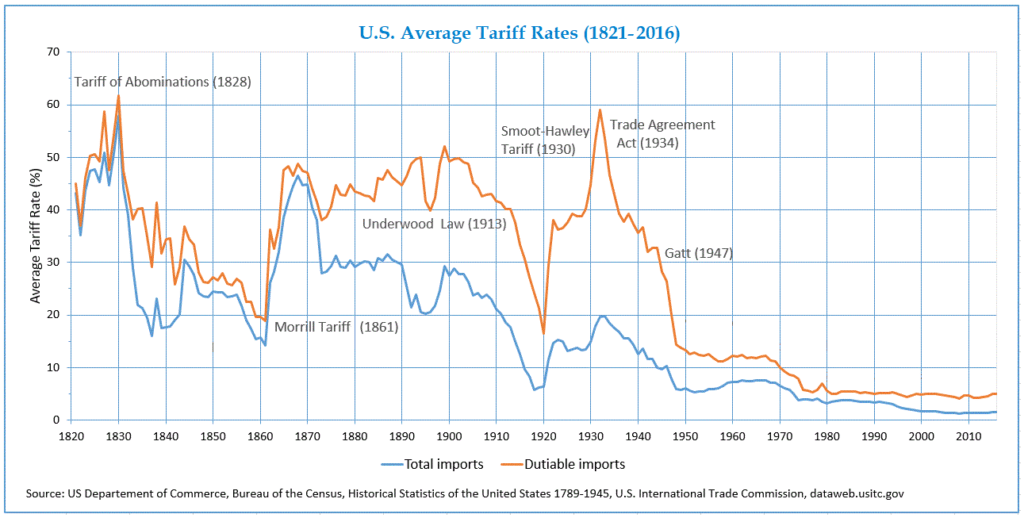
The main types of tariffs you’ll hear about
By how they’re calculated
- Ad valorem tariffs: charged as a percentage of the item’s value (example: 10% of the invoice price).
- Specific tariffs: charged as a fixed amount per unit (example: $2 per shirt).
- Tariff-rate quotas (TRQs): low tariff up to a quota, higher tariff above it (common in agriculture).
By what they’re trying to do
- Revenue tariffs: raise money for the government.
- Protective tariffs: make imports more expensive to give domestic producers an edge.
- Retaliatory tariffs: punishment or leverage against another country’s trade practices.
By legal “lane” in U.S. law (this is the key to the current moment)
Different laws authorize different kinds of tariffs, with different limits and procedures. Common lanes include:
- Section 232 (national security): Commerce investigates, the President can impose tariffs or restrictions.
- Section 301 (unfair trade practices): used after USTR investigations into another country’s practices.
- Section 201 (safeguards): for “serious injury” to a domestic industry from increased imports, based on USITC process.
- AD/CVD duties (anti-dumping/countervailing): targeted duties meant to offset dumping or subsidies, run through Commerce + USITC processes.
- Section 122 (balance-of-payments emergency): a rarely used authority that allows a temporary across-the-board surcharge up to 15% for up to 150 days.
The tariffs at issue in the Supreme Court case weren’t imposed under the usual legal pathways described above. They were imposed under IEEPA, an emergency-powers law, and the Court ruled that IEEPA doesn’t authorize tariffs.
What is the IEEPA (International Emergency Economic Powers Act): The lane Trump used for tariffs; the Court said this lane doesn’t authorize tariffs. It’s an emergency-powers statute that the administration used as the legal hook to impose the “drug trafficking” tariffs and the broad “reciprocal” tariffs. The Supreme Court’s ruling was essentially: IEEPA is not a tariff lane.
The Supreme Court decision, Trump’s response, and where we are now come down to these legal lanes for imposing tariffs.
What tariffs the Supreme Court ruled on
The Court’s decision in Learning Resources, Inc. v. Trump held that the International Emergency Economic Powers Act (IEEPA) does not authorize the president to impose tariffs.
The tariffs at issue were the administration’s IEEPA-based tariffs, including two big buckets described in reporting and in the case record:
- “Trafficking” (fentanyl) tariffs targeting imports from China, Canada, and Mexico. The case syllabus describes tariffs such as 25% duties on most Canadian and Mexican imports and 10% duties on most Chinese imports tied to that rationale.
- “Reciprocal” tariffs that imposed an initial 10% tariff on imports from almost all countries, with higher rates for dozens of countries.
The key point: the Court was not weighing whether tariffs are a wise policy. It was saying Congress did not clearly give the president that tariff power in IEEPA.
What happens to those struck-down tariffs now?
U.S. Customs and Border Protection said it would stop collecting tariffs imposed under IEEPA and deactivate tariff codes tied to those orders.
That raises a huge follow-on question: refunds. Reuters reported that the decision could put more than $175 billion in tariff revenue potentially in refund territory, based on estimates from Penn-Wharton Budget Model economists, and that the IEEPA tariffs had been generating over $500 million per day in gross revenue.
Refund mechanics can become their own legal and administrative battle, and uncertainty here is part of what businesses are reacting to.
So how can Trump announce more tariffs anyway?
Because the ruling did not say “the president can’t impose tariffs.” It said “IEEPA doesn’t give him that power.”
Trump moved immediately to a different lane: Section 122 of the Trade Act of 1974.
The new tariff: Section 122 “temporary import duty”
The White House issued a proclamation and fact sheet describing a temporary 10% ad valorem import duty for 150 days, under Section 122, framed as addressing “fundamental international payments problems.”
Reuters and other reporting describe the administration’s intent to push that temporary global tariff to 15%, though Customs can only collect what is formally ordered and published.
Why Section 122 matters
Section 122 is one of the few tools that can look like a broad “across-the-board” tariff, but it is also time-limited and condition-based (tied to a “serious” balance-of-payments situation).
That is why legal analysts and economists are already debating whether the administration’s use of Section 122 fits what the law was designed for.
And Trump can still reach for other authorities
Even after the IEEPA loss, most of the existing U.S. tariff machinery remains available. Reuters has reported the administration is also considering new national security tariffs under Section 232 in additional sectors.
So, yes: the Supreme Court clipped one branch of tariff power, but it did not remove the tree.
What this means for people trying to make a living
This is the part that gets lost in the cable-news version, because tariffs are often treated like a scoreboard of “tough” versus “weak.” For most households and employers, tariffs are something else: a moving cost shock with paperwork attached.
1) Prices can rise, but not always evenly or immediately
Tariffs hit inputs (parts, materials) and finished goods. When a tariff lands on an input, it can ripple through domestic production too. When it lands on a finished good, retailers and importers decide how much to pass on.
The result is rarely a clean “10% tariff equals 10% higher prices.” It is more like: higher costs show up where supply chains are tight, competition is limited, or contracts renew.
2) Volatility is its own tax
Even businesses that can handle a tariff rate struggle with a system where the rate can change quickly, or where the legal basis is shaky and refunds may appear later.
That uncertainty freezes decisions:
- Do you place inventory orders now or wait?
- Do you hire, or hold cash because your costs might jump next month?
- Do you sign a one-year contract when your landed costs might change midstream?
That is why trade policy can feel like it is happening “on TV” while it quietly changes the risk calculus on Main Street.
3) Some workers and industries may benefit, others get squeezed
Tariffs can help certain domestic producers compete, especially if they have spare capacity and can scale quickly. But industries that rely on imported components can see margins get crushed, and retaliation abroad can hit exporters.
The real-world effect is often a reshuffling: winners and losers inside the same economy, sometimes inside the same town.
4) The court fight doesn’t end the tariff fight, it relocates it
The Supreme Court decision is a message about who gets to tax and how clearly Congress must speak when delegating big economic power.
But for households, the practical consequence is that tariff policy is now more likely to be shaped by:
- which statutory lane the administration chooses next,
- how courts interpret the limits of that lane,
- and how quickly businesses can adjust.
In other words, the instability may persist even as the legal rationale changes.
The bottom line
Tariffs are taxes at the border, and they are powerful because they can move through the economy fast. The Supreme Court ruled that Trump’s IEEPA-based tariffs (including the fentanyl-linked “trafficking” tariffs and broad “reciprocal” tariffs) were imposed under the wrong legal authority, and Customs is stopping collection of those IEEPA duties.
But the administration can still impose new tariffs through other laws, and it has already pivoted to Section 122, which allows a temporary, across-the-board surcharge for up to 150 days.
For the rest of us, the biggest immediate story is not just “tariffs up or down.” It is that trade policy has become a high-speed lever, and when that lever moves, it changes prices, planning, hiring, and risk for ordinary people long before it shows up as a clear line item on a receipt.

Did Trump Save You Money in His First Year?

Iran in 2026: The currency crash, the uranium clock, and the thin line between a deal and a war

The Myth of Trickle-Down Economics: Why the Next Dollar Doesn’t Reach the Middle Class