Somebody Paid to Make Socialism a Slur
The federal government owns 640 million acres of land, 170 hospitals, and about 10 percent of Intel, and no one calls it socialism. This is what socialism actually means and who the word gets used against.
Nobody calls the fire department socialism
When your house is burning down, nobody comes up to you and has you pay a bill first. A truck shows up that the government owns, from a fire station that the government owns, using a hydrant that the government owns, worked by people who are employed and paid by the government through your taxes. There are something like 29,000 fire departments in this country, more than 360,000 career firefighters, and nearly 680,000 volunteers.
You send your kids to schools, in buildings that the government owns, to be taught by teachers employed by the government, funded in large part by property taxes you pay whether or not you have children in them. Nearly 50 million students attend public schools, taught by more than 3 million teachers.
The largest integrated health system in the country is owned by the government. The VA health system owns the hospitals and the doctors are federal employees. It serves 9.1 million enrolled veterans, and it is a textbook definition of socialized medicine.
All of it fits the standard definition of socialism, where the public owns the assets and employs the workers, and no one (no one reasonable) calls it socialism.
But now you’re skeptical. You’re skeptical of socialism and you’re skeptical of everything I’ve just said, and you’re probably saying to yourself, “Lots of people called the VA socialized medicine.” Or you’re saying to yourself, “My fire hydrants belong to the water utility, a utility that is investor-owned. That’s not socialism.” Or perhaps you’re saying, “That’s not what socialism means.”
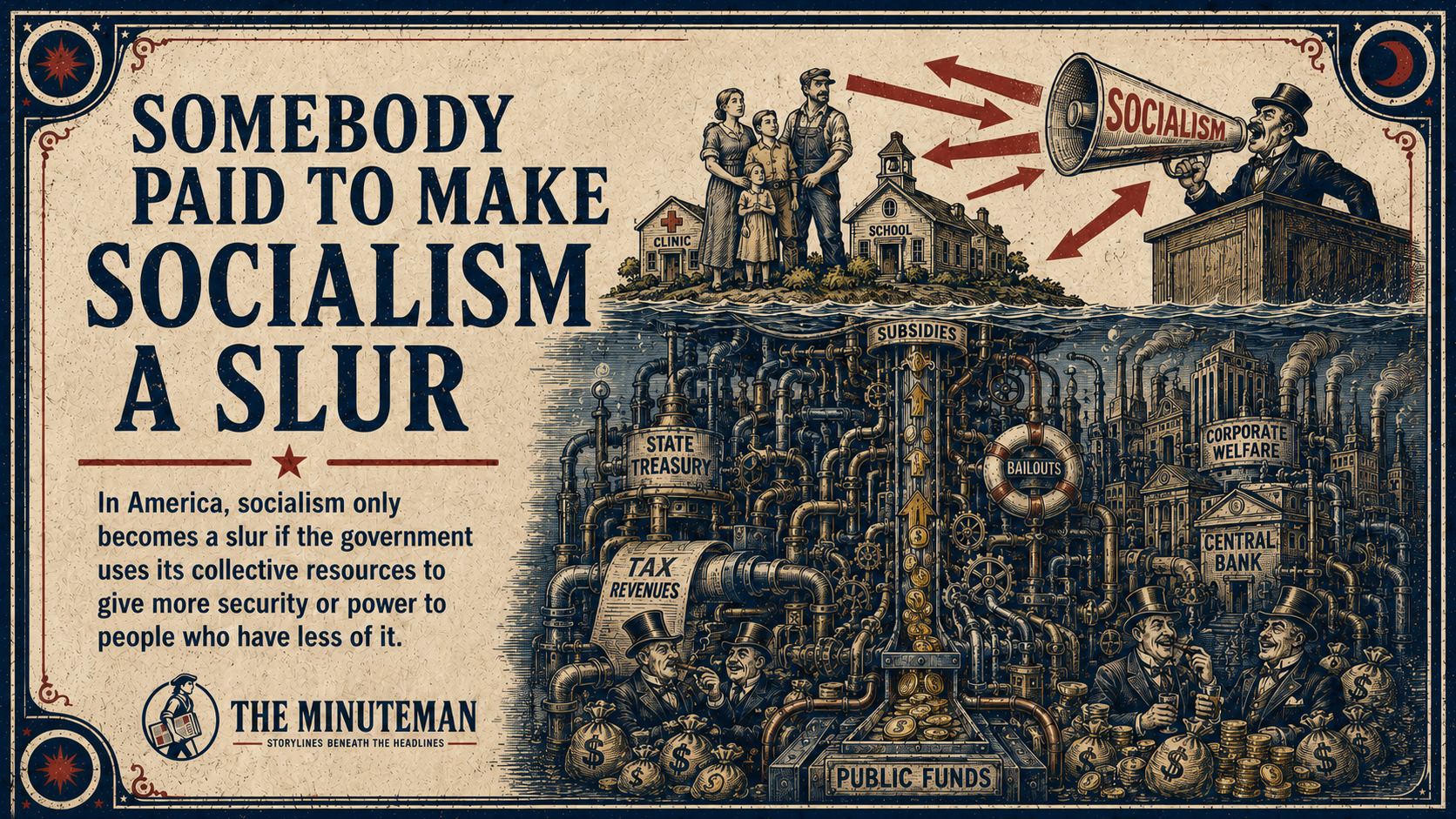
In America, socialism only becomes a slur if the government uses its collective resources to give more security or power to people who have less of it. When the government assumes costs or risks for those who already have power, we tend to call it something else. We don’t consistently object to socialization in this country. We object to who receives it.
What the word means
Let’s start with the definition.
The standard definition is social ownership of the means of production. The “means of production” are the things used to make other things. Your toothbrush is not one. A factory is. A power line is. A hospital building is. And social ownership has more than one form: direct public ownership, where the government owns the asset. Common ownership, where a whole society holds it without state involvement. Cooperative ownership, where the thing is owned by the people who work there or the people it serves. A volunteer fire company owned by its members and funded by the town it serves is cooperative ownership.
Historically, socialism was seen as the midpoint between capitalism and communism, so picture a line with those two at the ends.
Capitalism places the means of production, the thing that makes other things, into private hands. The downside of capitalism is that when it’s unregulated it can lead to the exploitation of labor and the concentration of wealth in the hands of very few.
Communism, particularly twentieth-century communism, handed the means of production to a one-party state that set prices and prohibited opposition. Originally the idea of communism was to create a classless society with absolute equality, where the government dictates the price, supply, and distribution of goods. The downside of that is that the only practical way to redistribute wealth with absolute equality tends to be force. So these governments usually end up becoming authoritarian regimes.
Socialism comes in right down the middle. The public owns the society’s major productive assets, through the government, cooperatives, or the workers, while some market systems still determine supply and demand. The downside of socialism is that it is very vulnerable to corruption. If the people running that system are corrupt, it skews toward authoritarianism too.
Democratic socialism then squeezes in between capitalism and socialism. It is socialism with a commitment to political democracy: elections, political pluralism, civil liberties, unions, and popular participation. It rejects the thing we actually fear from twentieth-century communism, the one-party rule that sets price, supply, and distribution.
The last term you need is social democracy. Social democracy leaves capitalism and private ownership intact and uses taxes, regulation, unions, and public programs to spread the benefits and risks more broadly. Universal health care, subsidized public college, strong labor protections, and a generous welfare state do not, by themselves, make an economy socialist.
I promise we are not hair-splitting here. People assign the word socialism to Denmark, and the Danish prime minister has said: “Denmark is far from a socialist planned economy. Denmark is a market economy.” People assign the word to Bernie Sanders, and Sanders has defined democratic socialism twice in formal speeches, at Georgetown in 2015 and George Washington in 2019, both times as Franklin Roosevelt’s unfinished Economic Bill of Rights: guaranteed health care, education, housing, and a secure retirement. Ownership stays where it is. Even the Democratic Socialists of America’s own history describes his program as social democratic and notes that he opposed state ownership of most corporations.
So the definitions are unambiguous, but the feelings are not. Gallup finds 39% of Americans view socialism positively: 66% of Democrats, 14% of Republicans. Two sides hear one word and see two different pictures, and neither picture is the definition. Which means the definition can’t tell you what the word does. For that, you have to watch it work.
The word, aimed down
In 1961, the AMA got a fading actor, Ronald Reagan, to record a 10-minute LP called “Ronald Reagan Speaks Out Against Socialized Medicine.” The point was to target a bill called King-Anderson, or H.R. 4222, which would supply hospital coverage for people over 65. You might know this as Medicare. The campaign was called Operation Coffee Cup. Doctors’ wives hosted coffee gatherings, played the record, and wrote letters to Congress. The bill died and it wasn’t until 1965 that Medicare passed with a Republican bill inside it.
That Republican bill belonged to John Byrnes of Wisconsin, the ranking Republican on Ways and Means, who proposed voluntary coverage of doctor visits, paid partly by the people who signed up and partly out of general tax revenue. Republicans called it Bettercare. In 1965, instead of picking one plan, Congress stacked them on top of each other. King-Anderson became Part A, which covers the hospital. Byrnes’s plan became Part B, which covers the doctor. An expansion of an older program for low-income families became Medicaid.
Somehow we went from the “dangers of socialized medicine” to the same concept with a new name written by a senior Republican.
So we just watched the word kill a bill for old people and then go quiet when it came back under a different name. Does it work the other way?
The same word, aimed up
On August 22, 2025, the United States bought 433 million shares of Intel at $8.9 billion, giving taxpayers a 10% stake in a private company. Rand Paul called it a step toward socialism: “If socialism is government owning the means of production, wouldn’t the government owning part of Intel be a step toward socialism? Terrible idea.” And yes, hell has frozen over, because Rand Paul and I agree on something (even if that something is the definition of socialism). The Wall Street Journal editorial board called the deal a de facto nationalization. National Review said the government should stay out of the chips business.
Trump pushed back and said he’d make deals like this all day long. And he has. The government has now put roughly $27 billion into 37 deals involving direct federal ownership. On July 29, 2026, the Commerce Department announced $874 million in federal incentives for seven semiconductor companies, on the condition that the U.S. government receive a minority ownership stake in every company. The Intel stake alone has quadrupled in value, and you will not find the gain recorded in any budget document. When Fortune went looking for the whole portfolio this summer, its headline was “good luck finding them.”
None of this is popular. In CNBC’s July poll, about half of voters said it is inappropriate for the federal government to own a share of a private company. The government did it anyway.
In June, Bernie Sanders introduced the American AI Sovereign Wealth Fund Act, a one-time 50% tax on the largest AI companies, paid in stock, with a public commission holding the voting shares. Within days The Wall Street Journal published an article titled “The Road to AI State Socialism.” The law remains an active proposal working its way through the legislative process. But ask yourself, how do you think this will turn out?
Look at the scorecard. Aimed down, at hospital coverage for old people, the word killed a bill. Aimed up, at a president buying pieces of private companies over the objection of half the country, the word produced a week of columns and 37 more deals. For some reason the word “socialism” only has a bite to it when its aimed at certain policies and people. Party doesn’t explain it, because the AMA killed a bill under a Democratic president with Democratic majorities. Public opinion doesn’t explain it, because the public opposed the stakes and the portfolio grew.
So if the word is thrown by whoever needs it, and it only lands with force half the time, then who is the word for?
What the word can’t do
In 2022, three political scientists published a paper called “Viewed from Different Engels?” They ran two experiments. In the first, 790 people from a census-matched sample rated three policies: Social Security, welfare, and free college. Half were told the programs were popular in socialist countries. Half were told the same programs were popular in capitalist countries. Support barely moved. The effect was statistically null. Even the people who said they hated socialism kept supporting the policies.
The second experiment showed people a fabricated news story attacking the government’s COVID response. One version blamed socialism, the other blamed capitalism. The label changed which economic system people blamed. It barely changed their support for the response itself.
The same study asked people to name socialist countries. People who liked socialism named Denmark and Norway. People who hated it named Russia, Venezuela, Cuba, North Korea.
Now, that result should bother you, because a few paragraphs ago I told you a record album killed a health care bill. But if the word can’t change anyone’s mind about a policy, a record album full of the word can’t either. So what really happened with the Medicare story?
The LP was just one piece of a much larger, much older plan. In December 1948, facing Harry Truman’s plan for national health insurance, the AMA charged each of its 140,000 members a special $25 fee and raised $3.5 million. It hired Whitaker & Baxter, the first political consulting firm in the country, and ran what was then the most expensive lobbying campaign in American history. Their name for Truman’s plan was “socialized medicine.” When the campaign started, mail arriving in Congress ran four and a half to one in favor of the plan. Nine months later it ran four to one against, and the plan died in committee.
There were no daily tracking polls in 1949. A congressman read his district through his mail, and a congressman cannot tell purchased mail from spontaneous mail. So the campaign never had to change millions of minds. It had to change what letters landed on a few hundred desks, and that is a much cheaper product. Operation Coffee Cup was that same product with a celebrity attached. The coffee gatherings existed to make doctors’ wives write letters that looked like they came from nowhere.
That is the short game. The long game is what the money does to the word itself.
Since 1984, the General Social Survey has asked half of (its sample of) Americans whether we spend too much or too little on “welfare,” and the other half whether we spend too much or too little on “assistance to the poor.” About two-thirds say we spend too little on assistance to the poor. But, call it welfare and support drops by roughly thirty points. In 1996 the political scientist Martin Gilens found the reason. He found that racial attitudes were the strongest predictor of white opposition to welfare, stronger than views about taxes, government, or the poor themselves. Decades of campaigns had attached a face to the word, and racism did the rest.
This pattern starts showing up everywhere once you see it. In 2013, CNBC polled the same law under two names, and Obamacare polled nine points worse than the Affordable Care Act. Gallup finds 81% of Americans view “free enterprise” positively and 54% say the same of “capitalism.” Same system, twenty-seven points apart.
Animosity toward socialism came easy because two generations of Americans heard the word next to the Soviet Union during a time when the Soviet Union was framed as America’s greatest threat. The rest of the pattern the Cold War cannot explain. “Welfare” had no Moscow. “Capitalism” against “free enterprise” had no USSR. Those gaps were built at home, by campaigns, one American dollar at a time.
So the word on its own doesn’t do much, and that is exactly why somebody has to pay for results. The short money buys the appearance of an angry district (think Operation Coffee Cup). The long money buys the meaning of the word (think government ownership of Intel). Which leaves us with one unanswered question: why does the money only ever aim it downhill?
Who gets seen
Follow the incentive. A campaign like the AMA’s Operation Coffee Cup is an investment an industry makes when a policy threatens its revenue. National health insurance threatened how 140,000 doctors billed, so the doctors bought a campaign.
Now run the same logic uphill. The tax exclusion for employer-sponsored health insurance is one of the largest tax breaks in the federal code. If you get insurance through work, the federal government is paying part of your premium, and about 60% of that benefit goes to households above four times the poverty line. Who would fund a campaign against it? The people with the money to fund campaigns are the people it pays. So the campaign has never existed, and the biggest health subsidy most working Americans receive has never spent a single day being called socialized medicine.
There is a second reason nobody aims the word uphill. The political scientist Suzanne Mettler calls it the submerged state: government that delivers its benefits through tax rules and subsidies, so the recipient never sees the government’s hand.
Help for people with less money is designed to be seen. You apply for it. A caseworker approves it. You recertify for it. You pull out an EBT card at the register in front of other people. The program has a name, a building, it’s argued about on debate stages.
Help for people with more money is built to be invisible. It turns op as a rule in the tax code no one wants to read, with no application, no caseworker, no card, and no debate. The Congressional Budget Office ran the numbers on the major tax expenditures and found half the dollars go to the top fifth of households. Only nine percent reach the bottom fifth.
When the pandemic hit, the Paycheck Protection Program moved roughly $800 billion. The economists who studied it estimate that 23 to 34 cents of every dollar reached workers who would otherwise have lost their jobs, and about 75% of the money went to the top fifth of households. It was called emergency relief, liquidity, stabilization. It was the government socializing private payroll risk, and no coffee pots were harmed.
Martin Luther King said it in his “Other America” speech in 1968: “we all too often have socialism for the rich and rugged free enterprise capitalism for the poor.” The help going down gets a program name, a building, a line to stand in, and a word waiting for it. The help going up gets called growth, relief, liquidity, competitiveness, industrial policy. You cannot aim a slur at something you cannot see, and nobody with the money to make you see it wants you to.
That is the answer to “who is the word for.” The word is for the government you can see. And the government was built so that what you can see is the help going down, while the help going up hides away as a line in the tax code. The word doesn’t create the asymmetry. The architecture does. The word is the alarm that only rings on one side of the building.
The test
If all of this is true we should be able to test it. So let’s through two harder cases at it and see what happens.
Nebraska is the most socialist place in America by the definition this article opened with. Every home and business in the state buys electricity from a utility the public owns: 121 city utilities, 30 public power districts, 10 cooperatives, and zero investor-owned companies. Nobody in Nebraska has bought a kilowatt-hour from a private power company since 1949. Power lines are means of production. The public owns all of them. Nebraska votes Republican by more than twenty points, and nobody calls it socialist, including the people who live there, who call it public power and like it.
If the word tracked ownership, Nebraska would be radioactive. If the word works the way I’ve described, Nebraska is invisible to it, because no industry loses money while the lights stay on, so no one has ever funded the campaign against it. The check clears for the whole state, so no one gets seen cashing it.
The VA runs the same test from the other side. The government owns the hospitals and employs the doctors, and for decades the word mostly left it alone, because the beneficiary is a veteran. Then in 2014, a scheduling scandal broke at a Phoenix VA hospital, and a group called Concerned Veterans for America, funded by the Koch network (yes, that Koch), went to work: congressional testimony, press conferences, ad buys, all pushing to move veterans into private care. Its executive director pointed at Phoenix and called it evidence of “socialized medicine at its worst.” The word showed up exactly when someone wanted the program gone, and not a day before. That is a tool coming out of the drawer when it benefits the person who can afford it.
The fire truck
Which brings back the fire truck.
You already own a fire department, a school, a road, a library, and the largest health system in the country. You’ve owned some of it your whole life, and nobody had to sell you on it, because you can see it, everybody benefits, and nobody is spending a dollar to make you afraid of it.
The word socialism will keep getting thrown around. When it comes, don’t argue about the word. We spent a good portion of this article solidifying what that word means. Instead, ask the right questions. Who owns the thing? Who decides how it runs? Who takes the profit? Who absorbs the loss? Who gets seen receiving the help, and who receives it invisibly? And the one this whole story adds: who paid for you to fear the word, and what do they lose if the thing survives?
The government already shares costs and risks. It has for as long as you’ve been alive. The only fight left is over which ones, for whom, and whether you’re allowed to see it.



Fuck you you Chinese back Communist mother fuckers Socialism sucks and you Globalists propaganda puppets know it thank you