Who Pays to Stop Inflation?
Do you understand inflation? No? Well don’t feel bad. No one does. This is the cost of trying to understand inflation and why our main strategy today may not be the band-aid we think it is.
Somebody Always Pays to Stop Inflation
Shit’s expensive.
Prices are climbing, wages aren’t chasing them as well as they used to, and the people in charge of fixing this problem keep reaching for the same response. Raise interest rates, make borrowing cost more. Wait for people to stop spending.
We treat that response as the natural and singular fix. It seems like everyone has always been talking about inflation. I was reading an article this week about inflation and I realized that I had no idea what it was. And then I had an even more concerning realization: I don’t think anyone knows what inflation is. Or how to deal with it.
So I went looking. What I found is that for most of the last century the United States fought inflation in very different ways, and the record of what worked and what failed looks nothing like what the current debate is willing to admit.
Raising interest rates does not always work. When it does work it can put millions of people out of jobs. Every method this country has tried, from the 1890s to today, has forced the same decision that nobody running the economy likes to say out loud. Someone has to absorb the cost, and the choice of who absorbs it has always been political.
This is the history of that choice.
What inflation actually is
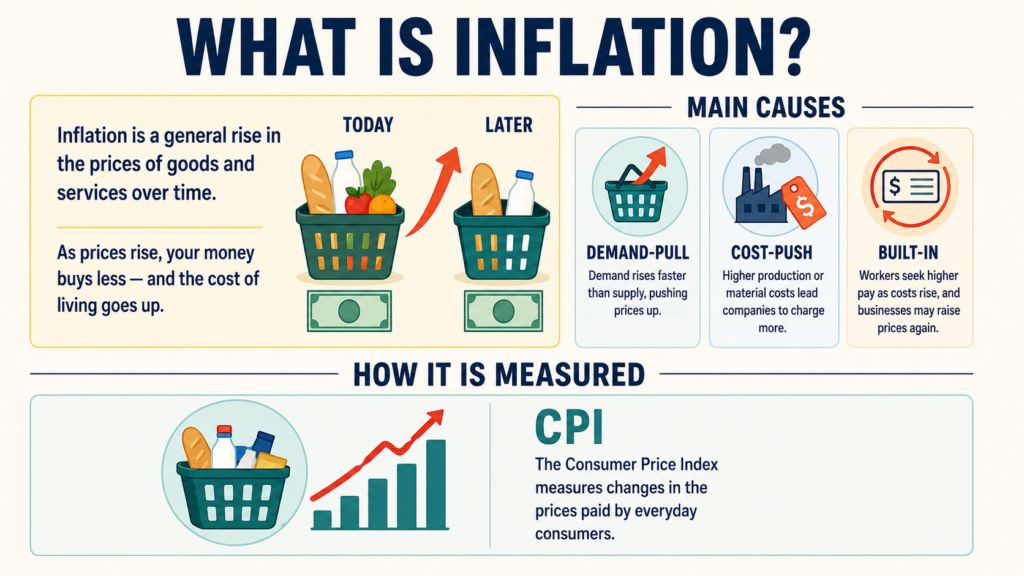
Inflation is a sustained rise in the general price level. Two words to focus on:
General means most things, not one thing. If a drought wrecks the coffee harvest and coffee doubles, coffee got more expensive. That isn’t inflation. That’s a coffee problem. Inflation is when your rent, your groceries, your insurance, your haircut, and your electric bill all climb at once, which tells you something has gone wrong with the money rather than with the coffee.
Sustained means it keeps happening. A one-time jump in the price level is different from a process that grinds forward month after month.
Where does it come from? Three places.
The first is too much demand. People have more money than there are goods to buy, so sellers raise prices because they can. Economists call this demand-pull. This is the version most people picture, and it’s the one interest rates were designed to fight.
The second is too little supply. A war closes a shipping lane. A pandemic strands containers in the wrong ports. A tariff adds a tax at the border. The goods get scarcer or costlier to produce, and prices rise even though nobody is spending more. Economists call this cost-push. Interest rates were not designed to fight it.
The third is expectations. If everyone believes prices will rise 6% next year, workers ask for 6% raises, landlords write 6% into leases, and suppliers pencil in 6% on next year’s contracts. The belief produces the outcome. Once that takes hold, inflation stops needing a cause and starts running on that expectation. This is the part central bankers lose sleep over, and it’s why they talk endlessly about credibility.
When inflation falls, prices do not fall. Inflation is a rate of change. If prices rose 9% one year and 3% the next, the news reports that inflation came down, and it did. The prices are still up 12% from where they started.
Getting inflation back to normal returns the speed to normal. It doesn’t return the level. Prices coming back down has a name, deflation, and the last time this country got a serious dose of it, people organized a national political movement to make it stop.
So when a politician says inflation is down and a person at the grocery store says everything is too expensive, both of them are telling the truth. They’re just describing different numbers.
How we count it, and why it’s political
You cannot fight a number you cannot measure, so before anyone could fight inflation, someone had to decide how to measure it. Every one of those decisions was made by a person.
The Consumer Price Index (CPI) works by pricing a basket of goods, weighted by how much the average household spends on each. That word “average” is already doing something. A household that rents and drives has a different basket than one that owns and takes the train, and the “average” gives you one answer for both.
Take housing. The largest single piece of the CPI is a category called owners’ equivalent rent, which by itself runs to about a quarter of the basket. Rent and owners’ equivalent rent together come to nearly a third. Owners’ equivalent rent is the answer to a survey question: homeowners are asked what they think their house would rent for. It is an estimate of a transaction that never happens, standing in for the housing cost of people who own their homes. It also lags actual market rents by a year or more, which is why in 2022 the official housing numbers were still climbing while the rental market had already turned. A third of the index was reporting last year’s conditions.
Then there’s the difference between headline and core inflation. Core inflation strips out food and energy on the theory that those prices bounce around too much to reveal the underlying trend. Officials mostly talk about core inflation. But households mostly buy food and energy. Deciding which prices count as a signal and which count as noise is a judgment call.
Those judgment calls move real money. In 1996 a Senate-appointed commission led by the economist Michael Boskin concluded that the CPI overstated the true rise in the cost of living by about 1.1 percentage points a year, and the methods changed. Social Security raises are tied to the index, so a technical fix inside a statistical agency trimmed the checks of every retiree in the country, every year after that, and no member of Congress had to vote for it.
But how does the Fed decide when to act? The Federal Reserve tries to keep inflation at 2% a year. That figure is the reference point for the entire American economy: when inflation runs above 2%, the Fed may raise interest rates to slow things down, and slowing things down is how people lose jobs. So where did 2% come from?
New Zealand. In 1989 its parliament told the country’s central bank to get inflation between zero and 2%, and the bank’s governor settled on a range around 2%. It worked. Prices there came down and stayed down. Other countries copied it, and the Federal Reserve made 2% official American policy in 2012. There was no study behind the original figure and no calculation proving 2% is the right amount of inflation for a modern economy. It was a round number that sounded reasonable and happened to work in a country of three million people.
The index is a construction, and every construction has a builder.
Why it feels worse than it usually is
Ask people what they hate about inflation and they don’t describe a rate of change. The Harvard economist Stefanie Stantcheva ran open-ended surveys on this in 2024 and found that about 80% of respondents believe prices rise faster than wages. They describe inflation as something that takes purchasing power away from them with no offsetting gain.
Part of that is real and part of it is how attention works. You see the price of gas on a forty-foot sign four times a week. You see grocery prices every seven days. You see your rent once a month and your raise once a year, and when the raise comes you experience it as something you earned, because you did. The price increase feels like something done to you and the wage increase feels like something you accomplished. Both hit the same paycheck. Only one of them registers as the economy.
Stantcheva also found that people split hard along party lines on who to blame, which tells you that inflation is one of the few economic conditions everybody experiences directly and nobody experiences neutrally. That combination, universal exposure and zero agreement about cause, is what makes it the most reliably destabilizing thing that can happen to a government.
The historical record of inflation
Before anyone tried to stop inflation, Americans spent thirty years fighting about the opposite problem.
In the last quarter of the nineteenth century the country was on the gold standard, the money supply grew slower than the economy, and prices fell year after year. For anyone holding cash or a bond, this was a windfall. Their dollars bought more every year while they did nothing.
For farmers it was ruin. A farmer borrowed against the harvest, and the loan came due in dollars. When crop prices fell, the same debt required more crops to repay. Corn sold for 63 cents a bushel in 1881, which made a $1,000 loan worth about 1,587 bushels of corn. By 1886 corn was 36 cents, and that same $1,000 took 2,777 bushels. The farmer had borrowed one amount and now owed nearly twice as much corn, without anyone changing the terms of the loan. Falling prices had rewritten the contract in the creditor’s favor.
The response was a mass political movement demanding that the government mint silver, expand the money supply, and let a little inflation ease the debts. It reached the Democratic convention in Chicago in July 1896, where William Jennings Bryan closed his case with the line that named the whole conflict: you shall not crucify mankind upon a cross of gold.
Bryan lost. Gold discoveries in the 1890s eventually delivered the mild inflation the farmers had wanted, and the movement got filed away in the textbooks under currency reform.
What it actually was is the first clean American example of the pattern that runs through everything after it. The price level is never neutral. Every time it moves, it moves wealth from one group to another, and the direction it moves is a political outcome. In the 1890s the country chose creditors over debtors and called it sound money. The farmers who lost their land understood exactly what had been decided and by whom.
The other lesson from that era is why nobody targets zero inflation today. Falling prices sound like a gift until you owe money, and most households, businesses, and governments owe money. When prices fall, debts get heavier, borrowers cut spending to service them, less spending means lower prices, and the thing feeds itself. Japan spent the better part of two decades stuck in a mild version of this. The 1930s were the severe version.
Aiming for a small positive rate keeps a country away from that spiral, and it leaves a central bank somewhere to cut interest rates to in a downturn before it hits zero and runs out of tools.
The agency that beat wartime inflation
In the 1940s, in neighborhoods across New York and much of the country, groups of women walked into shops with printed lists and checked the prices on the shelves against the legal ceiling.
In 1942 the federal government had asked ordinary people to police prices. The Office of Price Administration, created by Franklin Roosevelt in 1941 and given real authority by Congress early the next year, set legal ceilings on the price of nearly everything Americans bought.
Enforcing those ceilings across hundreds of thousands of stores took more inspectors than Congress would pay for, so the OPA printed price lists and recruited volunteers, many of them women, to check the posted prices in neighborhood shops against the law.
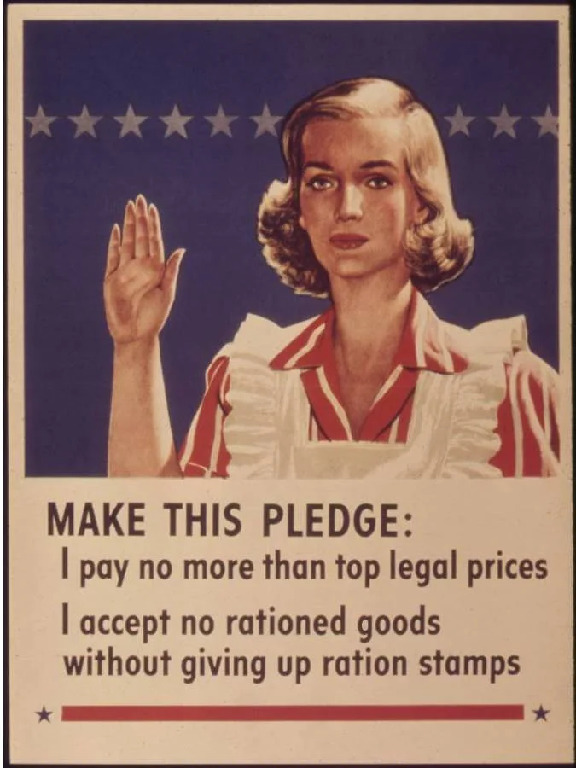
Opponents in Congress and business called them “snoopers,” and the economist John Kenneth Galbraith, who ran the OPA’s price division, felt he had to promise there would be no “Gestapo of volunteer housewives.”
The reason for all this was war. Factories were building tanks and planes instead of cars and refrigerators, which shrank the supply of goods for ordinary people at the same time that war jobs put more money in their pockets. More money chasing fewer goods pushed prices up.
Britain had already worked out the theory. In 1940 John Maynard Keynes published a short book called How to Pay for the War, and its argument was that a wartime economy has a fixed problem: the government needs to move resources from civilian use to military use, and the only question is how.
If you let prices rise, the resources still move, and the cost falls on wage earners whose paychecks buy less.
Keynes proposed taking the money out of circulation directly, through compulsory saving and taxation, so that the transfer happened on purpose and on a schedule the government could see. He designed the mechanism specifically so that workers would not absorb the cost through inflation without anyone admitting that was the plan.
The American program ran on the same logic.
The OPA held prices down by force, freezing them on close to 90% of retail food prices, and it paired the freeze with rationing of scarce goods like sugar, coffee, gasoline, tires, and meat.
Congress taxed excess corporate profits at rates that climbed into the ninetieth percentile, on the theory that a company should not get rich from a war other people were dying in. And the Treasury sold war bonds hard, taking cash out of household hands and holding it out of circulation for the duration.
Every piece of that program billed somebody, and the bills were clear for anyone to see. Consumers gave up choice. Producers gave up the price they could have charged. Corporations gave up profit. Savers accepted low returns on bonds. The government was honest about who was paying and what for.
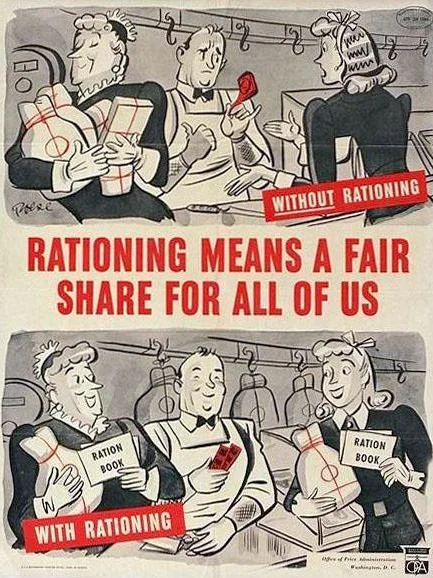
Rationing meant shortages and sacrifice, and it came with a black market and a slow decline in product quality that people at the time called “skimpflation.” It also meant a scarce cut of meat didn’t go to whoever could pay the most. A family of modest means, with a book of ration stamps, still got their share.
The historian Meg Jacobs has described the controlled economy as a high point for ordinary consumers, a system that protected their purchasing power and gave lower-income families reliable access to goods the open market would have priced them out of.
Measured inflation stayed low the entire time the system held.
How the controls died
The system held until the war ended and the pressure to lift it grew too strong to resist.
In mid-1946 the law authorizing price controls lapsed. Prices jumped and the cost of meat roughly doubled.
Truman and Congress put controls back on meat, and the cattle ranchers and meat packers responded by holding their animals off the market.
Meat production fell more than 80% in a matter of weeks. Butcher counters were bare, and the shortage was blamed on the very controls the withholding was designed to discredit.
In October, Truman gave up and lifted the controls.
The politics came first and the inflation came right behind. Republicans ran the 1946 midterms on a two-word slogan, “Had enough,” and swept both houses of Congress.
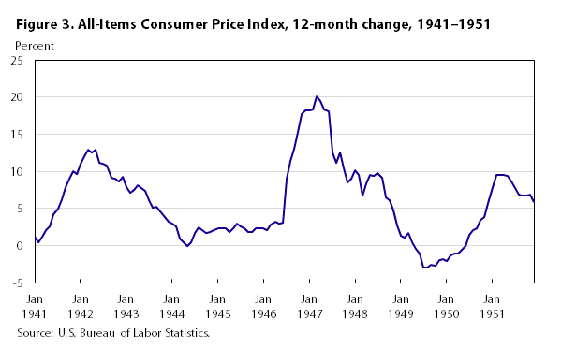
Fifty-four economists had warned in the New York Times that ending controls while demand still outran supply would set off a surge in prices. By the spring of 1947 inflation had reached about 20%, the second-highest twelve-month reading in the modern price record.
The controls worked while they were enforced, and the people who dismantled them were the ones positioned to profit from higher prices.
The war time debt we paid
Something else was happening in those same years, and almost nobody at the time understood it as a policy at all.
The war left the United States owing more money than the entire country produced in a year. Government debt gets measured against the size of the economy, because a debt is only as heavy as the income available to pay it, and by that measure federal debt stood at 106% of the economy in 1946. By 1974 it was down to 23%.
The story usually told about that drop is that America grew out of the problem. The economy got so much bigger that the old war debt shrank next to it.
Growth did some of the work. But two other things did more. One of them was ordinary: in a number of those years the government took in more than it spent and paid debt down on purpose. The other one nobody had to vote for.
When you buy a Treasury bond, you are lending money to the federal government and it pays you interest. From 1942 through early 1951 the Federal Reserve had agreed to hold the interest rate on long-term Treasury bonds at 2.5%, so the Treasury could borrow cheaply to fight the war, and it kept that promise for six years after the war ended.
Holding a bond’s interest rate down means buying bonds whenever demand for them slips, and the Fed buys bonds with money it creates. The arrangement pushed prices up while holding returns down.
Lend the government money at 2.5% in a year when prices rise 20%, as they did in 1947, and the interest you collect comes nowhere near covering what your dollars lost. You get your money back and it buys less than what you handed over. You have paid the government for the service of lending to it.
Economists call this financial repression. An IMF study asked what the postwar years would have looked like without it. Take away the budget surpluses and the suppressed interest rates, leave growth to do the job alone, and the debt falls from 106% to about 74% by 1974 rather than to 23%.
The distance between those two figures is the part of the war debt that got paid off by ordinary people holding bonds and savings accounts.
By early 1951 inflation was running above 20% at an annualized rate and the arrangement broke. Fed officials argued that defending the peg had turned the central bank into, in Marriner Eccles’s phrase, an engine of inflation. In March, the Treasury and the Fed reached the Accord that released the Fed from the peg and let it set interest rates on its own. Every argument about central bank independence for the next seventy-five years traces back to that document.
Before the Accord, the cost of the debt fell on savers, and it fell on them invisibly. After it, the Fed could raise rates to protect savers, and the cost of doing that would fall on borrowers and workers.
The Accord changed who paid the bill.
The half measure
The country tried controls one more time, and that attempt is the one most people remember because it failed.
As a young lawyer in 1942, Richard Nixon spent a few unhappy months at the OPA before leaving for the Navy. For years afterward he insisted controls could never work in peacetime. Then on August 15, 1971, he went on television and reversed himself.
The speech is remembered for the 90-day freeze on wages and prices, the only peacetime controls in American history. It contained two other things. Nixon suspended the convertibility of the dollar into gold, ending the Bretton Woods system that had organized global finance since 1944. And he imposed a 10% surcharge on imports.
A wage-price freeze and a global tariff, announced in the same speech, as parts of the same anti-inflation program. How do you think it turned out?
Nixon froze prices and did almost nothing else. He built no rationing system and stood up no agency with the reach of the wartime OPA. He asked businesses and workers to hold the line on their own (no kitchen Gestapo to hold you accountable).
Demand kept rising underneath the freeze with nothing to check it, and when the controls came off in stages over the next three years, prices climbed fast in a burst of catch-up inflation that erased the gains.
The freeze failed because Nixon kept the easy part and skipped the parts that made the wartime program work: the enforcement, the fiscal correction, and the rationing of what was scarce.
There was a second failure running alongside it, inside the Federal Reserve. Nixon wanted easy money going into his reelection, and he made sure his Fed chairman knew it.
The Nixon tapes, examined by the economist Burton Abrams in a 2006 study, record a sustained pressure campaign on Arthur Burns, including the February 1972 line, “I really don’t care what you do in [or after] April.”
Burns ran expansionary policy through the election. Whether he did it out of conviction or out of fear is still debated. The inflation that followed is not.
The decade that built the doctrine
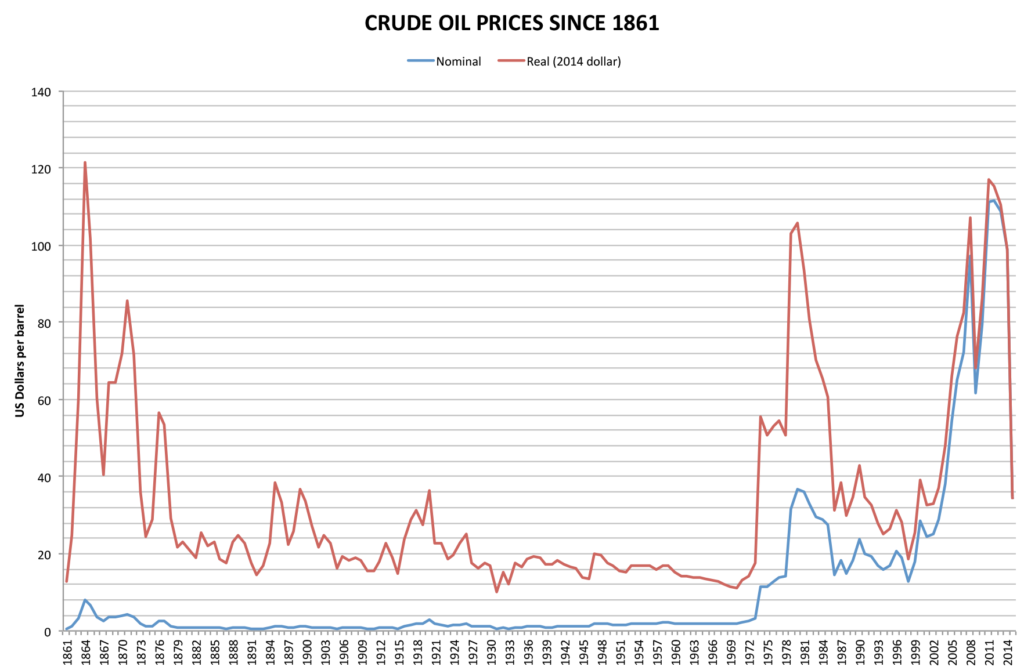
In 1973 the OPEC oil embargo quadrupled the price of crude. In 1979 the Iranian revolution did it again. Oil sits underneath the price of nearly everything, so when oil moves, the whole index moves, and it moves for reasons that have nothing to do with American consumers spending too much.
What the 1970s produced was inflation and unemployment at the same time. That combination was supposed to be impossible.
The governing framework of the era, the Phillips curve, held that inflation and unemployment traded off against each other: get unemployment down and prices rise, let unemployment rise and prices cool. A period with both high at once had no place in the model.
Milton Friedman and Edmund Phelps had predicted the breakdown in 1968, arguing that the tradeoff only worked as long as people were surprised. Once workers and firms expected inflation and built it into their wages and contracts, you would get the inflation without the employment gain.
The 1970s proved them right, the Phillips curve lost its authority, and Friedman’s alternative explanation moved to the center of the profession: inflation is always and everywhere a monetary phenomenon, a matter of the money supply growing faster than the economy.
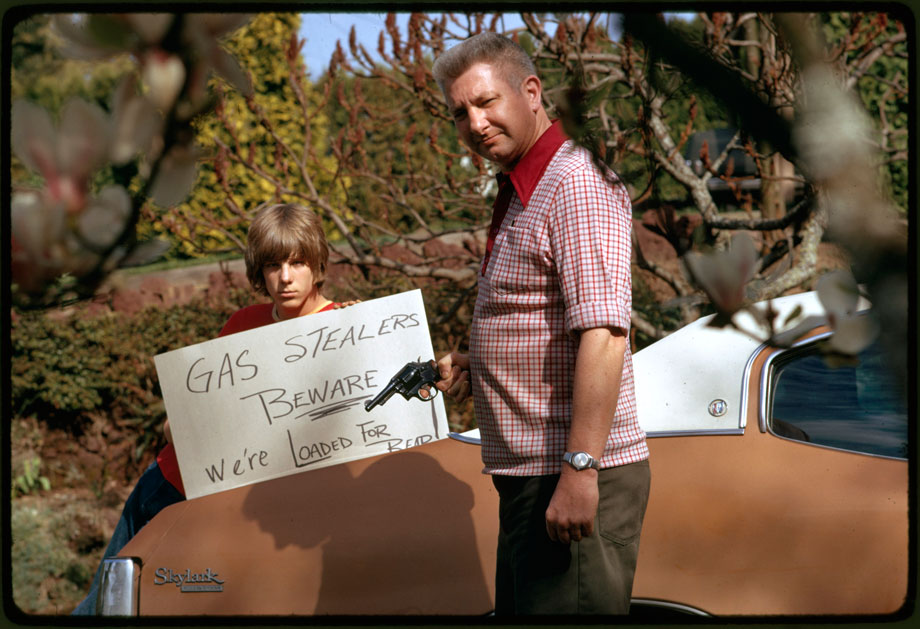
That idea, and the failure of Nixon’s freeze, and the memory of shortages, combined into a conclusion that has governed American policy ever since. Managing prices directly is a fantasy. Control the money and the prices take care of themselves.
Jimmy Carter tried one more direct intervention on the way out. In March 1980 he invoked emergency authority to impose controls on consumer credit, restricting credit cards and consumer loans rather than raising their price.
It worked far better than anyone intended. Consumer borrowing collapsed, and in the two months that followed, the unemployment rate rose more than 1.5 percentage points, which stood as the sharpest two-month increase in American history until the COVID shutdown.
The administration reversed the program within months. The recession it triggered probably cost Carter the election.
Nobody has tried credit controls since. When you restrict borrowing directly instead of making it expensive, the effect arrives in weeks rather than months, and by the time the damage shows up in the data it has already happened.
The switch to interest rates
Carter’s other decision that year outlasted him by four decades.
He appointed Paul Volcker to run the Federal Reserve in 1979. Volcker believed the way to break inflation was to force the whole economy to contract until price increases became impossible to pass along. Carter understood that meant a recession and heavy job losses, and appointed him anyway.
On the evening of Saturday, October 6, 1979, Volcker announced that the Fed would stop managing interest rates day to day. It would control the money supply instead, by limiting how much cash it let banks hold, and it would let interest rates go wherever that pushed them. Rates were no longer something the Fed set but something the market would discover.
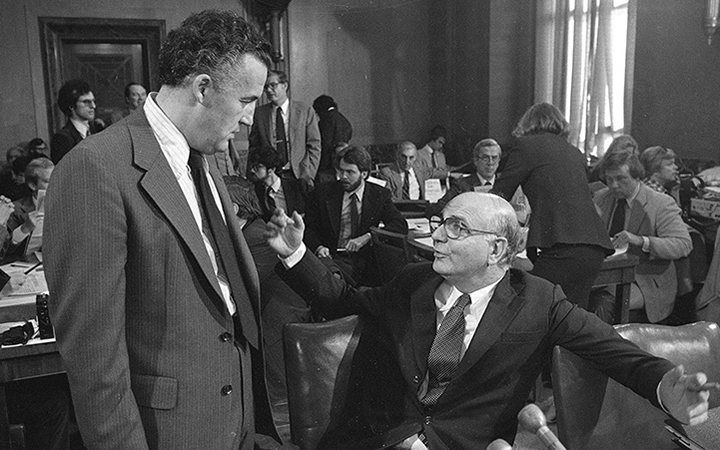
The market discovered a lot. The federal funds rate was 11.4% on October 5. Within weeks it was 13.8%, and by April 1980 it hit 17.6%. Mortgage rates followed. Borrowing nearly stopped.
Ronald Reagan ran for the presidency in 1980 on a promise to “make America great again” (does that sound familiar?), a phrase he used to accept the Republican nomination that summer.
For those without skills, we’ll find a way to help them get skills. For those without job opportunities, we’ll stimulate new opportunities, particularly in the inner cities where they live. For those who have abandoned hope, we’ll restore hope and we’ll welcome them into a great national crusade to make America great again!
At his inauguration he delivered the sentence that organized the next forty years of economic policy. “Government is not the solution to our problem; government is the problem.”
The governing idea was that markets correct themselves and that public management of the economy causes more harm than it prevents.
Volcker put the theory into practice from inside the Fed. Factories and construction sites shut down. Farmers drove tractors to Washington and circled the Federal Reserve building. Homebuilders mailed him two-by-fours from houses they couldn’t sell. Unemployment reached 10.8% at the end of 1982, the highest level since the Great Depression, which put roughly twelve million people out of work.
It also brought inflation down from about 13% to under 4%. The strong recovery that followed looked like proof of the whole theory. Interest rates had brought inflation down, the economy had come back, and the belief that government should stay out of prices settled into common sense.
The economics profession has a technical term for what happened to those twelve million people. It’s called the sacrifice ratio, and it measures how many percentage points of unemployment, held for how long, are required to bring inflation down by one point. The discipline built a formal accounting unit for human cost and then talked about it in decimals.
The cost was also not distributed the way the phrase “the economy” suggests. The Black unemployment rate in the United States runs at roughly twice the white rate, and that ratio holds through booms and busts. When a central bank decides to cool the labor market by some amount, arithmetic decides whose labor market cools first and cools hardest.
Volcker’s defenders make a serious argument that a worse recession was coming anyway if inflation had run another five years, and they may be right. Every method on this list has a defense that turns on what the alternative would have been. What the defense cannot do is make the cost disappear. It happened, it happened to specific people, and those people were not the ones setting prices.
The Fed becomes the answer
Alan Greenspan took over the Fed in 1987 and presided through the 1990s, a stretch of steady growth and mild inflation that commentators called the Goldilocks Economy: not too hot, not too cold.
In 1994 and 1995 he raised rates enough to cool the economy without tipping it into a recession, a soft landing that few Fed chairs before or since have managed.
Interest rates were now the accepted answer to inflation, and the chair of the Fed was treated as the one person who could keep prices in line.
Congressional hearings on inflation became hearings about what the chairman thought. Presidents stopped proposing price policy because there was no longer such a thing.
When the financial system collapsed in 2007 and 2008, the Fed cut interest rates to nearly zero to stop the fall and then bought trillions of dollars in bonds, creating the money to do it. The standard theory held that this much money, this cheap, for this long, would push inflation up.
It never happened. Rates stayed near zero for most of a decade and inflation stayed quiet, so quiet that the Fed spent years worried prices were rising too slowly.
Economists called it the missing inflation puzzle. The country had spent thirty years treating interest rates and the money supply as the dependable controls on inflation, and here was a long stretch where the relationship the whole approach rested on did not appear.
What other countries did while America stopped trying
America settled on one tool after 1980. The rest of the world kept experimenting, and the results complicate our prevailing theory.
Israel in 1985 had inflation running above 400% a year. In July the government enacted a stabilization program that did everything at once. It froze wages, prices, and the value of the currency together, cut the budget deficit sharply, and raised interest rates. The freeze was negotiated with the Histadrut, the national labor federation, which agreed to hold wages in exchange for the price controls and a commitment on employment. Within less than two years inflation was under 20%, and it did not come roaring back when the controls lifted.
Compare that against Nixon. Israel paired the freeze with the fiscal correction that removed the underlying pressure, and it got the buy-in of the people whose wages were being frozen. Nixon announced the freeze and skipped the rest.
Brazil in 1994 solved a harder version of the problem with a genuinely strange piece of engineering. Inflation had been running in the thousands of percent for years, and the trouble was that everyone repriced constantly because everyone expected everyone else to. The Plano Real introduced a parallel unit of account called the URV, pegged to the dollar. For four months, Brazilians kept paying in the old currency but quoted prices, wages, and contracts in URV. Once the whole economy had voluntarily repriced into a stable unit, the government converted the URV into a new currency, the real, at one to one. Monthly inflation went from 46.6% in June to 7.8% in July to 1.9% in August. No mass unemployment.
Argentina ran the opposite experiment recently. Javier Milei took office in December 2023 with inflation above 200% and applied straight shock therapy: a currency devaluation of more than 50%, deep cuts to fuel, transport, and energy subsidies, and mass public-sector layoffs. Inflation came down hard. So did everything else. Poverty rose from 41.7% in the second half of 2023 to 52.9% in the first half of 2024, which is 15.7 million people. It then fell back to around 31.6% by mid-2025 as inflation moderated and real wages recovered.
Argentina is the clearest illustration available. The stabilization worked. It worked by sending roughly eleven million additional people into poverty for a year and a half. It worked, and it sucked.
And here we are again
The quiet ended in 2022.
Inflation surged worldwide after the pandemic and peaked in the United States at 9.1% in June, the largest one-year jump in four decades. It happened in countries that had spent heavily during the pandemic and in countries that had not, which is itself evidence about the cause.
Jerome Powell’s Fed answered the only way the institution knew how, raising interest rates eleven times between March 2022 and July 2023.
In June 2022, Larry Summers, former Treasury Secretary and the most credentialed voice arguing that the Fed had to move harder and faster, told an audience in London that “we need five years of unemployment above 5% to contain inflation. In other words, we need two years of 7.5% unemployment, or five years of 6% unemployment, or one year of 10% unemployment.” Unemployment at the time was 3.6%. He was describing something like seventeen million people out of work as the price of containing inflation.
It didn’t happen.
Inflation fell most of the way toward target while unemployment stayed near historic lows. Whether the rate increases did the work, or whether healing supply chains and settling energy markets did most of it, economists have not settled.
The Federal Reserve’s own Christopher Waller had argued in 2022 that employers would respond to a slowdown by cancelling job openings before they started firing people, so the labor market could cool without unemployment climbing. That is roughly what occurred.
Something else happened that complicates the simple story about who inflation hurts. David Autor, Arindrajit Dube, and Annie McGrew documented that the tight labor market of 2021 through 2023 produced unusually fast wage growth at the bottom of the distribution, enough to reverse about a third of four decades of growth in wage inequality. Low-wage workers got hit hardest by rising prices and gained the most in wages, at the same time.
Then in early 2026 prices started climbing again, and this time the causes were more obvious.
The first was tariffs.
On February 20, 2026, the Supreme Court ruled 6-3 in Learning Resources, Inc. v. Trump that the International Emergency Economic Powers Act does not give a president the authority to impose tariffs, striking down the entire 2025 tariff structure and opening the door to as much as $175 billion in refunds. Within hours the administration invoked a different statute, Section 122 of the Trade Act of 1974, and imposed a 10% surcharge on all imports effective February 24. It was the first use of Section 122 in the statute’s history.
Whatever the legal authority, the economics are the same. A tariff is a tax collected at the border and paid by whoever buys the thing. The Yale Budget Lab estimates the current structure costs the average household several hundred dollars a year, and roughly double that if the replacement duties now under consideration take effect. The burden falls hardest on households that spend most of what they earn on goods, which is to say the households with the least room to absorb it.
The second cause was war.
American and Israeli strikes on Iran began on February 28, and the fighting disrupted traffic through the Strait of Hormuz, the chokepoint for about a quarter of the world’s seaborne oil. Energy prices climbed with it.
A ceasefire in April reopened the strait and Brent crude fell back below $100, and the June CPI report showed the effect: energy prices dropped 5.7% in the month, the biggest monthly decline since April 2020, pulling headline inflation down to 3.5% from 4.2% in May. Energy is still up 15.7% over the year. The conflict resumed in July.
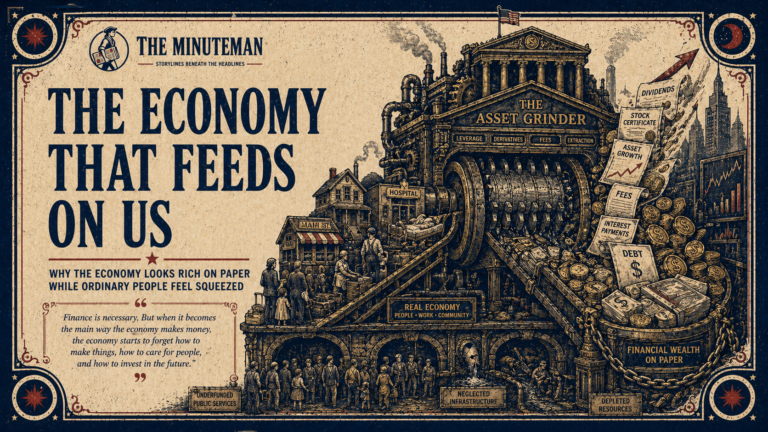
Households are living through what economists are calling an affordability crisis. (This is the cost of being alive in America.)
Both of these causes are supply problems.
A tariff raises the cost of goods at the border. A war removes oil from the market. Raising interest rates reaches neither one.
Higher borrowing costs cannot reopen a shipping lane or repeal a tariff. They can only shrink demand by slowing the entire economy, which does nothing about the actual source of the price increases and once again asks workers to carry the cost.
Into this the administration has installed a new Fed chair, Kevin Warsh, confirmed in May 2026 by a Senate vote of 54 to 45.
Warsh went before Congress on July 14 and called sixty-three consecutive months of above-target inflation an “unfair burden” on American households, promised a “regime change” in monetary policy, and announced five internal task forces, one of them on the inflation framework itself. He has not said what the new framework will be.
The question is what in the historical record suggests that a demand tool, under a new name, will cure an inflation caused by a tariff and a war.
The record does not supply an answer, because interest rates were never built for this kind of inflation. The only thing a demand tool can do about a supply shock is make the rest of the economy small enough that the shrinking offsets the missing goods.
That is an option. But it has a price, and the price is measured in jobs.
What the record says actually works
Inflation caused by too much demand and inflation caused by too little supply are different problems that call for different cures, and the current debate keeps skipping past the difference.
When people have more money than there are goods to buy, slowing spending helps, and raising interest rates is one way to slow spending.
When the supply of goods shrinks because of a tariff, a war, or a broken supply chain, cutting demand does not put the missing goods back. It slows the whole economy and spreads the cost more widely.
The 2026 inflation is largely a supply story, and that points to a different set of responses.
The first: Stop causing it.
The tariffs are a self-inflicted price increase, a policy the government chose and can reverse, and the current version comes with an expiration date already written into the law.
The second has a serious intellectual foundation and a track record that did not exist five years ago.
The economist Isabella Weber argued in 2021 for targeted, temporary controls on the specific prices that push inflation through the rest of the economy, prices like energy and key foods, in place of the blanket freeze Nixon tried.
The reaction was brutal. A New Yorker profile recorded that her Guardian essay had briefly made her the most hated woman in economics.
But Europe did exactly that.
Facing the energy shock after Russia’s invasion of Ukraine, Spain and Portugal won permission from Brussels for what became known as the Iberian exception: a cap on the price of natural gas used to generate electricity, with producers compensated for the difference. Wholesale electricity prices in the Iberian market fell an estimated 35% relative to what they would have been.
Germany ran a gas price brake. France capped regulated electricity tariffs and had its state-controlled utility absorb the difference, which is the most direct answer to the question of who pays that any government gave during that period. It was the French treasury, and by extension the French taxpayer, and everyone could see it.
The third response comes straight from the World War II record.
When a good is truly scarce, rationing shares it on some basis other than wealth, so that the people with the most money do not take all of it while everyone else goes without.
Nobody enjoys this. It is also the only method on the list that distributes the shortage on purpose instead of letting the price sort out who goes without.
There is a fourth argument, about corporate pricing power, and it has not been settled.
The Kansas City Fed found that rising business markups accounted for more than half of 2021’s inflation. The San Francisco Fed found that markups across the economy stayed roughly flat and were not a main driver. The studies disagree because measuring a markup requires knowing a firm’s true marginal cost, which nobody outside the firm knows, and because profits in the national accounts are a residual, the number left over after everything else is counted. A profit spike can be a symptom of scarcity as easily as a cause of it.
Weber’s own version of the argument is narrower than the word “greedflation” suggests. Her claim is that a bottleneck hands firms in the affected sector a temporary ability to raise prices beyond their cost increase, along with a public signal that everyone else is raising prices too, so nobody loses customers by going first.
The profit share did spike in 2021 and 2022 and then came back down, which fits the temporary-power story better than it fits a story about permanent corporate character.
The meat packers of 1946 established that firms will withhold supply and let prices rise when they have the power to do it and a political motive to prove a point. That history stays relevant. But it does not settle a question about 2021 that the data itself cannot settle.
The limit on all of this is Nixon.
Price controls fail when a government freezes prices and skips the enforcement, the fiscal correction, and the fair distribution that make a freeze hold. Israel proved that the full package can work in a modern economy. Nixon proved that the announcement alone does nothing.
The methods that worked all asked something of people with power and required the government to do the actual labor of governing. That, more than any question of whether they succeeded, is why they were dropped.
Who decides
Somebody chooses who pays. Here is who.
Interest rates in the United States are set by the Federal Open Market Committee: seven governors appointed by the president and confirmed by the Senate, plus five of the twelve regional Federal Reserve Bank presidents, who are selected by boards that include representatives of the banks in their district.
None of them face the voters. That insulation is intentional. The Burns episode is the case for it. A central bank that answers to whoever is running for reelection produces the 1970s.
Independence is also a distributional choice. It protects the fight against inflation from politics. It does not protect employment from the fight against inflation.
The Humphrey-Hawkins Act of 1978 gave the Fed a dual mandate, maximum employment and stable prices, with no instruction about how to weigh them when they conflict. The weighting is left to the committee. Which means that engineering a recession to bring prices down is a choice the institution is empowered to make, not a technical necessity it is forced into.
Banks are required to keep a pile of cash at the Federal Reserve, and since 2022 the Fed has paid them interest on it, at rates that rose with every hike, while the older bonds the Fed itself owns pay much less. The result is that the Fed has been operating at a loss.
It normally sends its profits to the Treasury. It has sent nothing since 2022, the first interruption since 1934, and by the end of the third quarter of 2025 the accumulated shortfall stood at $243 billion. The Congressional Budget Office projects it will take until at least 2030 to work off.
That is public revenue that isn’t arriving, as a byproduct of the anti-inflation program, flowing to the banking system.
You can argue it’s the necessary cost of the operating framework. Either way, it’s a bill someone at sometime has to pay.
The ledger
For the last eighty years, every method of fighting inflation we’ve used sends the bill to somebody. There has never been an option where no one has to pay the price.
Raise interest rates and the bill goes to people who lose their jobs, to small businesses that can’t refinance, to first-time homebuyers priced out of a mortgage, and to developing countries whose dollar debts get more expensive overnight.
Freeze prices and the bill goes to sellers, who lose the price they could have charged, and then to consumers through shortages and lines, and the people with the least flexible schedules wait in those lines the longest.
Ration and the bill goes to everyone, deliberately, in small even pieces, with a side payment to whoever runs the black market.
Impose tariffs and the bill goes to consumers and to the firms that import what they need to make things.
Let the inflation run and the bill goes to lenders, savers, anyone holding cash, and anyone on a pension that doesn’t rise with prices, while borrowers get a discount on their debts. That is what happened between 1946 and 1974, and it retired a war.
Cut spending to cool the economy and the bill goes to whoever loses the programs we cut.
Tax excess profits and the bill goes to shareholders.
Cut the value of the currency against other currencies and the bill goes to importers and to wage earners, whose paychecks buy less of everything made abroad.
And if prices fall instead of rise, the bill goes to debtors and workers, which is what the farmers of the 1890s were trying to tell everybody.
The country’s default answer since 1980 has been the first one, and the first one is the only method on that list that works specifically by making people unemployed. We have spent forty years calling that the responsible choice and calling the alternatives radical.
Reagan’s sentence still governs this debate. The claim that government is the problem and markets fix themselves has guided one political party for two generations, and that party’s own behavior no longer matches it.
The tax law it passed in 2025 by a republican majority is projected by the Congressional Budget Office to add $4.1 trillion to the national debt over ten years, and its tariffs raise a tax that falls hardest on working families. The party that once defined itself by balanced budgets is running enormous deficits to cut taxes at the top while raising prices at the bottom.
Meanwhile the methods with the strongest record of stopping inflation without mass unemployment, targeted management of essential prices, fair rationing of what is scarce, fiscal correction, and a willingness to look hard at pricing power, are the ones now waved off as socialist. The people who propose them are treated as unserious, while the serious choice is defined as the one that only works by putting people out of work.
What now
The 10% tariff was imposed under Section 122, and Section 122 doesn’t last forever. The statute allows a surcharge for 150 days and no longer unless Congress votes to extend it. That clock ran out on July 24, 2026. A president cannot extend it alone. Theoretically, since it lapsed, that self-inflicted price increase should come off the economy. If it is replaced under a different statute, one without a time constraint, that will also be a choice, made by identifiable people, in public, this year (with midterms coming up).
The Fed’s inflation framework is being rewritten right now by five task forces expected to finish their work by the end of the year. What comes out of that review sets the terms for the next decade.
Warsh serves at the pleasure of nobody, but the governors around him were confirmed by senators who answer to voters, and the framework has no constituency except the people who show up to have an opinion about it.
And tariff authority, the whole tangle of statutes that lets a president tax imports without a vote, belongs to Congress under the Constitution and was handed to the executive by Congress over the course of the twentieth century. The Supreme Court said as much in February. Congress can take it back whenever it decides to.
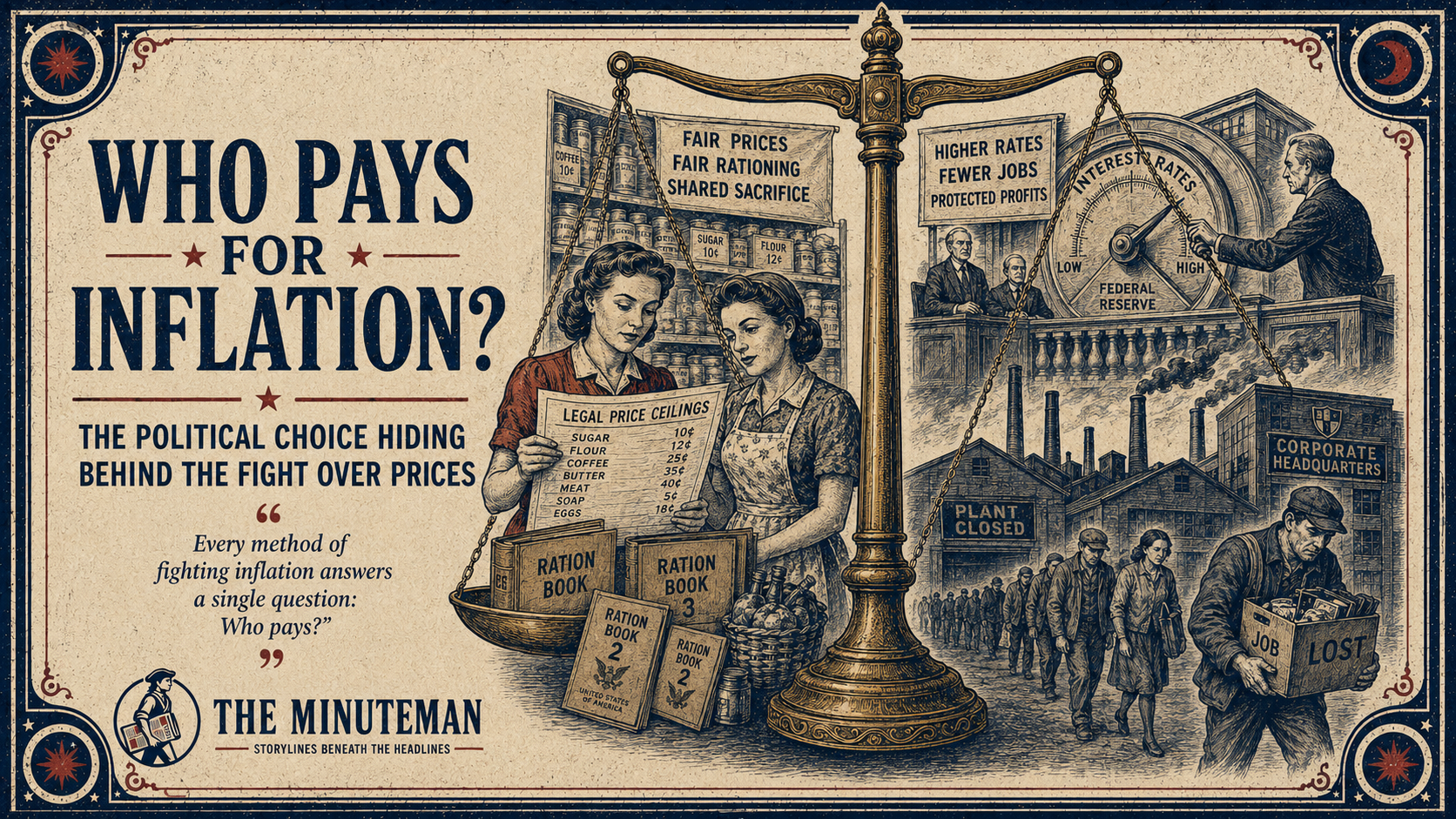
Every method of fighting inflation answers a single question: who pays.
The war economy of the 1940s answered it by asking almost everyone to give up a little so the scarce things could be shared, and by taxing the people who profited most from the emergency.
The approach the country has used since Reagan answers it by asking the people who lose their jobs to absorb the entire cost while the people who set prices absorb none of it.
We have spent decades treating that as the only responsible answer.
The history says it was a decision, made by particular people at a particular moment, for reasons that had as much to do with politics as with economics. Decisions can be made again.
The affordability crisis in front of us is the occasion to notice that the question was never whether somebody pays. It was always who pays.